
By Tim Parsons-
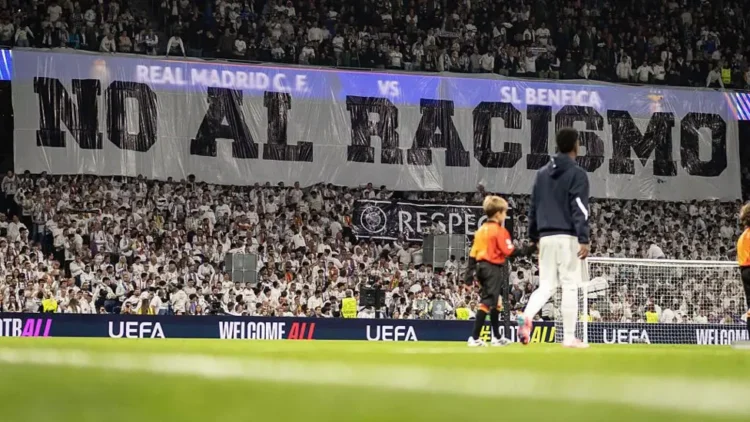
Real Madrid have been fined €15,000 by European football’s governing body after a supporter inside the Santiago Bernabéu Stadium was filmed performing a Nazi-style salute during a recent Champions League match, an incident that has reignited debate about extremism in football stadiums and the responsibilities clubs carry for the behaviour of those in their stands. The sanction, handed down by UEFA, followed a disciplinary investigation into events surrounding the Spanish club’s knockout-stage meeting with S.L. Benfica, a tie that had already been overshadowed by accusations of racism earlier in the fixture.
The disciplinary body ruled that the behaviour constituted “racist and/or discriminatory conduct,” imposing a financial penalty of €15,000 on the Spanish giants and ordering the conditional closure of 500 seats in the lower south stand of the Bernabéu for a future European match. That stadium sanction, however, will remain suspended for one year provided no similar incidents occur during that period.
The controversy unfolded before kick-off in the return leg of the Champions League playoff between Real Madrid and Benfica. Television cameras captured a fan extending his arm in a gesture widely associated with Nazi ideology while positioned near the club’s organised supporters’ section. Images of the moment circulated rapidly on social media and television broadcasts, prompting swift condemnation from anti-racism groups and placing pressure on the club to respond decisively.
Real Madrid moved quickly to distance itself from the act. Club officials identified the supporter shortly after the broadcast footage emerged and removed him from the stadium before the match began. In an official statement, the club said it had initiated disciplinary proceedings to expel the individual permanently from membership, reiterating its condemnation of gestures that promote hatred or violence.
While the financial penalty itself is modest for a club of Real Madrid’s resources, the symbolism of the sanction is significant. UEFA has increasingly adopted a zero-tolerance approach toward discriminatory behaviour in football grounds, arguing that clubs must take responsibility not only for players and staff but also for the conduct of their supporters during competitions organised by the governing body. The suspended closure of part of the Bernabéu serves as a warning that repeat offences could result in more severe sporting consequences, including full or partial stadium bans.
The incident occurred against the backdrop of broader tensions in the same European tie. During the first leg in Lisbon, Real Madrid winger Vinícius Júnior alleged he had been subjected to racist language from an opposing player, accusations that further inflamed an already heated encounter between the two clubs. Though unrelated directly to the salute incident, the allegation added a layer of sensitivity to the disciplinary proceedings and intensified scrutiny on behaviour both on and off the pitch.
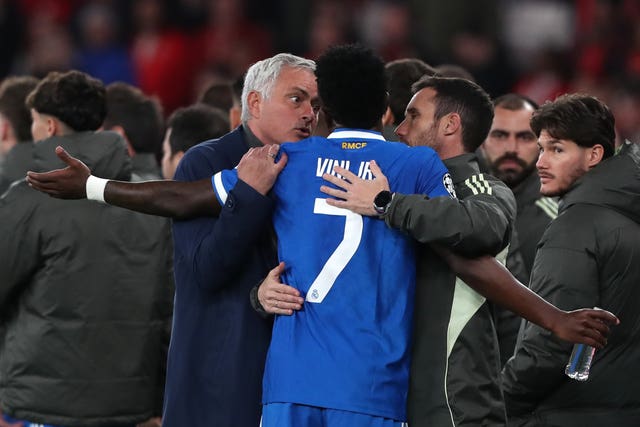
Vinicius Junior argues with Jose Mourinho after making an allegation of racial abuse against a Benfica player (Pedro Rocha/AP)
The case for football authourities represents another chapter in a long and uneasy history of extremist symbolism appearing around the sport. While relatively rare, gestures linked to fascist or Nazi ideology have surfaced at various times across European football, sometimes involving supporters and occasionally involving players themselves. Each case has prompted disciplinary action and renewed debate about how football institutions should confront political extremism.
One of the most notorious examples occurred in Italy in 2005 when Paolo Di Canio, then playing for S.S. Lazio, made a fascist salute toward sections of the crowd after a Serie A match against A.S. Roma. The gesture drew widespread condemnation both within Italy and internationally. Italian football authorities responded by suspending the player for one match and imposing a fine of €10,000, ruling that the action risked inciting violence or disorder among rival supporters.
Di Canio, who had previously expressed admiration for aspects of Italy’s fascist past, defended the salute at the time as a gesture of solidarity with supporters rather than a political statement. Nevertheless, the controversy proved enduring. Images of the moment circulated widely in the media and were cited repeatedly in discussions about the relationship between football culture and extremist symbolism.
Another high-profile incident unfolded in Greece in 2013 involving Giorgos Katidis, a young midfielder then playing for AEK Athens. After scoring a dramatic late winner in a league match, Katidis celebrated by raising his arm in what appeared to be a Nazi salute toward the crowd. The reaction was swift and severe. The Hellenic Football Federation issued a lifetime ban preventing him from representing the Greek national team, while his club suspended him for the remainder of the season and imposed a financial penalty.
Katidis later insisted that he had been unaware of the gesture’s historical significance, claiming he simply intended to dedicate the goal to a teammate in the stands. But the explanation did little to quell the outrage. Political leaders, fan groups and international media outlets condemned the incident, arguing that ignorance could not excuse such a symbol in a country deeply scarred by the legacy of fascism and occupation during the Second World War.
Even when gestures are ambiguous, football authorities have shown increasing willingness to intervene. In 2013 the French striker Nicolas Anelka faced sanctions in England after performing the “quenelle,” a controversial hand gesture linked by critics to anti-Semitism, during a match for West Bromwich Albion. Although Anelka denied any discriminatory intent, the Football Association imposed a five-match ban and fine, arguing that the gesture carried offensive connotations in the broader public sphere.
Fan behaviour has also triggered disciplinary measures on numerous occasions. In Australia, authorities fined Sydney United 58 FC after supporters were filmed performing Nazi salutes during the 2022 Australia Cup final. The club received a monetary penalty and a series of suspended sanctions after investigations concluded that extremist symbols and chants had been displayed in the stands during the match.
Such cases illustrate a persistent challenge for football administrators. Stadiums often bring together tens of thousands of spectators from diverse social and political backgrounds, and the visibility of televised matches means any gesture captured on camera can quickly become a global controversy. Governing bodies therefore argue that strict disciplinary frameworks are necessary both to deter extremist behaviour and to protect the sport’s international reputation.
UEFA’s regulations place direct responsibility on clubs for discriminatory actions by supporters during matches under its jurisdiction. Penalties can range from fines to partial stadium closures, points deductions or even expulsion from competitions in severe or repeated cases. In recent years the organisation has increasingly combined disciplinary sanctions with broader educational initiatives, encouraging clubs to work with anti-racism campaigns and fan groups to promote inclusivity.
Real Madrid, one of the most globally recognised institutions in the sport, has frequently positioned itself as a supporter of such initiatives. The club has publicly backed campaigns against racism and discrimination and has repeatedly expressed solidarity with players who have faced abuse. Its swift move to expel the supporter involved in the Bernabéu incident was widely interpreted as an effort to demonstrate zero tolerance for extremist symbolism within its stadium.
Yet the episode underscores how even isolated acts by individuals can overshadow major sporting occasions. The Champions League tie itself — a fiercely contested encounter between two historic European clubs — risked being remembered less for the football than for the controversy that erupted in the stands.
For UEFA officials, the hope is that swift disciplinary action will prevent similar incidents in future fixtures. The €15,000 fine imposed on Real Madrid is modest compared with the financial scale of modern European football, but the suspended stadium closure serves as a warning that repeated offences could carry more severe consequences.
The governing body has repeatedly stressed that the battle against racism and extremism in football requires constant vigilance. Over the past two decades, governing bodies, clubs and supporters’ organisations have introduced a range of measures designed to identify offenders more quickly, including improved stadium surveillance and cooperation with law-enforcement authorities.
Despite those efforts, episodes like the one at the Bernabéu show that the issue has not disappeared entirely. For clubs competing on the global stage, the reputational stakes are high. A single image captured by television cameras can travel across the world in seconds, igniting political controversy far beyond the boundaries of sport.
In Madrid, the immediate focus now shifts back to football. Real Madrid continue their pursuit of European success while navigating the disciplinary probation imposed by UEFA. Yet the incident serves as a reminder that the spectacle of the modern game extends far beyond the pitch itself.
For governing bodies, players and clubs alike, the challenge remains the same as it has been for years: ensuring that the passion of football crowds does not cross into expressions of hatred or extremism. Whether through fines, bans or education campaigns, the sport continues to grapple with how best to protect its global appeal while confronting the darker gestures that occasionally surface in its stadiums.
The former Chelsea and Manchester United manager said he was “completely, utterly opposed to any kind of discrimination or prejudice or ignorance or stupidity”.

AD: Capeesh Restaurant
He added: “If my player did not respect these principles, which are mine and Benfica’s as well, then that player’s career with a coach named Jose Mourinho and at a club named Benfica will come to an end.”
Real won the second leg 2-1 to claim a 3-1 aggregate victory, with Vinicius scoring the second-half winner. They will face Manchester City in the last 16.

AD: Heritage And Restaurant Lounge Bar
-
Share On
- Categories
- Date