
By Aaron Miller-
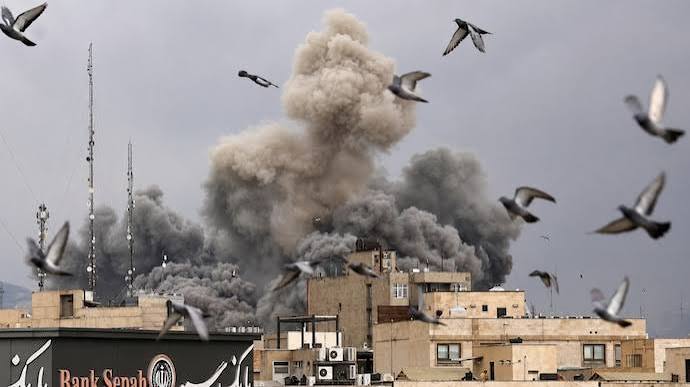
The United States has resumed direct military strikes against Iran after several days of relative calm, dramatically raising fears that the conflict between Washington, Tehran and their regional allies is entering an even more dangerous phase.
The latest attacks came just hours after President Donald Trump vowed to hit Iran “very hard” following a missile and drone attack on a US military installation in Jordan, signalling that hopes of reviving stalled diplomatic efforts have once again been overtaken by military escalation.

AD: Capeesh Restaurant
According to US Central Command, American forces carried out a two-hour operation targeting dozens of sites belonging to Iran’s Islamic Revolutionary Guard Corps (IRGC), including military command centres, missile and drone infrastructure, and coastal surveillance and air defence installations.
Iranian state media reported explosions on the strategically important island of Qeshm in the Strait of Hormuz, where at least two people were reportedly injured, while further blasts were also reported in Khuzestan province in southwestern Iran.
The renewed attacks follow a days-long lull in direct confrontation between the United States and Iran, a pause that had prompted cautious optimism among regional mediators seeking to restore negotiations and prevent the conflict from widening further. Those hopes have now been thrown into doubt as violence spreads across multiple theatres in the Middle East.

AD: Oysterian Sea Food Restaurant And Bar
The latest American operation came less than 24 hours after US forces joined Saudi Arabia in launching coordinated strikes against Iranian-backed militias in neighbouring Iraq. Iraqi officials said at least 20 militia fighters were killed and dozens more wounded, while Iranian media reported that several Iranian military advisers were also among the dead.
The Popular Mobilization Forces (PMF), an umbrella organisation made up largely of Shiite militias aligned with Tehran, condemned the strikes. Although the PMF officially forms part of Iraq’s state security apparatus, many of its constituent groups maintain considerable operational independence and have long been accused by Washington of carrying out attacks on American military facilities throughout Iraq and Syria.
President Trump left little doubt that the latest strikes were intended as retaliation for Iran’s attack on a US base in Jordan. Speaking during an event in the Oval Office, he declared that “it’s our turn to hit them,” promising that Tehran would face a forceful military response.
His remarks reflected an increasingly confrontational approach that has characterised US policy since the conflict intensified earlier this year.
Military analysts warn that the latest exchange represents far more than another isolated round of retaliatory strikes. Instead, it signals an increasingly interconnected regional conflict stretching from the Persian Gulf to Iraq, Jordan, Yemen and the Red Sea, involving not only the United States and Iran but also Saudi Arabia, Israel and numerous Iranian-backed armed groups.
The conflict has become increasingly difficult to contain because Iran has spent decades developing what many analysts describe as its “axis of resistance”—a network of allied militias and proxy organisations operating across the Middle East.
These include Hezbollah in Lebanon, Shiite armed groups in Iraq, various factions in Syria and the Houthi movement in Yemen. Rather than relying solely on conventional military confrontation, Tehran has often projected influence through these partners, allowing conflicts to spread across multiple fronts simultaneously.
That strategy has become increasingly apparent during the current crisis.
While US aircraft struck Iranian military targets, fresh drone attacks also ignited fires aboard two natural gas vessels near Egypt’s Mediterranean port of Damietta. One vessel was reported to be American-owned while the other belonged to a Greek operator.
No casualties were reported, and responsibility for the attacks has not been formally established. Nevertheless, the incidents underscored growing concerns that vital international shipping routes are becoming increasingly vulnerable.
The world’s attention remains firmly focused on the Strait of Hormuz, one of the most strategically significant waterways on the planet. Situated between Iran and Oman, the narrow channel carries roughly one-fifth of globally traded crude oil, making any disruption there an immediate concern for energy markets and the global economy.
Iran has repeatedly threatened to restrict shipping through the strait during periods of heightened tension with Western powers, although it has never fully closed the waterway.
At the same time, another maritime chokepoint is coming under increasing pressure. Yemen’s Iran-backed Houthi movement has declared a blockade targeting Saudi shipping through the Bab el-Mandeb Strait, the narrow entrance linking the Red Sea with the Gulf of Aden.
Earlier this week, the Houthis claimed responsibility for drone attacks targeting oil infrastructure associated with Saudi exports to the Red Sea port of Yanbu, describing the operation as retaliation for alleged Saudi military activity over Yemen.
The simultaneous pressure on both the Strait of Hormuz and the Bab el-Mandeb has heightened fears that two of the world’s most important energy corridors could face sustained disruption if hostilities continue to escalate.
Financial markets responded swiftly to the deteriorating security situation. Brent crude oil surged more than seven per cent, climbing above $88 a barrel as traders assessed the increased likelihood of prolonged instability across the Gulf.
Energy analysts have repeatedly warned that any significant interruption to shipping through Hormuz could send oil prices substantially higher and reignite inflationary pressures worldwide.
The current conflict also highlights the increasingly close military coordination between Washington and Riyadh. Relations between the United States and Saudi Arabia have fluctuated over recent decades, but shared concerns over Iran’s regional influence have repeatedly drawn the two countries into closer security cooperation.
Wednesday’s joint strikes in Iraq reflected that renewed alignment, coming after Saudi Arabia accused Iraqi militias of launching drones against its oil infrastructure.
For Iraq, the latest escalation once again exposes the country’s difficult balancing act between its two most powerful partners. Since the US-led invasion in 2003, successive Iraqi governments have attempted to maintain strategic relationships with both Washington and Tehran, despite their deep rivalry.
The emergence of the Islamic State group in 2014 further complicated that picture, leading to the rapid expansion of the Popular Mobilisation Forces, which played a central role in defeating ISIS but also strengthened Iran’s influence inside Iraq.
Many of those same armed groups have since become regular participants in confrontations involving American forces stationed in the country.
Meanwhile, diplomatic efforts appear to be struggling to keep pace with events on the battlefield. Before the latest exchange of strikes, mediators had expressed cautious optimism that negotiations between Washington and Tehran could resume after months of intermittent indirect talks.
However, those efforts reportedly stalled following renewed fighting around the Strait of Hormuz, with both sides accusing the other of undermining prospects for a ceasefire.
Although regional mediators continue to pursue behind-the-scenes diplomacy, there has been little public indication that either side is prepared to significantly reduce military operations. One regional official familiar with the negotiations said discussions were continuing but declined to provide details, reflecting the highly sensitive nature of the talks.
The conflict is also placing increasing pressure on the US military. Defence analysts have warned that sustained operations across several fronts risk depleting stockpiles of precision-guided missiles, air defence interceptors and other advanced munitions needed to protect American forces and allies throughout the Middle East.
The renewed confrontation presents both strategic and political challenges for president Trump. While his administration has argued that robust military action is necessary to deter further Iranian attacks, opinion polls have suggested prolonged involvement in another Middle Eastern conflict remains deeply unpopular among many American voters.
The conflict has evolved far beyond a bilateral dispute between Washington and Tehran. It now encompasses proxy forces, maritime security, global energy supplies and some of the world’s most strategically vital waterways.
With military operations expanding across several countries and diplomatic efforts struggling to regain momentum, fears are growing that the region may be edging closer to a broader conflict whose consequences could extend well beyond the Middle East.

AD: Heritage And Restaurant Lounge Bar