
By Ben Kerrigan-
Britain has dramatically hardened its position towards Israel’s settlement policy, with Foreign Secretary Ed Miliband announcing a ban on imports of goods produced in Israeli settlements in the occupied West Bank and accusing Israel of failing to stop what he described as an “ethnic cleansing” campaign against Palestinians.
The move represents a significant escalation in the UK’s response to settlement expansion and settler violence. Britain, France and Canada have announced coordinated measures targeting goods and economic activity linked to Israeli settlements, with the UK also moving against companies providing services to settlements, including financing, construction, infrastructure, property and advertising.

AD: Capeesh Restaurant
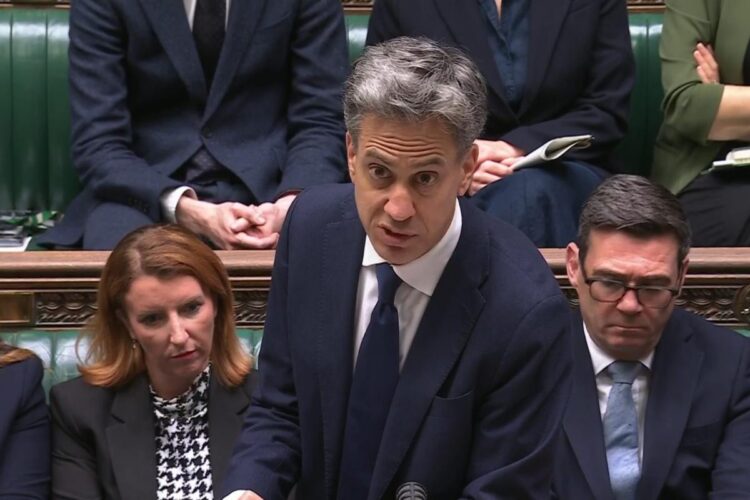
Addressing Parliament, Miliband said the Government could no longer simply condemn settlement expansion without taking action. He argued that the settlements threaten the possibility of a viable Palestinian state and said Britain had a responsibility to “call out” what it regards as violations of international law.
The Foreign Secretary’s language was unusually direct. He accused extremist Israeli settlers of carrying out what he described as “ethnic cleansing” in the West Bank and criticised the Israeli government’s failure to prevent or adequately respond to the violence and displacement of Palestinians.
The measures come amid growing international concern about the rapid expansion of Israeli settlements and the future of the two-state solution. The controversial E1 settlement project has become a particular focus of international criticism because of fears that development could effectively divide the West Bank and make the creation of a contiguous Palestinian state significantly more difficult.

AD: Oysterian Sea Food Restaurant And Bar
Miliband’s intervention also reflects a wider change in Britain’s approach to the Israeli-Palestinian conflict. Rather than limiting its response to diplomatic criticism, the UK is now using trade and economic measures to try to increase pressure over settlement activity. The Uk government insists that the measures are directed at the Israeli government and settlement enterprise, rather than at Israeli people as a whole.
Miliband also made an emphatic distinction between criticism of Israel’s government and hostility towards British Jews.“Holding British Jews responsible for the actions of the Israeli Government is antisemitism, plain and simple,” he told Parliament. That distinction is central to the Government’s argument as it attempts to pursue a tougher policy towards Israel while confronting a separate and growing concern over antisemitism in Britain.
Miliband, who is himself Jewish, said the UK had “unshakeable bonds” with the people of Israel but that Britain’s disagreement was with the conduct of the Israeli government. He reiterated that the objective remained a negotiated two-state solution capable of providing security and political rights for both Israelis and Palestinians.
The Government’s position is therefore an attempt to draw a line between opposition to Israeli settlement policy and hostility towards Israel or Jewish people. That distinction emphasis has become increasingly important as the political debate over Israel has become more polarised in Britain.
The Israeli government has strongly condemned the British measures. Israel’s Foreign Minister Gideon Sa’ar described the sanctions as unacceptable interference, while Israel has responded by ordering the closure of the British consulate in East Jerusalem within 30 days and imposing restrictions on British officials. The diplomatic retaliation underlines the seriousness of the rupture.
The British consulate in East Jerusalem is particularly significant because it has traditionally played an important role in Britain’s diplomatic engagement concerning the Palestinians, including the West Bank and Gaza. Israel’s decision to close it marks a sharp deterioration in relations between two countries that have traditionally maintained close diplomatic, security and economic ties.
The new British restrictions are nevertheless relatively limited in direct economic terms. Settlement production represents only a small proportion of Israel’s overall trade, meaning that the immediate commercial effect of the import ban is expected to be limited. Its political significance, however, could be considerably greater.
The measures send a message that Britain is no longer prepared to treat settlement expansion as simply a diplomatic disagreement. Instead, the Government is seeking to attach an economic cost to activity it regards as contrary to international law and damaging to the prospects of Palestinian statehood. The move also places Britain among a growing group of Western countries prepared to impose targeted measures over Israeli settlement activity.
France and Canada have joined the UK in the trade restrictions, while several other European governments have backed action against settlement products and expansion. The issue is therefore bigger than individual products arriving on British supermarket shelves.
It is about whether Britain is willing to use its economic and diplomatic influence to challenge a system of settlement expansion that successive British governments have described as illegal under international law. The Foreign Secretary’s language suggests that the Government believes the situation has reached a point where condemnation alone is insufficient. That position is likely to generate further controversy at home.
Critics of the policy argue that Britain risks damaging its relationship with Israel and isolating a longstanding ally. Opposition politicians have also warned that an increasingly confrontational approach towards Israel could contribute to further tensions and antisemitism in Britain.
The Government, however, maintains that failing to distinguish between Israel’s government and British Jews would itself be antisemitic — precisely why Miliband has been so explicit in making that distinction.The political challenge for the Foreign Secretary will now be to maintain that line.
Britain is attempting to say two things simultaneously: that Israel has a legitimate right to security and that Jewish people in Britain must never be held responsible for decisions taken by the Israeli government; but also that Israel’s settlement policy and the conduct of extremist settlers can no longer be met with diplomatic criticism alone.
Miliband’s message is that those positions are not contradictory. The UK can defend Israel’s security while opposing the occupation. It can condemn settlement expansion while condemning antisemitism. And it can impose economic pressure on settlement activity while insisting that its dispute is with government policy rather than with Israeli or Jewish people.
Whether that distinction survives the increasingly bitter political debate remains to be seen. What is clear is that Britain’s relationship with Israel has entered a markedly more confrontational phase. The calculation is that the protection of a future two-state solution requires action now, rather than further expressions of concern.
And for Israel, the British decision represents another sign that international patience with settlement expansion is running out. The consequences will extend well beyond the goods now being removed from Britain’s potential supply chains. They could shape Britain’s diplomatic relationship with Israel, the future of the West Bank and the increasingly contentious international debate over how far governments should go to challenge Israeli settlement policy.
At the centre of that issue is Miliband’s insistence that calling out what he describes as ethnic cleansing and opposing antisemitism are not competing positions, but obligations that must be pursued simultaneously

AD: Heritage And Restaurant Lounge Bar