
By Gavin Mackintosh-
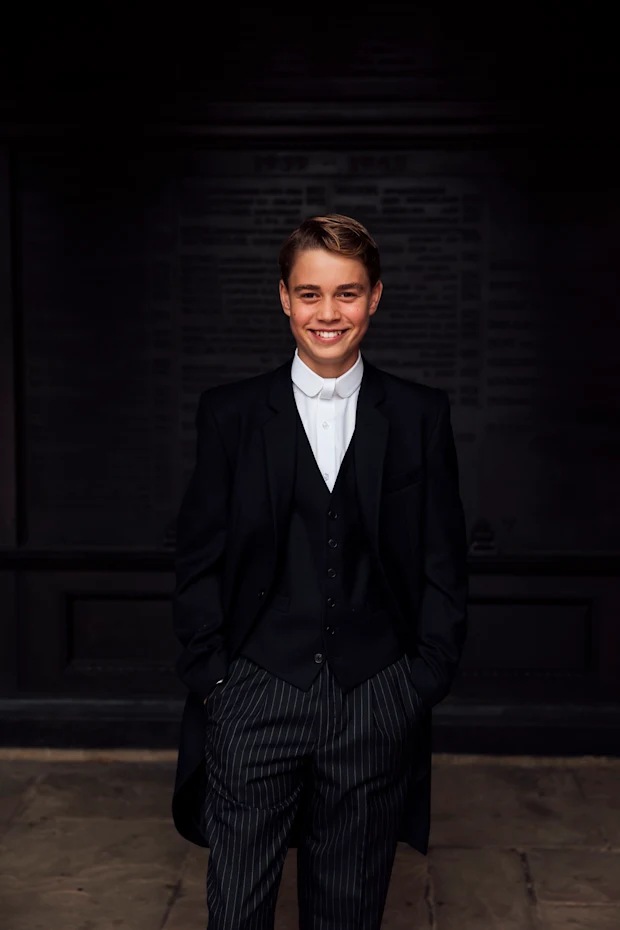
Prince George has begun the next stage of his education at one of Britain’s most famous schools, entering a world of tailcoats, boarding houses, demanding examinations ,and an academic record that places Eton College firmly among the country’s elite independent schools.
It was revealed on Tuesday that the 13-year-old, second in line to the throne, arrived at Eton on Tuesday accompanied by his parents, the Prince and Princess of Wales. His father, Prince William, attended the school from 1995 to 2000, while his uncle Prince Harry was also educated there. George’s arrival restores a royal connection to Eton that has already attracted enormous attention.

AD: Capeesh Restaurant
But behind the royal symbolism is a serious educational institution. Founded by Henry VI in 1440, Eton is a full boarding school for boys aged roughly 13 to 18 and has about 1,345 pupils, according to the Independent Schools Inspectorate’s 2024 report. The question for many parents is what makes Eton so difficult to enter — and whether its extraordinary academic reputation is justified.
The answer begins with the admissions process, because for ordinary 13-plus entry, prospective pupils are first assessed using the ISEB Common Pre–Tests, covering verbal reasoning, non-verbal reasoning, English and mathematics. Those who progress face an individual interview and an online predictive assessment of academic ability and potential.
Successful candidates are then given a conditional place which must ultimately be confirmed through the Eton Entrance examination, Common Entrance or, for the most academically gifted, the King’s Scholarship route.

AD: Oysterian Sea Food Restaurant And Bar
It is an unusually prolonged selection process. Parents must normally register their sons by the end of Year 5, when they are around 10 years old. The school then assesses academic ability and potential several years before the pupil actually arrives. Eton says its admissions system is designed not merely to identify current attainment but to assess whether a boy is likely to thrive in its demanding boarding environment. For those attempting to become King’s Scholars, the academic bar rises still further.
Eton describes the King’s Scholarship examination as deliberately “very demanding”. Candidates must sit compulsory papers in English, mathematics, science and general studies and then choose additional subjects from areas including mathematics, history, geography, divinity, French, Latin and Greek. Only about 14 King’s Scholarships are awarded each year, from a highly competitive And getting through the entrance examination is only one part of the financial equation.
For the 2026/27 academic year, Eton’s published fee is £21,891 per half-term, with three halves making up the academic year. That amounts to £65,673 annually, including VAT, before additional expenses.
Registration currently costs £480 and the acceptance fee for boys joining in Michaelmas 2026 is £3,840, of which £500 is refundable when the pupil eventually leaves, subject to the school’s conditions. Extra costs can include music lessons, trips, insurance and other acti
That price tag puts Eton among the most expensive schools in Britain. Yet it is important not to suggest that every family pays the headline figure.
Eton operates a substantial financial-aid programme. In 2023/24, 247 boys received fee reductions, with an average award equivalent to 71 per cent of the fee, while 99 boys paid no fees at all. The school says it spent more than £10 million on financial aid in 2024/25. Academically, the results are formidable.
Eton’s 2025 results, as reported by the Good Schools Guide, showed 94 per cent of GCSE grades at 9-7, while 78 per cent of A-level grades were A/A and 95 per cent were A-B**. The school’s average A-level points score was reported at 51.01, considerably above national and local averages.
Eton itself stresses that examination results are only one measure of education. Its curriculum offers 28 subjects, including nine modern and classical languages, while teaching is delivered by subject specialists. The school says it aims to develop independent learning and intellectual curiosity rather than simply preparing pupils to accumulate examination grades.
The scale of the school also creates an interesting contrast.Eton has more than 1,300 pupils, but its boarding system is divided into relatively small communities. There are 25 boarding houses, with approximately 55 boys in each and around 11 boys per year group in a house. Every boy has his own room from the beginning.
There is no single published figure that can fairly be described as “the average class size” across the entire school, because class sizes vary according to subject, year and teaching arrangements. The smaller boarding-house structure should therefore not be confused with classroom size. What Eton does provide is an individual tutor for every boy, alongside house pastoral staff and specialist wellbeing provision.
The academic environment is also considerably broader than conventional classroom teaching. Sport, music, drama, debating, societies, lectures and other activities occupy a substantial part of school life. Eton describes the co-curricular programme as an important part of developing pupils’ interests and talents beyond examination performance.
And then comes the question that perhaps best illustrates Eton’s extraordinary position in British education-where do its pupils go afterwards? The answer is overwhelmingly towards highly selective universities.
The school says almost all its leavers progress to universities with high entrance requirements in Britain, Europe and the United States. In 2026, 27 boys received early offers from American universities including Harvard, Yale, the University of Pennsylvania, the University of Chicago and Dartmouth. More than 15 per cent of Eton leavers apply to US universities, according to the school
The Good Schools Guide reports that Eton typically sends between 30 and 50 pupils to Oxford and Cambridge a year, although it notes that figures for 2025 were not available. It also reports that around 15 per cent of pupils go into medicine or dentistry and that Eton’s international university applications increasingly include leading institutions in North America and elsewhere
The list of former pupils extends far beyond academia. Eton has educated numerous politicians, writers, actors, sportsmen and members of the royal family. Twenty British prime ministers have attended the school, while alumni include David Cameron, Boris Johnson, Eddie Redmayne and, of course, Prince William and Prince Harry.
Eton’s reputation cannot be explained simply by its examination results. Its enormous advantage is the combination of selective admissions, highly experienced teaching staff, extensive facilities, a powerful alumni network, small pastoral communities and an extraordinary range of opportunities. The school can select academically capable pupils before they arrive and then provide them with resources that few schools can match.
That is precisely what makes assessing Eton’s “quality” complicated. Its outstanding results demonstrate what its pupils achieve. But those results also reflect the fact that Eton starts with a highly selected cohort. It would therefore be misleading to claim that its examination statistics alone prove that Eton transforms average pupils into exceptional ones.
However, the quality and standard of every school also includes the calibre of students allowed to attend the school in the first instance. This is important and every school’s prerogative. What can be said is that Eton has constructed an educational environment in which academically able pupils are given unusually extensive opportunities to develop.
That environment will now become Prince George’s daily reality. He enters not merely a famous school but an institution that has spent almost six centuries cultivating academic achievement, tradition, independence and connections to Britain’s political and cultural establishment.
Whether he eventually follows his father into public service, pursues an entirely different career or ultimately becomes King, Eton’s stated purpose will be to prepare him for much more than examinations.
The real measure of the school, however, will remain the same as it is for every other pupil who walks through its gates: whether the extraordinary resources, opportunities and academic pressure translate into an education that is genuinely worth the extraordinary cost.
For Eton, the numbers suggest an emphatic academic success story. The £65,673 annual fee, highly selective admissions and exceptional university destinations explain why. But they also underline the enduring question surrounding Britain’s most prestigious independent schools. How much of their success comes from what they teach — and how much comes from whom they are able to select and surround with opportunity

AD: Heritage And Restaurant Lounge Bar
-
Share On
- Categories
- Date