
By Ben Kerrigan-
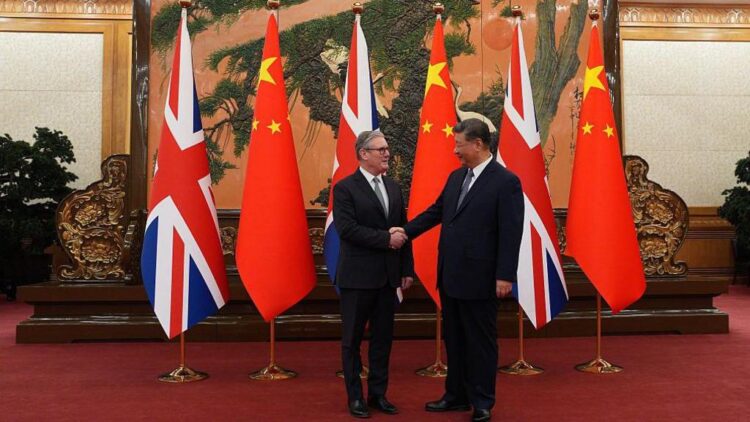
British Prime Minister Sir Keir Starmer met Chinese President Xi Jinping in Beijing on Thursday in a high-stakes diplomatic encounter aimed at resetting relations between the United Kingdom and China after years of strain.
In one of the most significant foreign visits of his premiership, Starmer told Xi that it was “too long” since a British prime minister had come to China and that the two nations must build a “more sophisticated relationship” to tackle shared global challenges and boost economic ties.

AD: Capeesh Restaurant
The meeting taking place in the Great Hall of the People marked the first visit by a UK leader to China in eight years and comes at a time of mounting geopolitical uncertainty, with global tensions over trade, technology competition, and security reshaping alliances.
Alongside discussions on economic cooperation, both leaders agreed on the importance of sustained dialogue, even as disagreements remain over issues such as human rights and regional security.
Resetting Diplomatic and Economic Ties
Starmer’s message to Xi centred on deepening cooperation with China while managing areas of disagreement. “China is a vital player on the global stage and it is vital that we build a more sophisticated relationship,” the prime minister said at the start of their talks.

AD: Oysterian Sea Food Restaurant And Bar
Starmer and his delegation, which include senior ministers and business leaders representing sectors such as banking, pharmaceuticals, aviation, and technology, are in the Chinese capital to secure commercial opportunities as well as diplomatic breakthroughs.
Trade between the UK and China remains significant China is one of Britain’s largest trading partners and bolstering economic links has been a key driver of the visit.
Xi acknowledged the complexity of UK–China relations, noting that “twists and turns” in recent years had not served either country’s interests and stressing the need for strengthened dialogue and cooperation. In remarks to Starmer, he said closer engagement would benefit “world peace and stability” as well as their respective economies and peoples.
The tone of the meeting suggested a deliberate attempt by both sides to soften longstanding tensions while also advancing practical cooperation.
Before the bilateral talks, Starmer was welcomed by Zhao Leji, chairman of China’s National People’s Congress, who described the development of UK–China ties as “significant amid the changing and turbulent international landscape.”
During his remarks, Starmer framed the visit as part of his government’s broader foreign policy aim: making Britain “face outwards again” after what he described as a period of inconsistency in relations. “It is with the British people in mind that I am here today,” he said, arguing that global engagement affects domestic issues like inflation, supply chains, and national security.
Challenges and Shared Agenda
Despite the promising diplomatic language, challenges remain. The UK has raised concerns over issues such as espionage, human rights abuses in Xinjiang, and restrictions on freedoms in Hong Kong, which have all been sources of tension in previous years.
While these were not at the forefront of Thursday’s public comments, they hover in the background of UK–China relations and could shape future negotiations.
The broader geopolitical environment has also influenced the timing of the visit. With shifting US foreign policy dynamics and trade disputes under President Donald Trump, Western nations are reassessing their China policies.
Starmer’s trip follows similar engagements by other Western leaders seeking to strike a balance between strategic competition and economic cooperation with Beijing.
Alongside high-level discussions, both countries are expected to explore practical cooperation areas, including law enforcement efforts to combat transnational crime for example, agreements on tackling smuggling and illegal migration routes and collaborations on climate change, technological innovation, and global stability
. These areas of engagement reflect a shared interest in addressing global challenges even amid disagreements.
With his part, Xi promised that China is ready to develop a “long-term and consistent strategic partnership” with the UK, underscoring Beijing’s interest in positioning itself as a reliable global partner despite Western critiques.
Back in the UK, reactions to Starmer’s China visit have been mixed. Supporters argue that engagement with the world’s second-largest economy is essential for British prosperity, especially given China’s central role in global supply chains and as a market for UK exports.
Critics, however, express caution, pointing to national security concerns and human rights as issues that must not be sidelined in the pursuit of economic deals.
Opposition voices have also raised concerns that closer ties with Beijing could complicate the UK’s relationships with key allies, particularly the United States, which has adopted a tougher stance on China in recent years.
However, Starmer has sought to position his government’s China strategy as complementary to relations with the US, asserting that the UK does not have to “choose between” the two powers but can instead navigate its own path in a complex global landscape.
Analysts say that Starmer’s approach reflects a broader trend in European foreign policy: balancing economic pragmatism with geopolitical caution. While liberal democracies continue to express concerns about China’s governance and global ambitions, there is a growing recognition that engagement, rather than isolation, may yield more stable and predictable outcomes.
The Starmer–Xi meeting is significant both for UK foreign policy and global geopolitics. It represents a departure from years of strained engagement and signals London’s willingness to pursue a nuanced relationship with Beijing one that seeks cooperation where possible while not shying away from differences.
The emphasis on a “sophisticated relationship” suggests a layering of diplomatic, economic, cultural, and security ties, rather than a narrow transactional partnership.
Economically, improved UK–China relations could lead to expanded trade, investment opportunities, and collaboration in sectors ranging from green technology to pharmaceuticals. Politically, the visit could ease tensions and open channels for dialogue on contentious issues, potentially contributing to greater stability amid rising global tensions.
At the same time, the meeting underscores the complex balancing act facing Starmer’s government: to engage with China in ways that promote British interests without compromising on core values like human rights and national security. How this balance is maintained in the weeks and months ahead will be closely watched both in London and internationally.
The Starmer–Xi encounter in Beijing thus marks a pivotal moment in UK–China relations, offering a blueprint for how two very different powers might navigate cooperation in an era defined by global competition, technological change, and geopolitical realignment.

AD: Heritage And Restaurant Lounge Bar