
By Samantha Jones-
A small town in northern Germany has been left reeling after a shooting at a youth welfare and mother-and-child shelter in Stade claimed six lives, in what police have described as one of the country’s most serious recent violent incidents.
Authorities confirmed that a suspected gunman has been arrested and that there is no ongoing threat to the public, though investigations into the motive remain ongoing. The attack unfolded on Monday inside a facility that provides accommodation and support for vulnerable families, including young mothers and their children. Police said five victims died at the scene and a sixth later succumbed to injuries in hospital. Several others were also injured, some seriously, as emergency services rushed to contain the unfolding crisis.

AD: Capeesh Restaurant
While officials have not yet publicly released detailed identities, early reporting suggests the victims were adults connected to the centre’s operations. The suspect, a man believed to be in custody shortly after the incident, is now the focus of a multi-agency investigation involving regional police and federal prosecutors. Stade, a small city in northern Germany located west of Hamburg, has around 50,000 residents and is generally regarded as a quiet regional centre rather than a place associated with major violent crime.
The facility at the centre of the attack is a youth welfare and mother-and-child support centre that provides accommodation and care for pregnant women and young mothers with children in vulnerable circumstances. That combination of a typically peaceful town setting and a social care institution designed to offer protection rather than conflict has deepened the shock felt across the local community and beyond, as residents struggle to reconcile the violence with a place normally associated with support and safety.
According to police statements and initial reporting, emergency calls began shortly after gunfire was heard inside the building complex. Officers arriving at the scene encountered multiple victims in different areas of the facility, suggesting the violence may have moved through more than one room or corridor before being contained.

AD: Oysterian Sea Food Restaurant And Bar
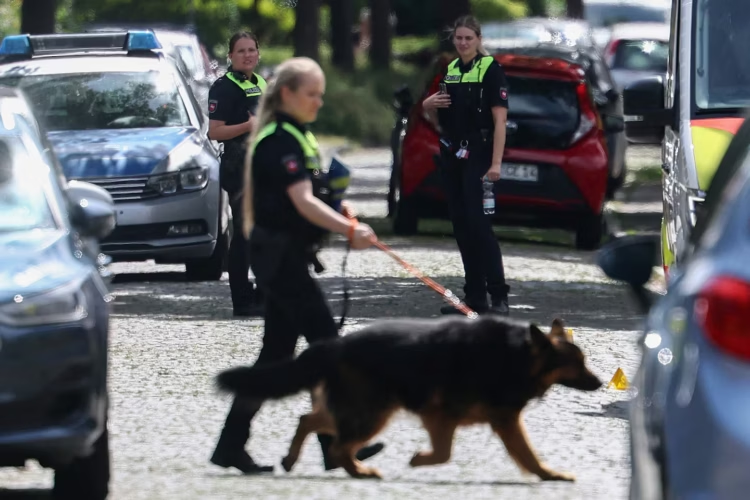
A spokesperson for the regional police described the operation that followed as rapid and coordinated, with tactical units securing the building while paramedics attempted life-saving treatment. Within a short period, the suspected shooter was detained, ending what officials later confirmed was an isolated incident. Authorities have stressed that there is currently no evidence of additional suspects or an ongoing wider threat. However, they have also urged caution against speculation as forensic work continues and investigators begin interviewing witnesses and analysing evidence from the scene.
As the immediate emergency response gave way to investigation, attention shifted to understanding what led to the attack. German officials have not confirmed a motive, though early assessments reported by multiple outlets suggest investigators are exploring the possibility of a personal dispute connected to the facility rather than a broader ideological or terror-related act.
The Federal Prosecutor’s Office has been notified, reflecting the seriousness with which the case is being treated. Evidence collection teams remained at the scene into the evening, documenting rooms, corridors, and surrounding outdoor areas while officers cordoned off parts of the neighbourhood. Residents nearby described confusion and fear as police sirens filled the streets and helicopters circled overhead. One witness told reporters that the scale of the emergency response made it immediately clear that something “far beyond a routine incident” was unfolding.
Officials have also confirmed that additional individuals were taken into custody for questioning, though their precise involvement has not been clarified. In breaking reports, agencies including Reuters noted that at least two people were initially detained alongside the primary suspect as part of precautionary measures during the fast-moving operation.
German President Frank-Walter Steinmeier expressed shock at the violence, extending condolences to the families of the victims and praising emergency responders for their swift action. Local authorities have similarly pledged full transparency as the investigation progresses, though they caution that it may take time before a clear picture emerges.
As Stade begins to confront the aftermath, the focus has turned to mourning and recovery. Counselling services have been made available for survivors and staff connected to the facility, while the surrounding area remains partially restricted as forensic teams complete their work. In a country where mass shootings remain rare but deeply unsettling, the incident has reignited difficult questions about prevention, intervention, and how such violence can emerge even in spaces designed for protection and care.
Germany maintains some of Europe’s strictest firearms regulations, requiring background checks, psychological assessments in certain cases, and licensing procedures that are intended to limit access to weapons. As investigators work to reconstruct the events in Stade, attention is once again turning to the gaps that can still exist between regulation on paper and risk in reality.
Officials and security experts are expected to examine whether warning signs were missed, whether any prior complaints or behavioural concerns were raised, and how quickly authorities can realistically respond when violence unfolds inside residential or care environments. The incident also places renewed focus on the role of early intervention systems, particularly in cases where personal disputes, mental health struggles, or social isolation may escalate without detection.
In recent years, German authorities have expanded cooperation between local police, social services, and federal agencies, aiming to identify potential threats before they turn into tragedies. However, incidents like this underline how difficult it remains to anticipate sudden acts of extreme violence, especially when they occur in private or semi-private institutions rather than public spaces with visible security presence.
The most immediate concern is not policy but the emotional aftermath. Small communities like Stade often feel the impact of such events more intensely, as victims, responders, and witnesses are frequently interconnected through schools, workplaces, or neighbourhood ties.
The presence of a youth welfare and mother-and-child facility at the centre of the tragedy has added another layer of distress, as such institutions are typically associated with safety, recovery, and support rather than danger. The disruption of that expectation has left many struggling to process what happened and why.
With investigation progresses, more details may emerge about the suspect’s background and the circumstances leading up to the attack, but for the community, the immediate reality is one of shock and fragmentation. Life in Stade will gradually resume its routines, yet the sense of normality has been disrupted in a way that will likely take considerable time to repair.

AD: Heritage And Restaurant Lounge Bar