
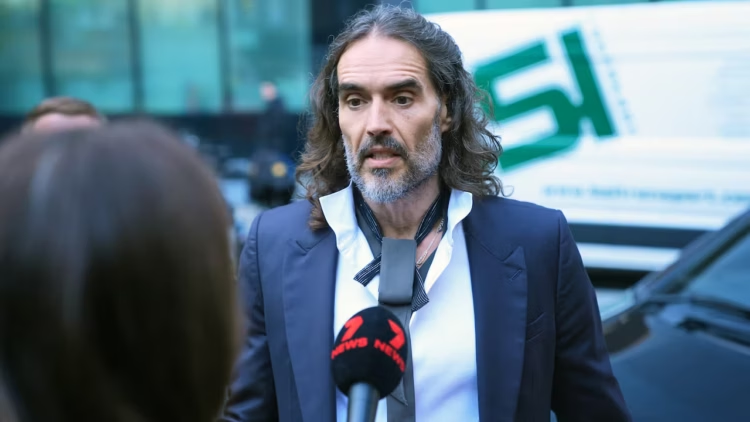
By Lucy Caulkett-
Throughout the trial of Russell Brand, many of his supporters end some ordianry people expressed concerns that the allegations against him were the culmination of a government-orchestrated campaign to silence a prominent critic of the establishment. Some of these views were expressed on facebook platforms, and in other cases, by word of mouth.
Underlying those views were the idea thst the allegations and the prosecution were somehow being staged by the authurities to punish brand for his fierce critics of the UK government during the lockdown period. A jury facing the reality of the evidence and chronology of events has reached a very different conclusion

AD: Capeesh Restaurant
Many of Russell Brand’s increasingly devoted online following can be forgiven for believing that tthe prosecution of the former comedian has always been about something bigger than allegations of sexual misconduct, before the full trial played out in court.
However, after hearing the details of the evidence, the idea that this was an establishment attempt to destroy a man who dared to challenge the accepted narrative on Covid, question pharmaceutical companies and expose what he described as the concentration of power among political and corporate elites, becomes redundant
Brand’s message found an audience among people who felt alienated by official explanations and increasingly suspicious of institutions. To his followers, Brand became an alternative voice willing to ask questions that others supposedly feared to raise.

AD: Oysterian Sea Food Restaurant And Bar
So when allegations of sexual misconduct emerged in September 2023, some supporters were quick to see a connection. Was this coincidence, they asked, or was the establishment finally attempting to silence one of its most outspoken critics? But the difficulty with that argument is the evidence presented in court, and the timeline of the alleged offences.
The allegations for which Brand has now been convicted concern events between 2004 and 2009. They predate Covid, the lockdowns and his subsequent transformation into a prominent online conspiracy commentator by more than a decade.
On 5 November 2026, a jury at Southwark Crown Court found Brand guilty of one count of rape and three counts of sexual assault. He was acquitted of two further rape charges and an attempted indecent assault charge. He is due to be sentenced on 9 November.
The verdicts represent a significant difference between the competing narratives surrounding his case. The prosecution’s argument was not that Brand held controversial political opinions, nor that his criticism of the government made him a criminal. It was that four women had been subjected to sexual offences and that the evidence established his guilt beyond reasonable doubt on four specific counts.
The jury had to consider the individual allegations, rather than simply decide whether they liked or disliked the defendant. The central legal questions were whether the woman had consented and whether Brand reasonably believed she had. For each sexual assault conviction, jurors had to be satisfied that the deliberate contact was sexual, that there was no consent and that he did not reasonably believe consent had been given.
These were not questions about his political opinions, his public persona or his hostility towards mainstream institutions. They were questions about individual conduct and consent.The prosecution also presented evidence from women who had no apparent connection with one another, describing experiences spanning several years. Their accounts were supported by testimony from other witnesses and evidence about the circumstances surrounding the alleged incidents.
The prosecution argued that a recurring pattern emerged: charm and attention followed by behaviour that disregarded the women’s wishes. It suggested Brand’s celebrity and influence had enabled him to exercise power over women in situations where their consent was not forthcoming.
The jury did not accept every allegation. That is important. Its acquittals on two rape charges and attempted indecent assault demonstrate that the jurors considered the counts individually rather than simply endorsing the prosecution’s entire case. I
ndeed, this is arguably the most compelling answer to claims of a predetermined establishment conspiracy. The jury distinguished between allegations it considered proved beyond reasonable doubt and those it did not.
The origins of the investigation also matter. The 2023 joint investigation by The Sunday Times, The Times and Channel 4’s Dispatches prompted women to approach the authorities. Prosecutors argued that the complainants came forward independently, for their own reasons, rather than being manufactured into a collective campaign against Brand.
That does not mean media investigations should be beyond scrutiny, or that powerful institutions cannot abuse their influence. It means that allegations must be tested against evidence, as they were in court. Brand’s Covid-era commentary may nevertheless have helped create the environment in which his supporters now interpret his downfall.
Once an audience accepts that government, media and pharmaceutical institutions operate through coordinated deception, almost any subsequent accusation against a prominent critic can be presented as further evidence of persecution.
It is a powerful narrative because it offers a simple explanation for an uncomfortable reality. It also risks making its subject immune to legitimate scrutiny. There is a profound difference between questioning authority and dismissing every damaging development as proof of an orchestrated conspiracy. Brand was entitled to challenge lockdown policy, question pharmaceutical interests and criticise the government. Those views were not on trial at Southwark Crown Court.
But neither should they provide a shield against the consequences of conduct established by a jury.The question was not whether Russell Brand had become inconvenient to the establishment. It was whether the prosecution had proved the individual offences beyond reasonable doubt.
On four counts, twelve ordinary jurors returned guilty verdicts. That is a considerably more compelling explanation of the outcome than the suggestion that a government conspiracy, rather than evidence, brought him down.
Al of the allegations were evry serious, but one of the most distrubing was the one in which the victim said she consented to vaginal sex, but then Brand flipped her over on all fours and began subjecting her to anal sex, ignoring her pleas for him to stop, resulting in pain and enormous bleeding. THe victim’s friend and father testified that they had been told of the encounter.
Brand himself mever denied engaging in anal sex with the woman, but simply said they had spoken about it prior to the sexual activity from the beginning. THe former comedia faced two problems with his claim. Firstly, he did not say that during his police interview wher ehe would have been told that whatever he does not say but later relies on in court could be used against him.
Secondly, it would be very difficult to come across a neytral mind that would rather believe a man than a woman in those circumstances. This particular charge was one the former comedian could not have escaped beign found guilty, because the allegation and hi defence in that incidence speaks for themselves. When a woman says she consented to vaginal sex, but not anal sex, and then goes to police, a man has virtually no chance of convincing an unbiased outside party.

AD: Heritage And Restaurant Lounge Bar