
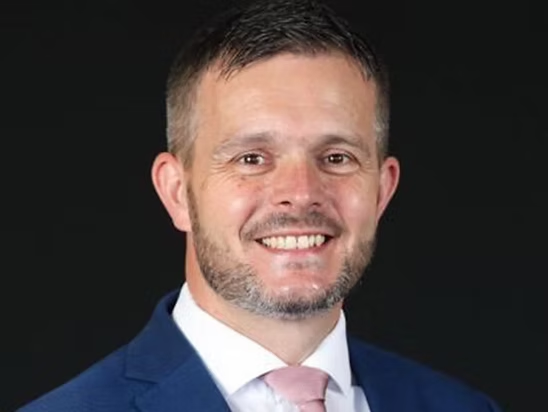
By Tony O’Reilly-
Robbie Butler has taken charge of one of the biggest and most politically sensitive departments at Stormont, stepping into the role of Health Minister less than 48 hours after the resignation of Mike Nesbitt plunged the Ulster Unionist Party into a public dispute over the future of hospital services. The Lagan Valley MLA was confirmed in the post on Thursday by UUP leader Jon Burrows, who said he had his “full confidence and the full backing” of the Assembly team. Butler inherits a health service facing enormous pressures, from lengthy waiting lists and workforce shortages to pressure on primary care, cancer services and hospital capacity. He also walks into the department at a particularly delicate moment, with the controversy over proposed changes to emergency general surgery at Causeway Hospital still unresolved.
His appointment therefore represents more than a change of minister. It is an opportunity to determine whether the UUP intends to continue the direction set by Nesbitt or whether Butler will establish a different political and managerial approach. Butler has already signalled that he intends to put his own stamp on the department.

AD: Capeesh Restaurant
“This is an enormous responsibility,” he said, promising that decisions would be guided by clinical evidence, frontline experience, patient needs and the confidence of communities.
He said there should be “one objective: to make things better for everyone” and acknowledged that too many people are waiting too long for treatment while staff are working under relentless pressure.
His language is significant because Butler is not arriving at the Department of Health as a career health politician.

AD: Oysterian Sea Food Restaurant And Bar
His route into Stormont has been unusually rooted in frontline public service. Before entering politics, Butler trained as a butcher. He subsequently spent four years in the Northern Ireland Prison Service and 16 years with the Northern Ireland Fire & Rescue Service. He has described his experience as a firefighter as shaping his understanding of public-sector workers and the pressures they face.The UUP says he holds a degree in Leadership and Management Practice. That background could prove relevant in a department where the central challenge is not simply setting policy but attempting to make a huge and complex public service function under sustained pressure.
Butler has been an MLA for Lagan Valley since 2016 and has held a succession of Assembly and party roles. He has served as UUP chief whip and deputy leader and, before taking the Health portfolio, chaired the Agriculture, Environment and Rural Affairs Committee. The Assembly records also show his involvement in scrutiny across a wide range of health-related issues. His previous work has also brought him into contact with issues including mental health, suicide prevention, disability, cancer, autism, women’s health, terminal illness, learning disability, addiction and community pharmacy.That does not make Butler a health professional, but it does mean his political background has not been detached from the issues that sit at the heart of the Health Department.He has also previously criticised pressures within the health service. In 2024, for example, he warned that disruption affecting community services would add to an already heavily backlogged health system and highlighted the consequences for GP appointments, respite services and speech and language and physiotherapy appointments.
His record on public-sector workers could also influence his approach to the workforce crisis. In 2024, drawing on his own experience as a former firefighter who had participated in industrial action over pay and conditions, Butler expressed solidarity with public-sector workers taking strike action. That history gives him a different perspective from a minister whose professional career has been entirely political.But it may also make the next few months particularly demanding. The Department of Health is confronting problems that cannot be solved simply through political messaging. Waiting lists require additional capacity and changes to how services are delivered. Workforce pressures require recruitment, retention and improvements in pay and morale. Primary care is under strain, while hospital trusts are having to consider difficult decisions about where specialist and emergency services can realistically be maintained. And then there is Causeway.
Nesbitt resigned after a breakdown in relations with Burrows over the proposed withdrawal of emergency general surgery from Causeway Hospital in Coleraine. Burrows had publicly opposed the proposed removal of the service at a town hall meeting, while Nesbitt accused his party leader of effectively establishing a political red line without properly communicating it to him. Butler now inherits that dispute.His own comments on Thursday appear designed to establish a framework for dealing with precisely these kinds of decisions. He said clinical evidence, frontline experience and patient needs must guide decisions, while also stressing the importance of confidence among communities across Northern Ireland. That formulation could become one of the defining tests of his tenure.
Healthcare reform inevitably involves difficult choices. Services cannot necessarily be maintained in every location in their existing form indefinitely, particularly when there are shortages of specialist staff and growing demand. But communities are understandably reluctant to accept the loss or relocation of services unless they are convinced that the alternative is safe, accessible and properly resourced. Butler will therefore have to navigate the tension between clinical evidence and community confidence rather than simply choosing one over the other. He has promised to spend considerable time on the frontline rather than operating from behind a desk. “I will bring urgency, curiosity and a willingness to challenge where I believe it is necessary,” he said.
He also made clear that he would not pretend the problems could be solved overnight. That acknowledgement may prove important. The temptation for any incoming minister is to announce a series of initiatives and promise rapid transformation. Butler instead appears to be positioning himself as a minister who intends to listen, make decisions and accept responsibility for them.The question now is how that approach translates into action.
DUP health spokesperson Diane Dodds has already warned that the new minister’s in-tray is “huge”, pointing to workforce pressures, pay and morale, pressure on GP services, cancer waiting times and the need for genuine transformation. SDLP health spokesperson Colin McGrath has similarly called for stability and warned that rural communities cannot simply be expected to accept services moving further away without confidence that alternative arrangements will deliver timely and appropriate care. Those are challenges Butler will have to confront almost immediately.His unusual career may offer useful experience. A butcher, prison officer and firefighter who became an MLA has spent much of his working life in occupations where decisions have consequences for people and where teamwork, discipline and practical problem-solving matter.. His political career has also given him almost a decade of experience at Stormont, including committee scrutiny and work on health and social policy.
What he brings to the Department of Health, then, is not clinical expertise but a combination of frontline public-service experience, political longevity and an apparent willingness to engage directly with difficult issues. Whether that proves sufficient will ultimately be judged not by the speeches made on his first day, but by whether patients begin to experience shorter waits, easier access and more reliable services.
Butler himself has set the benchmark. He said reform should not simply be discussed in strategies or measured by changes to structures. People should be able to “see and feel the difference” in the care they receive. That is a straightforward promise. The difficulty will be delivering it in a health service where almost every significant improvement requires money, staff, time and, often, politically uncomfortable decisions. Some believe he honeymoon for the new minister will be short. He has arrived with an unconventional CV, considerable frontline experience and a pledge to listen and act. Now comes the harder part: turning those qualities into results.

AD: Heritage And Restaurant Lounge Bar