
By Segun Ade-
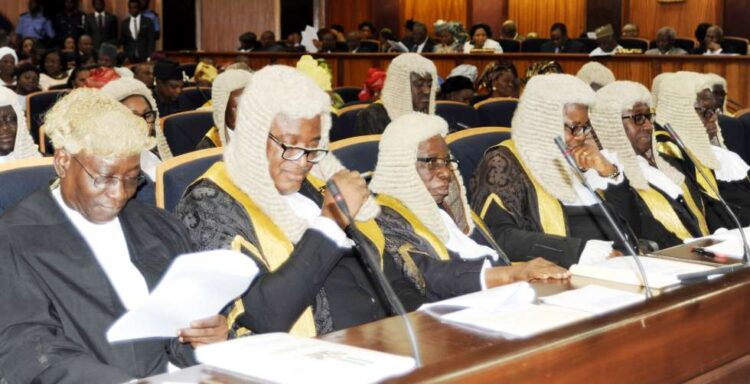
ABUJA- The National Judicial Council (NJC) in Nigeria has quietly launched a far-reaching investigation into some of the country’s most senior judges, including heads of courts, in what insiders describe as an “extraordinary” inquiry sparked by increasingly serious complaints.
According to officials familiar with the probe, a series of “damning and disturbing petitions” alleging misconduct — spanning forgery and false asset declarations — have been filed against unnamed judicial officers, prompting Chief Justice of Nigeria (CJN) Kudirat Kekere-Ekun, who also chairs the NJC, to marshal a confidential review aimed at “cleansing” the judiciary.

AD: Capeesh Restaurant
The integrity of Judges in Nigeria has long bene notorious, and there is now a concerted effort to probe judges in a push for reform in West Africa’s most populous country.
Under Paragraph 20 of Part One of the Third Schedule to the 1999 Constitution, the NJC is empowered to recommend appointments, promotions and disciplinary actions for judicial officers across Nigeria’s courts.
In essence, its constitutional responsibilities include investigating complaints and petitions against judges, initiating disciplinary processes including warnings, suspensions, compulsory retirement and recommendations for removal.

AD: Oysterian Sea Food Restaurant And Bar
It also includes the recommendation of appointment and elevation of judicial officers from lower courts up to the Supreme Court, and the overseeing policy and administration of judiciary affairs in concert with other bodies.
In recent years, the NJC has regularly convened panels to probe allegations against judges, including investigations into dozens of judicial officers and the suspension or compulsory retirement of several judges found culpable in past years.
However, there is no publicly known punitive measures that has been taken against those judges.
The Nigerian judiciary has long been beset by institutional challenges. Although the NJC has strong constitutional authority to discipline judicial officers, its actions have sometimes been contested.
A landmark Court of Appeal ruling in 2022 briefly cast uncertainty over the NJC’s disciplinary decisions — holding that it could not recommend punishment without input from the Federal Judicial Service Commission (FJSC) — a verdict that sparked anxiety across the judiciary and forced the NJC to appeal the judgment.
In the past two decades, the NJC has recommended the removal or retirement of judges and taken disciplinary action against more than a thousand officers, signalling the depth of misconduct concerns within the system.
Historic efforts to reform the judiciary go back even further. During the administration of President Olusegun Obasanjo, a major anti-corruption panel — the Kayode Eso Panel — uncovered widespread judicial corruption, leading to the sacking of dozens of judges on NJC recommendation.
legally, the NJC has the authority to investigate and discipline judges. Its powers are designed precisely to insulate the judiciary from external influence — whether from the executive, legislature or powerful politicians — ensuring that no judge is above scrutiny.
However, in practice, the effectiveness of such probes depends heavily on political will, institutional independence and transparency.
However, opaque investigations, handled with confidentiality, can undermine public confidence unless outcomes are communicated clearly.
However, many analysts believe that judges with strong political backing — especially those supported by powerful governors or national figures — may be shielded from consequences unless overwhelming evidence is produced.
Historical rulings that construe limits on NJC powers (like the 2022 Court of Appeal judgment) illustrate that legal challenges can weaken disciplinary authority.
Nigeria’s judiciary remains at a crossroads. Public trust has fluctuated over years of corruption allegations and high-profile misconduct cases, and the current probe — even if discreet — underscores a renewed effort by the nation’s top judicial leaders to restore integrity.
Most members of the Nigerian public aware of this latest investigation will be cynical of the chances of this leading to tangible reforms and accountability — particularly in cases where judges are perceived to be aligned with entrenched political interests — remains to be seen.
At the moment, the NJC’s actions signal that institutional self-scrutiny is underway, and that the constitutional mandate to uphold judicial integrity is being tested in real time.

AD: Heritage And Restaurant Lounge Bar