
By Martin Cole-
New Zealand is reeling from one of the most severe weather events in recent memory as days of torrential rain have swept across the North Island, triggering widespread flooding, landslides and power outages.

AD: Capeesh Restaurant
At the centre of the crisis is a deadly landslide at a bustling holiday park that has left several people, including children, missing, prompting grim comparisons to a “war zone” by a government minister.
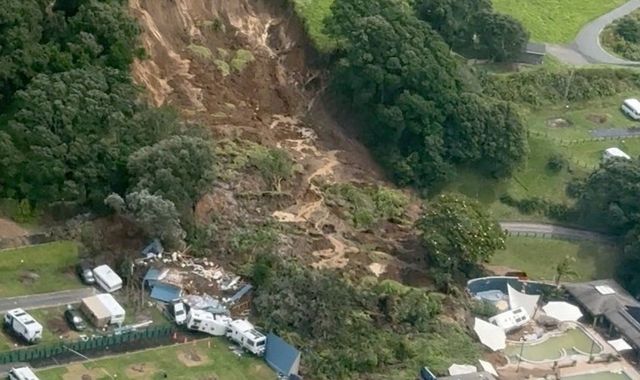
On the morning of Thursday 22 January 2026, a powerful landslide tore through the Beachside Holiday Park at the base of Mount Maunganui a scenic and busy campground on New Zealand’s North Island that is usually filled with holiday‑makers and families.
The slip, which was triggered by record‑breaking rainfall and saturating floodwaters, sent massive volumes of earth, debris, campervans and tents careening downhill, crushing facilities such as toilets and shower blocks and burying large swathes of the park beneath mud and rubble.

AD: Oysterian Sea Food Restaurant And Bar
Rescue crews, including urban search and rescue teams, sniffer dogs and more than 40 firefighters, were deployed to search for signs of life amid the devastation. Fire and Emergency commander William Pike confirmed that search teams initially heard voices from under the debris, but as conditions worsened and the land remained unstable, rescuers were forced to pull back for safety.
Emergency services and volunteers worked through dangerous terrain and broken infrastructure, digging through thick mud and debris as darkness fell.
Police District Commander Superintendent Tim Anderson stated that the number of missing people was believed to be in the single digits, but exact figures remained difficult to confirm because some campers had left the site without informing authorities.
Among those unaccounted for was at least one young girl, confirmed by Emergency Management Minister Mark Mitchell, who said the situation was “fluid” and “very difficult and challenging.”
Witnesses described terrifying scenes of homes and holiday vehicles overturned, entire sections of hillside torn away, and frantic attempts by bystanders to help before professionals arrived.
An Australian tourist, Sonny Worrall, told local media he narrowly escaped as the landslide thundered behind him while he was swimming nearby, calling it “the scariest thing I’ve ever felt in my life.”
Tragically, lives have already been lost in the storm’s wake. Separate landslides struck other areas, including Welcome Bay, where two bodies were recovered after a home was hit, and a man was reported missing after being swept away near a river crossing north of Auckland.
The intensity of the event reflects just how extreme the storm has been. Tauranga, the closest city to Mount Maunganui, recorded nearly 300 mm of rain in 30 hours a deluge that overwhelmed rivers, saturated hillsides and caused massive flooding across communities.
A State of Emergency and Wide‑Ranging Impact
The landslide at Mount Maunganui is only one manifestation of a broader storm system that has battered New Zealand’s North Island.
The National Emergency Management Agency warned that more heavy rainfall was expected, saying that rain was falling on ground that was already saturated, increasing the likelihood of further flooding, landslides and dangerous river conditions.
Emergency Minister Mark Mitchell painted a stark picture of the destruction. Comparing conditions on the east coast to a “war zone,” he described scenes where helicopters were rescuing families from rooftops as floodwaters surged around them and states of emergency were declared in at least five regions, including Northland and the East Cape.
The storm has had a far‑reaching impact beyond the landslide site. Thousands of residents across the North Island are without power, roads have been cut off by debris and floodwaters, and farmland and homes have been inundated.
Rescue crews have worked around the clock to evacuate people from flood‑stricken houses and assist communities isolated by broken infrastructure.
Prime Minister Christopher Luxon has expressed national grief, acknowledging that New Zealand was “heavy with grief” in the face of widespread damage and loss of life. He pledged government support and urged people across the country to follow official safety advice amid ongoing extreme weather warnings.
Local authorities also emphasised the unpredictable nature of the environment as the recovery continues. Geoscientists have highlighted that landslides are a natural hazard in New Zealand’s steep hill country especially on the North Island, where volcanic soil, high rainfall and unstable slopes are common. But the scale and severity of this event underscore just how vulnerable communities can be when weather extremes intensify.
Amid the chaos, communities have come together to support those affected. Locals, emergency services and volunteers have worked side by side, coordinating efforts to track missing persons, clear blocked roads and provide shelter for displaced families. Every reported sighting, every whisper of hope, has spurred renewed effort among exhausted search crews.
But the challenges are immense. Unstable land, ongoing rain and the risk of further slips have hampered efforts to access deeper layers of rubble. Fire and Emergency New Zealand reiterated that safety remains paramount, meaning that crews must carefully balance the urgency to find survivors with the need to avoid further casualties among rescuers.
At the Beachside Holiday Park itself, the devastation is unmistakable: flattened tents lie scattered, camper vans are twisted and crushed, and the landscape has been dramatically altered by the force of the landslide.
Witnesses on social media and in local reports have shared chilling accounts of how quickly the hillside gave way, with trees cracking and soil releasing in what one eyewitness described as “rolling thunder.”
While crews press on using helicopters, heavy machinery and trained dogs the emotional toll on families and first responders is palpable. Police and local officials have been careful not to confirm the final tally of missing people, both to avoid speculation and because accurate numbers are still being compiled.
Some campers are believed to have left the area without checking in, complicating efforts to determine exactly how many remained at the moment the landslide struck.
While New Zealand’s dramatic topography makes landslides a known hazard, scientists and climate experts warn that extreme weather events like this are becoming more frequent and intense due to climate change.
Warmer oceans and changing atmospheric patterns can result in heavier rainfall falling over shorter periods, overwhelming natural and engineered drainage systems and destabilising hillsides that might otherwise stand firm.
From farmers to coastal town residents, the increasing unpredictability of weather has led to heightened community awareness about preparing for emergencies. Local councils have stressed the importance of early warnings, evacuation planning and robust communication networks measures that can save lives when disaster strikes.
Although New Zealand’s infrastructure and emergency services are among the world’s most prepared, the sheer ferocity of the storm has tested those systems to their limits.
The Government’s response declaring states of emergency, mobilising national task forces, and coordinating with local councils reflects the severity of the event. And while immediate priorities are rescue and relief, recovery and rebuilding are likely to be long‑term endeavours.
Even in the face of such devastation, stories of courage and solidarity have emerged. First responders have worked tirelessly through hazardous conditions, neighbours have opened their homes to evacuees, and volunteers have coordinated supplies and shelter.
The collective hope is that ongoing search efforts will yield positive results, that missing families will be found safe, and that the full extent of the disaster can be accounted for in a way that brings closure to loved ones.

AD: Heritage And Restaurant Lounge Bar