
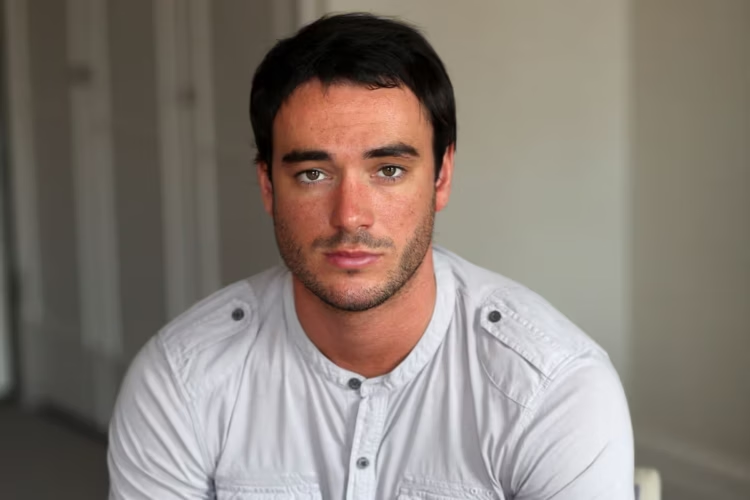
By James SImons-
Former reality television personality Jack Tweed,(pictured) the widower of late Big Brother star Jade Goody, has been banned from driving after admitting he was behind the wheel while over the legal limit for cannabis.
Tweed, 39, appeared at Chelmsford Magistrates’ Court where he pleaded guilty to one charge of driving a motor vehicle with a proportion of a specified controlled drug above the permitted limit. The court heard that Tweed was stopped by police while driving his Volkswagen Golf on Three Mile Hill, near Chelmsford, on December 6 last year after officers suspected cannabis may have been present in the vehicle and that he may have been driving under its influence.

AD: Capeesh Restaurant
A roadside drug test was carried out after police stopped him, which returned a positive result. Tweed was subsequently taken to a police station, where a blood sample recorded 5.6 micrograms of delta-9-tetrahydrocannabinol (THC)—the main psychoactive component of cannabis—in his system. The legal driving limit for THC is two micrograms.
Prosecutor Rebecca Debenham told the court that officers believed cannabis may have been in the vehicle and that Tweed may have been driving while affected by the substance. The court imposed a financial penalty of £692, along with a £277 surcharge and £85 in prosecution costs. Tweed was also disqualified from driving.
During the hearing, Tweed offered an apology and told the court that he accepted responsibility for his actions.

AD: Oysterian Sea Food Restaurant And Bar
“I’m not making excuses,” he said, explaining that he had experienced difficult periods in his life, including trauma, depression and anxiety. Tweed said he had used cannabis because he struggled with sleep problems, adding that he believed it helped him rest.
“I can’t sleep at night, I’d found having a little bit of that helps me sleep through the night and that’s what I was doing,” he told the court.
However, he admitted that driving the following morning was a serious mistake.
“I had some the night before to help me sleep again… stupid decision, I drove in the morning when I shouldn’t have.”
Tweed told magistrates that he had been attempting to rebuild his life and had found alternative ways of managing his difficulties without using drugs.
“I’ve been working on myself, I’ve found other things to help myself get through situations and sleeping that doesn’t involve drugs,” he said.
He also explained that he currently works as an electrician and that being unable to drive would create difficulties for his employment.
“I do work to keep my life in the forward motion – if I get banned it’s just going to go backwards,” he told the court.
Tweed concluded his remarks by apologising for his actions.
“I apologise, I’m sorry.”
The court was also told that Tweed has seven previous convictions relating to 14 offences. His criminal history includes a 2007 conviction for driving with excess alcohol. Tweed first became widely known to the public through his relationship with Jade Goody, who rose to fame after appearing on Big Brother in 2002 before becoming one of Britain’s most recognisable reality television figures.
Their relationship attracted significant media attention, particularly after Goody was diagnosed with cervical cancer in 2008. The couple married in February 2009 in a ceremony that received extensive public coverage, with Goody’s final months documented by television cameras as she raised awareness of cervical cancer screening.
Goody died on March 22, 2009, aged just 27, leaving behind two sons, Bobby and Freddie.Her decision to publicly share her cancer battle had a lasting impact on awareness of cervical screening. Following her diagnosis and death, charities and health organisations reported increased public discussion about the importance of regular cervical smear tests, with the phenomenon often referred to as the “Jade Goody effect”.
Tweed, who was 22 when he met Goody, has spoken in previous years about the emotional impact of losing his wife at such a young age. After Goody’s death, he faced intense public scrutiny while attempting to move forward with his life away from the spotlight.
Before his relationship with Goody, Tweed had already attracted media attention, including through his appearance on Celebrity Big Brother in 2007. His time on the programme came shortly after he had been sentenced to a custodial term following an assault conviction.
Over the years, Tweed has repeatedly attempted to distance himself from his earlier reputation and has spoken publicly about changing his lifestyle. His latest court appearance once again placed his personal struggles and past difficulties under public examination.
Tweed’s case highlights wider concerns about drug driving, an offence that has increased in prominence since changes to the law introduced in 2015 made it easier for police to prosecute motorists who have illegal drug levels above specified limits.
Unlike traditional drink-driving offences, drug-driving legislation does not require prosecutors to prove that a driver was visibly impaired. Instead, drivers can be prosecuted if they exceed the legal threshold for specified substances. Police forces across the country have continued to warn motorists that cannabis and other drugs can affect reaction times, concentration and decision-making, creating risks not only for drivers themselves but also for passengers, pedestrians and other road users.
Road safety organisations have repeatedly stressed that recreational or medicinal use does not remove the responsibility to ensure a person is safe and legally able to drive. Tweed’s case also illustrates the challenges faced by courts when dealing with offences committed by individuals who describe personal difficulties behind their actions.
Magistrates must consider both the seriousness of the offence and the circumstances of the individual involved. While personal struggles may provide context, they do not remove the legal responsibility placed on every driver to ensure they are not impaired or over the prescribed limit.The court hearing marks another difficult chapter in a life that has frequently played out under intense public attention.
The message from road safety experts remains clear that regardless of background, personal circumstances or public profile, drivers are responsible for ensuring they are fit and legal to drive.The wider challenge will be maintaining the progress he told the court he has worked hard to achieve while continuing to move his life forward away from past difficulties.

AD: Heritage And Restaurant Lounge Bar