
By Tim Parsons-
Erling Haaland delivered the decisive moment for Norway as his country defeated Ivory Coast 2–1 to secure their first-ever victory in a FIFA World Cup knockout match, a breakthrough that instantly reshapes how the nation is viewed on football’s biggest stage. The win marks a historic milestone in Norway’s tournament history and underlines the growing influence of one of world football’s most feared strikers.
The match had the atmosphere of a contest aware of its own significance. Norway started with intensity, pressing high and attempting to assert control through midfield creativity led by Martin Ødegaard, while Ivory Coast relied on pace in transition and compact defensive organisation. Both sides created openings, but neither could fully impose themselves for long stretches.

AD: Capeesh Restaurant
Norway struck first after capitalising on a defensive misjudgement, finishing a flowing move inside the box. Ivory Coast responded with composure and physicality, gradually growing into the game before equalising with a sharp counterattack that exposed space behind Norway’s defensive line. Within that moment, the match tightened into a contest defined by nerves and fine margins. Then came Haaland’s defining intervention.
A curling cross from the right found the Manchester City forward peeling away from his marker. In one decisive movement, he powered a header past the goalkeeper, a finish that reflected both timing and force. It was the kind of moment that has become synonymous with his career: simple in execution, devastating in consequence.
According to FIFA’s historical records of tournament performance, Norway have reached the Round of 16 in previous World Cups but have never progressed beyond that stage, meaning they have not recorded a knockout-stage victory leading to advancement in the competition.

AD: Oysterian Sea Food Restaurant And Bar
FIFA competition archives show that Norway’s best finishes came in 1938 and 1998, both ending at the Round of 16 stage, reinforcing their historically limited progression in knockout rounds.
With this result, FIFA’s documented tournament history supports the view that Norway’s World Cup campaigns have typically ended in the early knockout rounds or group stages, rather than extending into deeper elimination phases.
This victory represents more than progression into the next round with Norway. It signals a shift in competitive identity, from hopeful participant to genuine knockout contender. Their journey in recent tournaments has often been defined by narrow margins and missed opportunities, but this performance showed both resilience and composure under pressure.
Ivory Coast entered the match full of confidence after a strong group-stage campaign, arriving at the knockout round with momentum built on disciplined performances and positive results. Within the reports, they competed strongly in spells and showed the ability to threaten in transition against higher-ranked opposition, but ultimately found it difficult to sustain control against Norway’s attacking pressure over the full 90 minutes.
Their equaliser reflected sharp tactical awareness and quick attacking movement, moments that briefly unsettled Norway and shifted the rhythm of the game. However, according to reports, Norway’s forward structure and individual quality particularly in decisive moments continued to pose problems throughout the match, with the game ultimately decided by fine margins and a late moment of elite finishing.
Haaland’s goal will inevitably dominate the headlines, but the broader tactical performance also mattered. Norway’s midfield balance, particularly through Ødegaard’s distribution and control, allowed them to sustain pressure even when Ivory Coast briefly swung momentum in their favour.
Football analysts often point to knockout football as a different psychological environment, where execution outweighs dominance. That distinction was clear in Dortmund. Ivory Coast matched Norway in several phases of play, but Norway produced the defining action when it mattered most. The result also reinforces Haaland’s reputation as one of the most decisive forwards in modern football. His scoring record at club level with Manchester City has already established him as one of the most prolific strikers in the game, and this performance extends that influence onto the international stage in a format that demands precision under pressure.
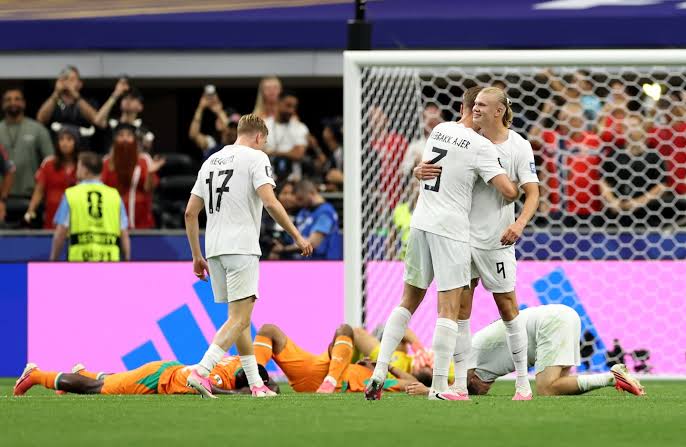
The final whistle confirmed Norway’s historic win, players and supporters reacted with visible emotion. Relief mixed with disbelief on the pitch, while the travelling fans celebrated a result that will be remembered as a turning point rather than a routine victory.
While Ivory Coast, the exit is painful but not without positives. Their organisation and ability to respond after conceding demonstrated a side capable of competing at this level. However, knockout football often hinges on a single moment of brilliance, and this time it belonged to Norway. The significance of the result will likely grow with time. Tournament histories are often defined not just by trophies, but by breakthroughs that change how nations perceive their place in the sport. For Norway, this victory represents exactly that kind of shift.
Haaland’s header will be replayed for years, not just for its technical execution but for what it represents: a nation crossing a barrier that once seemed fixed. And as Norway moves deeper into the tournament, the question is no longer whether they belong at this stage, but how far a team led by one of the world’s most lethal finishers can now go.
This moment feels less like a single result and more like a shift in identity with Norway. Tournament football has often been where they fell short competitive in spells, organised in structure, but historically lacking the decisive edge required when matches tighten in knockout rounds. That pattern now appears to be changing.
With composure under pressure and a growing sense of belief, Norway are beginning to resemble a side capable of navigating the margins that define World Cup success. Much of that transformation inevitably centres on Erling Haaland, whose presence alters not only how Norway attack, but how opponents defend.
His movement inside the box forces defenders to collapse deeper, his physicality reduces reaction time in crowded areas, and his finishing ensures that even half-chances carry real consequence. Seen in his decisive strike, the margin between parity and elimination can shrink to a single delivery, a single leap, a single header.
But what makes this development more significant is that Norway are no longer relying solely on individual brilliance. The structure around Haaland, including midfield control and wider attacking support, has begun to function with greater cohesion. That balance is what turns dangerous teams into tournament contenders.
Whether that carries them into a deep knockout run or simply marks a historic breakthrough, this victory has already altered the perception of what Norwegian football can achieve. Haaland’s header, then, is more than a winner. It is a statement that the ceiling may no longer be where it once was.

AD: Heritage And Restaurant Lounge Bar