
By Tony O’Reilly-
A former Cambridgeshire Police sergeant has been convicted for misconduct in public office, laying bare a troubling picture of leadership failure, abuse of authority and a culture in which offensive behaviour was allowed to flourish unchecked within a specialist policing unit.
What began as an investigation into the conduct of a single officer ultimately widened to encompass 13 police officers, exposing inappropriate WhatsApp exchanges, the unlawful sharing of private images, derogatory comments about members of the public and an apparent reluctance among colleagues to challenge unacceptable behaviour.

AD: Capeesh Restaurant
Former Police Sergeant Paul Street, 41, was found guilty at the Old Bailey of two counts of misconduct in public office following an investigation directed by the Independent Office for Police Conduct (IOPC). He had previously admitted two offences under the Data Protection Act. Jurors acquitted him of assault occasioning actual bodily harm and perverting the course of justice. Street, who resigned from Cambridgeshire Police in February 2024, will be sentenced at a later date after being remanded into custody.
For much of his policing career, Street held a position carrying considerable responsibility. As the sergeant leading the Southern Neighbourhood Impact Team based at Cambourne Police Station, he supervised officers tasked with disrupting organised crime groups and tackling drug-related offending. Such units depend upon discipline, sound judgement and public confidence. Instead, investigators concluded that the culture developing under his leadership moved in the opposite direction.
Evidence recovered from Street’s mobile telephone became the catalyst for one of the most significant professional standards investigations the force has experienced in recent years. Among the messages discovered were WhatsApp conversations dating from April 2020 relating to a 17-year-old who had been detained and strip-searched on suspicion of possessing drugs. Prosecutors told the court that Street encouraged colleagues to intimidate and bully the teenager. Messages included references to using violence against the child, including one suggesting officers should “smash his little head in”.

AD: Oysterian Sea Food Restaurant And Bar
Investigators also uncovered a video recorded by Street in which he used offensive language while making threats intended to be shown to the detained teenager. Although no physical assault resulted from the recording itself, the prosecution argued successfully that such conduct represented a serious abuse of public office by an officer entrusted with safeguarding those in police custody.
Perhaps even more disturbing were the findings concerning the handling of sensitive personal material belonging to a woman whose mobile phone had been lawfully seized during a criminal investigation. The woman had expressly informed officers that the device contained intimate photographs and requested that her privacy be respected. Such material is routinely encountered during digital examinations, and officers receive training emphasising that access must be confined strictly to legitimate policing purposes.
The evidence showed something very different. On 1 October 2020, fellow officer PC Josh Williams informed Street via WhatsApp that the seized phone contained intimate material. Street replied with a question that would later become central to the prosecution case: “Any nudes?”
Williams then photographed the woman’s camera roll, displaying multiple intimate images, and forwarded the photograph to Street. Six months later, Street contacted Williams again asking whether he still possessed an intimate video taken from the woman’s phone because he wanted to “show the lads from footy”.
The knowledge that officers had circulated her private images for personal amusement proved deeply distressing. for the victim Beyond the obvious invasion of privacy, the incident represented a profound breach of the trust upon which policing depends. Citizens surrender personal devices during investigations on the understanding that officers will exercise the highest standards of integrity. The misconduct exposed in this case fundamentally violated that expectation.
Williams previously pleaded guilty to misconduct in public office. He has since been dismissed without notice and placed on the College of Policing’s Barred List, preventing any future service as a police officer.
The IOPC was unsparing in its assessment of Street’s leadership.
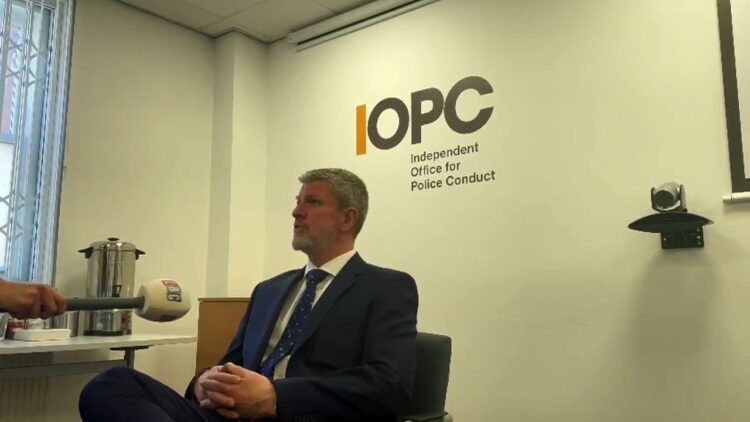
Emily Barry, the watchdog’s Director of Engagement, concluded that Street had established “a toxic team culture which junior officers would find very difficult to challenge”. According to investigators, his conduct normalised inappropriate behaviour among more junior colleagues, encouraging participation rather than restraint.
Equally revealing was Street’s reported response when one officer finally challenged what was happening. Rather than welcoming accountability, investigators said he labelled the whistleblower a “snake” within the team’s WhatsApp group, a reaction that may help explain why problematic workplace cultures can persist for years before being exposed.
The significance of this case extends well beyond the convictions themselves.
Evidence obtained from Street’s telephone prompted investigators to widen their inquiry, eventually identifying misconduct or performance concerns involving a further 12 officers.
PC Steve Girdlestone was dismissed without notice after disciplinary proceedings found he had used discriminatory and derogatory language about members of the public in WhatsApp messages. PC Amadae Dowd received a final written warning for gross misconduct after sharing images of an injured child and an adult without any legitimate policing purpose.
Four additional officers faced misconduct proceedings, while five others entered the Reflective Practice Review Process, bringing the total number of officers subject to disciplinary or performance procedures arising from the investigation to 13. The breadth of those findings suggests that investigators were confronting not isolated lapses of judgement but behavioural patterns capable of becoming embedded within a workplace culture.
Such concerns have become increasingly prominent across British policing during the past decade. The murders committed by former Metropolitan Police officer Wayne Couzens in 2021, together with the criminal convictions of former officer David Carrick for multiple sexual offences, prompted sweeping examinations of police culture nationally.
Baroness Louise Casey’s landmark review of the Metropolitan Police concluded in 2023 that serious cultural failings had allowed misogyny, racism and bullying to persist within parts of the organisation, while His Majesty’s Inspectorate of Constabulary has repeatedly emphasised that forces must become more effective at identifying and removing officers whose conduct falls below expected standards.
Although the overwhelming majority of police officers perform their duties professionally, official statistics demonstrate the scale of disciplinary work now being undertaken. Home Office figures for the year ending March 2025 recorded 15,843 misconduct allegations being finalised across police forces in England and Wales. During the same period, 1,687 officers were referred to formal misconduct proceedings, of whom 1,369—approximately 81 per cent—were found to have committed misconduct or gross misconduct. A total of 695 officers were dismissed following those proceedings.
Those figures represent only a small fraction of the more than 148,000 officers serving across England and Wales. Oversight bodies consistently warn that each substantiated abuse of authority can inflict damage well beyond the individuals directly involved, weakening public confidence in policing more broadly.
Perhaps the most encouraging aspect of the Cambridgeshire investigation was that it ultimately relied upon an officer prepared to challenge unacceptable behaviour despite considerable professional pressure. Emily Barry praised that individual, saying the officer “should be acknowledged for standing up for what is right”.
Her observation carries wider significance. Modern policing depends not merely upon robust disciplinary systems after misconduct has occurred but upon officers possessing the confidence to question colleagues before misconduct becomes normalised.
As Street awaits sentencing, the case stands as a sobering study of how leadership can influence organisational culture for better or worse. A specialist team established to combat organised crime instead became the focus of one of the force’s most damaging misconduct investigations, not because of operational failures, but because those entrusted with enforcing the law were found to have disregarded the professional and ethical standards expected of them.
For the teenager subjected to intimidation, for the woman whose private images were unlawfully shared, and for the many police officers who carry out their duties with integrity every day, the significance of this case lies not simply in one former sergeant’s conviction. It lies in the reminder that public confidence is built slowly, but can be eroded with startling speed whenever authority is exercised without accountability.

AD: Heritage And Restaurant Lounge Bar