
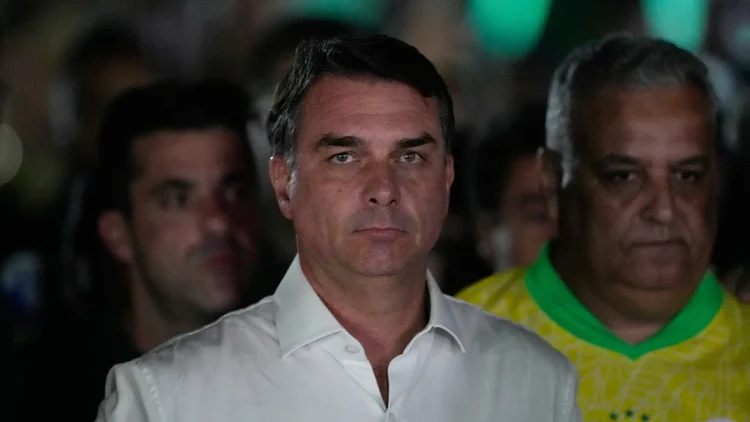
Brazilian politician Flávio Bolsonaro(pictured) has arrived in the United States with his wife, Fernanda, and their two daughters, drawing renewed attention to an investigation into alleged corruption and money laundering that he denies.
His arrival also raises questions over his failure to comply with a Brazilian Supreme Court order requiring him to surrender his passports. Footage of Bolsonaro disembarking from the plane shows the defeated presidential candidate arriving alongside his family as scrutiny of his legal circumstances continues.

AD: Capeesh Restaurant
His journey to the US comes at a sensitive time, with the investigation in Brazil placing his personal affairs and political future under renewed public attention. The US State Department has told the BBC that it would issue visas to Bolsonaro and his family, allowing them to travel to the country.
The statement provides confirmation of the US position on their entry, although further details about the visa arrangements and the circumstances of their journey have not been provided in the information available.

AD: Oysterian Sea Food Restaurant And Bar
Bolsonaro’s arrival is particularly significant because he had failed to comply with an order from Brazil’s Supreme Court to surrender his passports.
Such an order raises important questions about the restrictions imposed on an individual under investigation and the legal requirements governing international travel.
However, the precise consequences of his failure to surrender the documents would depend on the terms of the court order and any subsequent decisions by Brazilian authorities.
The development is likely to intensify debate over the legal challenges facing Bolsonaro and the extent to which they could affect his political standing.
Even as a defeated presidential candidate, he remains a prominent figure in Brazil’s political landscape, making the investigation a matter of interest beyond his immediate personal circumstances.
The allegations of corruption and money laundering are serious, but they remain allegations. Bolsonaro denies wrongdoing, and an investigation alone does not establish criminal liability.
Any determination of guilt would depend on the evidence and the outcome of the appropriate legal proceedings. Corruption investigations involving prominent political figures can have wider implications for public confidence in institutions, particularly when questions arise over compliance with court orders. #
In this case, the combination of the ongoing investigation and Bolsonaro’s failure to surrender his passports places the actions of both the politician and the relevant authorities under scrutiny. The Supreme Court’s order is an important part of the story because it raises questions about compliance with judicial authority.
Nevertheless, without further information about the order’s precise terms, the reasons for non-compliance and any subsequent judicial response, it would be premature to conclude that
Bolsonaro’s arrival in the United States constitutes a separate criminal offence or that he has breached any additional legal restriction.
The US decision to issue visas to Bolsonaro and his family is also distinct from the Brazilian investigation. The granting of a visa does not determine whether allegations made in another country are true, nor does it amount to a legal finding concerning the conduct under investigation.
Questions about his immigration status in the United States and his legal position in Brazil will be considered separately.
His presence in the United States does not, by itself, bring the investigation to an end or resolve the allegations against him. Instead, it adds another dimension to a case that already raises questions about political accountability, judicial authority and the responsibilities of public figures facing serious accusations.

AD: Heritage And Restaurant Lounge Bar
Bolsonaro maintains his denial of the alleged corruption and money laundering. The central issues remain whether investigators can substantiate the accusations, what legal consequences may follow from the passport dispute and how Brazilian authorities intend to proceed.