
By Theodore Brown-
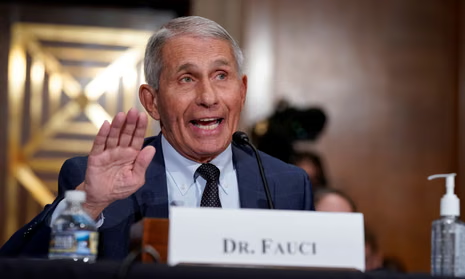
Private messages sent by Dr Anthony Fauci during the Covid-19 pandemic have shed new light on the discussions among senior US health officials over whether pregnant women should receive Covid vaccines.
The messages reveal concerns about possible theoretical risks before federal health authorities ultimately recommended vaccination.

AD: Capeesh Restaurant
The messages, presented during a congressional investigation into Fauci’s leadership and conduct during the pandemic, provide a glimpse into the uncertainty confronting senior officials as they attempted to make decisions about a rapidly developing virus and vaccines for which long-term data were initially limited.
Fauci, who served as director of the National Institute of Allergy and Infectious Diseases and became one of the most recognisable faces of the US pandemic response, exchanged messages with senior health officials about the potential effects of vaccination during pregnancy at a time when evidence was still emerging.
The committee examining his actions also released entries from Fauci’s personal diary covering the period from 2019 to 2022. More than 1,000 pages of diary material were examined, alongside a vast collection of communications reportedly recovered from his phone, including more than 34,000 messages and 522 voicemails. Eleven text messages were presented during the hearing.

AD: Oysterian Sea Food Restaurant And Bar
One of the most revealing exchanges took place on 25 January 2021, when Dr Vivek Murthy, who was serving as an adviser to President Joe Biden, asked Fauci about the potential risks of Covid vaccination during pregnancy.
At that stage, evidence concerning vaccination during pregnancy was still developing. Unlike later in the pandemic, health officials did not yet have the benefit of the large body of observational data that would eventually inform recommendations.
Fauci responded that there was no data, or theoretical basis, to suggest that receiving a vaccine early in pregnancy was preferable to receiving it later. But he also raised a possible theoretical concern relating to the body’s response to vaccination.
Fauci noted that some people experienced significant cytokine responses and fever following the second vaccine dose. He said that, theoretically, such a reaction could be associated with miscarriage during the first trimester.
Dr Rochelle Walensky, then director of the Centers for Disease Control and Prevention, responded that this was “definitely a good point”, particularly in relation to the second dose.
The exchange does not show Fauci concluding that Covid vaccines were unsafe for pregnant women. Instead, it illustrates the uncertainty surrounding a medical decision at a time when officials were attempting to assess potential risks in the absence of comprehensive pregnancy-specific data.
A further exchange the following day demonstrated the balancing exercise facing the officials. “One must weigh the potential risks against the benefits,” Fauci wrote.
He also emphasised that Covid infection itself could be particularly serious during pregnancy. That distinction is central to understanding the messages. The discussion was not simply about whether a vaccine might carry a theoretical risk. Officials were simultaneously considering the potentially serious consequences of Covid infection for pregnant women.
The issue eventually moved towards a clearer evidence-based position as more information became available. On 11 August 2021, the CDC formally recommended that pregnant women receive Covid vaccination after reviewing data that did not indicate an increased risk of miscarriage or other major safety concerns associated with the vaccines.
Subsequent research provided further evidence supporting vaccination during pregnancy, with serious adverse reactions found to be uncommon.
The newly examined messages therefore offer a snapshot of the scientific uncertainty that existed before the recommendation was made rather than evidence that senior health officials secretly knew the vaccines were dangerous.
Nevertheless, the communications are likely to attract political scrutiny because they reveal the private conversations that preceded public health guidance affecting millions of Americans.
Critics of Fauci and the government’s pandemic response, will consider the messages as reinforcing arguments that officials were making major policy decisions while important questions remained unanswered.
Defenders of Faucci and the vaccine programme, are likely to argue that the exchanges demonstrate precisely how scientific decision-making is supposed to operate when evidence is incomplete: officials identify potential risks, compare them with the dangers posed by the disease and revise recommendations as new evidence emerges.
The congressional investigation has become part of a much wider political battle over the legacy of the pandemic and the decisions made by the US government during the crisis.
Republicans have subjected Fauci’s record to intense scrutiny, including his communications, policy decisions and handling of scientific information. Democrats, meanwhile, have accused Republicans of using the investigation to redirect attention away from former President Donald Trump’s handling of the pandemic.
Senator Richard Blumenthal defended Fauci during the proceedings, arguing that the campaign against the former health official formed part of what he described as a broader attack on science and factual evidence.
“The campaign to vilify you, Dr. Fauci, is just one part of this larger campaign against science and facts,” Blumenthal said, arguing that such attacks had made Americans less safe.
The release of Fauci’s personal diary adds another dimension to the investigation.
The entries, covering the period from 2019 through 2022, reportedly document his growing concerns as the virus spread, his frustrations with aspects of the government’s response and his interactions with officials during both the Trump and Biden administrations.
Fauci occupied an unusual position during the pandemic. Initially appointed as NIAID director years before Covid emerged, he became one of the principal public faces of the US response as the virus spread across the country.
His prominence also made him a target of political criticism. Supporters regarded him as a trusted scientific authority who helped guide the public through an unprecedented health emergency. Critics accused him of wielding excessive influence and questioned whether the government was sufficiently transparent about the evidence behind its policies.
The newly released communications are unlikely to settle that argument. Instead, they show how difficult some of the decisions were at a time when officials were being asked to provide definitive answers about a virus and vaccines while scientists were still collecting the evidence needed to reach firm conclusions.
Pregnancy presented a particular challenge because pregnant women were often excluded from or underrepresented in early clinical trials, meaning that officials initially had less direct evidence than they would have liked.
That made the January 2021 discussion especially significant. Fauci and his colleagues were not working with the extensive pregnancy data that became available later. They were weighing a theoretical concern against the known and potentially severe consequences of Covid infection.
The subsequent recommendation in August 2021 followed the accumulation and assessment of additional evidence. That evolution is an important part of the story because scientific guidance during a rapidly developing health emergency was never intended to remain fixed. Recommendations could change as researchers collected more information about the virus, vaccines and different groups of patients.
The private messages also demonstrate the difference between discussing a theoretical possibility and establishing that a medical intervention causes harm.
Fauci’s reference to a possible connection between post-vaccination fever and miscarriage was explicitly framed as theoretical. The later evidence did not establish an increased risk of miscarriage associated with Covid vaccination.
That distinction is particularly important now that the messages are being examined in a highly charged political environment.
The release nonetheless raises legitimate questions about how uncertainty was communicated to the public. If senior officials were privately discussing possible risks, members of the public may reasonably ask how those concerns were reflected in the public explanation of vaccine recommendations and whether the uncertainty was communicated clearly enough.
At the same time, the records show that officials were considering both sides of the equation: potential vaccine risks and the dangers posed by Covid itself.
For pregnant women, the consequences of infection could be serious, making the decision more complicated than simply identifying whether a vaccine carried a theoretical risk.
The eventual CDC recommendation reflected the evidence available by August 2021, while subsequent research continued to strengthen the evidence base supporting vaccination during pregnancy. The latest disclosures therefore provide neither a simple vindication nor a definitive indictment of Fauci.
They reveal something more complicated: senior officials confronting an unprecedented medical emergency, attempting to make decisions with incomplete information and debating risks that had not yet been fully quantified.
The release of more than 1,000 pages of diary entries and thousands of messages is likely to ensure that the debate over Fauci’s role in the pandemic continues.
But perhaps the most revealing element of the material is not a hidden admission that the vaccines were unsafe. It is the record of uncertainty itself. Before the evidence became clearer, officials were asking difficult questions about pregnancy, vaccination, fever, immune responses and the consequences of Covid infection. They did not have all the answers.
As the evidence developed, the guidance changed.
The released messages do provide is a rare window into the conversations behind one of the most consequential public health decisions of the Covid era.

AD: Heritage And Restaurant Lounge Bar