
By Ben Kerrigan-
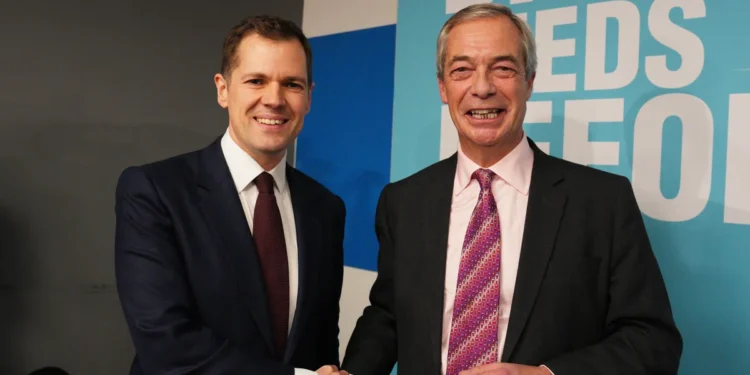
Nigel Farage is preparing to unveil Robert Jenrick a high‑profile defector from the Conservative Party as his party’s potential future chancellor‑in‑waiting in what could be a defining moment for Reform UK’s bid to portray itself as a government‑ready force.
The announcement is expected at a press conference this week, and signals a concerted effort by Farage to dispel critics’ claims that his party resembles little more than a “one‑man band.”

AD: Capeesh Restaurant
Jenrick’s elevation reflects both his personal political journey and broader turbulence on the British right. Once a senior Conservative minister holding roles including housing and immigration secretary Jenrick defected to Reform UK in January after being dismissed from the Conservative frontbench by leader Kemi Badenoch amid evidence he was planning to switch allegiances.
At a party rally in Romford last week, Farage emphasised that the appointments designed to build out a formal leadership team are intended to demonstrate that Reform is preparing to take power, not just win votes. “I think the moment to properly move away from the potential criticism that we’re a one‑man band has been there now for a few weeks,” he said.
Pressure and Priorities
Jenrick’s expected role as Reform’s economic lead often described as shadow chancellor in press reports puts him at the forefront of the party’s economic strategy, despite ongoing debate within Reform about who should fill the position.

AD: Oysterian Sea Food Restaurant And Bar
Senior figures such as Richard Tice, Reform’s deputy leader, had been widely anticipated as contenders for the post but are instead being positioned in other strategic roles, including business and energy.
The shake‑up extends beyond Jenrick. Party policy chief Zia Yusuf is tipped to oversee home affairs and immigration, while former Conservative MP Nadhim Zahawi is expected to take on foreign policy responsibilities.
Each of these appointments underscores Farage’s strategy of recruiting experienced politicians from outside Reform’s traditional ranks a move with both political and ideological consequences.
Farage’s decision arrives at a delicate moment. Recent polling shows Reform UK ahead of the Labour Party and the Conservatives nationally, raising the possibility that Farage’s insurgent movement could reshape the political landscape. However, concerns about his personal popularity have also emerged; analysts note that Farage’s public favourability has dipped, even as his party gains ground.
Sources close to the party say Farage hopes that promoting seasoned politicians like Jenrick will broaden Reform’s appeal to voters who might otherwise be wary of the party’s relative youth and limited government experience.
But not all within the party are convinced: the prominence of former Conservatives in key posts has sparked quiet tension, with some members wary that the party’s identity could be diluted.
Jenrick’s Rise and the Road Ahead
Robert Jenrick’s political trajectory has been notable. Elected as Conservative MP for Newark in 2014, he previously served at the heart of government, with experience as Exchequer secretary and as a cabinet minister under former prime ministers including Rishi Sunak and Theresa May.
His defection to Reform UK marked a dramatic turning point, following his dismissal from the Conservative Party amid reports he was planning to join Farage’s ranks.
At the press conference where he announced his defection, Jenrick described the Conservative Party as having “failed the country,” arguing that Reform offered a platform better aligned with voters’ frustrations and priorities. That rhetoric and his willingness to take on a leading role in Farage’s party illustrates the growing political realignment on the right.
Farage’s critics, however, do not mince their words. Some commentators and grassroots figures have accused him of opportunism, suggesting that the embrace of former Conservative politicians like Jenrick represents a compromise of core principles for the sake of political expediency. These voices argue that Reform risks alienating its base even as it seeks broader credibility.
The timing of Jenrick’s likely appointment is significant. With local elections approaching in May, Farage is under pressure to show that Reform UK is more than a protest movement that it can also offer coherent, experienced leadership across key areas of government.
Economic policy, in particular, will be scrutinised, and Jenrick’s portfolio will place him under intense spotlight as he articulates Reform’s fiscal vision.
Yet questions remain over how Reform’s evolving leadership structure will sit with voters beyond its core base. While the party’s rise has drawn support from disenchanted Conservative voters, it has also sparked unease in other quarters.
Opponents argue that Farage’s rhetoric and policies could deepen divisions on issues such as immigration and economic reform, complicating efforts to build broader consensus.
For now, Farage insists that his leadership team reflects a pragmatic approach to winning power and delivering change. Through elevating Jenrick and other experienced politicians, he aims to present Reform UK as a credible alternative to the established parties capable of leading the nation through economic challenges and political transformation.
The coming weeks will test whether that gamble pays off, and whether Reform’s revamped leadership can withstand both internal pressures and external scrutiny in a rapidly shifting political landscape.
Farage has repeatedly framed the appointments as a signal that Reform UK is no longer a single-figure movement but a party with depth and administrative capability. He argues that voters are seeking experienced hands to manage critical areas such as public finance, housing, and business policy, and that figures like Jenrick bring exactly that expertise.
This positioning is particularly important as the UK faces an uncertain economic climate, including rising inflation, energy instability, and the lingering effects of Brexit on trade and regulatory frameworks.
While showcasing a leadership team with a mix of political experience and outsider energy, Farage hopes to convince voters that Reform UK is equipped not only to critique the status quo but to govern responsibly if given the mandate.
However, analysts caution that the party’s newfound credibility comes with risks. The inclusion of high-profile defectors may bolster Reform’s image in Westminster corridors, but it could alienate long-time supporters who value Farage’s outsider, anti-establishment identity.
Furthermore, scrutiny from both the media and political opponents will intensify, as every policy statement and cabinet-style appointment is dissected for coherence and feasibility. Farage and Jenrick will need to balance bold messaging with careful policy planning, demonstrating that Reform UK can act decisively without losing its grassroots support.
Ultimately, the success of this leadership strategy will hinge on public perception. If voters embrace the team as capable and trustworthy, Reform could shift from a protest movement to a serious contender in national politics.
But any misstep policy inconsistency, internal disagreement, or mismanaged media narrative could quickly undermine the party’s credibility, leaving Farage to defend both his choices and his broader vision for the UK.
The weeks ahead will reveal whether Reform UK’s gamble on experienced leadership is a masterstroke or a cautionary tale for insurgent parties navigating the complex terrain of British politics.

AD: Heritage And Restaurant Lounge Bar