
By Aaron Miller-
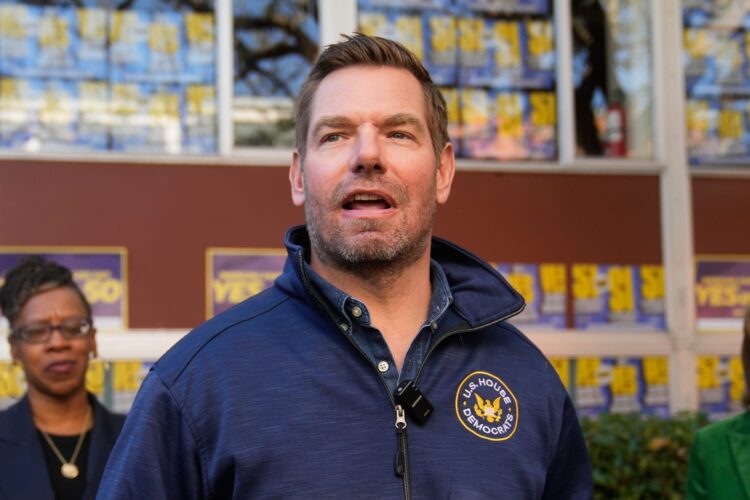
The abrupt collapse of a major gubernatorial campaign in California has sent political shockwaves far beyond the state’s borders, as allegations of sexual assault against Eric Swalwell forced one of the Democratic Party’s most recognisable figures to withdraw from the race to succeed Gavin Newsom.
What had been shaping up as a high-profile and competitive contest has instead become a defining moment in the ongoing reckoning over power, accountability, and personal conduct in American public life.
Swalwell’s decision to step down on Sunday came just 48 hours after detailed allegations were first reported by the San Francisco Chronicle and later amplified by CNN. The reports outlined claims from a woman who said she had been sexually assaulted by the congressman on two separate occasions—once in 2019, when she was working for him, and again in 2024. According to her account, both incidents occurred while she was too intoxicated to give consent.
The speed with which the campaign unravelled was striking. Within hours of the allegations gaining national attention, political allies began distancing themselves. By the end of the weekend, what had been a well-funded and strategically positioned campaign had become untenable. Swalwell, while forcefully denying the accusations, acknowledged that the controversy had eclipsed his candidacy.
“I will fight the serious, false allegations that have been made,” he said in a statement announcing his withdrawal. “But that’s my fight, not a campaign’s.”
Before the allegations emerged, Swalwell had been widely viewed as a formidable contender in the race to lead America’s most populous state. California’s governorship is not only a position of immense administrative power but also a national political platform, often seen as a springboard to presidential ambitions. With Newsom barred from seeking a third term, the race had drawn intense attention from across the রাজনৈতিক spectrum.
Swalwell’s credentials positioned him strongly. First elected to Congress in 2012, he represented a district east of San Francisco and built a reputation as a vocal figure on issues ranging from national security to judicial oversight. A former prosecutor in Alameda County, he frequently highlighted his law enforcement background as evidence of his commitment to justice and accountability.
His national profile rose significantly during his tenure in Congress, particularly through his involvement in high-profile investigations and his appearances on national media. In 2019, he launched a bid for the Democratic presidential nomination, seeking to present himself as a generational alternative within the party. Although that campaign ultimately failed to gain traction, it cemented his status as a recognised figure on the national stage.
By the time he entered the California gubernatorial race, Swalwell had assembled a coalition of donors, strategists, and endorsements that made him an early favourite. Among those backing him was Adam Schiff, a prominent Democrat whose support signalled establishment confidence in Swalwell’s candidacy. That support evaporated almost overnight.
Following the publication of the allegations, Schiff withdrew his endorsement and joined a growing chorus of Democratic figures calling for Swalwell to step aside. The speed of the reversal reflected both the seriousness of the accusations and the broader political environment, in which parties have become increasingly sensitive to allegations of sexual misconduct.
Newsom himself issued a carefully worded statement, emphasising the gravity of the situation. “As we continue to learn more, these allegations from multiple sources are deeply troubling and must be taken seriously,” he said, underscoring the extent to which the controversy had reverberated through California’s political leadership.
Meanwhile, Nancy Pelosi, one of the most influential figures in Democratic politics, indicated that the allegations warranted investigation outside the context of an active campaign. Her comments were widely interpreted as a signal that Swalwell’s position had become politically untenable.
Allegations and Investigations
At the centre of the unfolding crisis are the claims made by the woman whose account triggered the scandal. She told the Chronicle that she had not reported the alleged assaults at the time because she feared she would not be believed—a concern that has been echoed in numerous high-profile cases involving powerful individuals.
Her allegations describe two separate encounters, years apart, in which she says she was unable to consent due to intoxication. The inclusion of a more recent incident in 2024 added an immediate legal dimension to the case. Authorities in New York confirmed that the Manhattan District Attorney’s Office is investigating the alleged assault that reportedly took place there.
CNN’s reporting further intensified the situation by including accounts from additional women who accused Swalwell of other forms of sexual misconduct. While these claims vary in nature and have not all been substantiated, their cumulative effect has been to deepen the political and reputational damage.
Swalwell has categorically denied all allegations. His defence has centred on the assertion that the claims are false and politically motivated, though he has provided limited detail publicly as the investigation continues. The dual track of legal scrutiny and public opinion now places him in a precarious position, with the potential for long-term consequences regardless of the outcome.
The case also highlights the complex dynamics that often surround allegations of sexual misconduct involving powerful figures. Delayed reporting, questions of evidence, and the interplay between legal standards and public perception all contribute to the difficulty of reaching definitive conclusions in such cases. At the same time, the political ramifications can be immediate and irreversible.
Echoes Of Past Scandals
The downfall of Swalwell’s gubernatorial bid fits into a broader pattern that has reshaped American politics over the past decade. Allegations of sexual misconduct have brought down figures at the highest levels of government, demonstrating how quickly careers can unravel under the weight of such claims.
One of the most prominent recent examples is Andrew Cuomo, who resigned in 2021 after an investigation concluded that he had sexually harassed multiple women. Cuomo denied intentional wrongdoing, but the findings of the inquiry and the resulting political pressure made his position untenable. Like Swalwell, he initially attempted to remain in office before ultimately stepping down.
At the federal level, numerous members of Congress from both parties have faced accusations ranging from harassment to assault. Some have resigned, others have been defeated in elections, and a few have weathered the storm, illustrating the uneven consequences that can follow such allegations.
Historically, the issue is not new. Cases involving powerful men accused of exploiting their positions have surfaced repeatedly over decades, though the response has evolved significantly. The rise of movements such as #MeToo has shifted public expectations, increasing scrutiny and reducing tolerance for behaviour that might once have been overlooked or dismissed.
What distinguishes the current era is the speed and intensity with which allegations can transform a political landscape. In Swalwell’s case, the timeline from publication to withdrawal spanned just two days—a reflection of both the media environment and the heightened sensitivity within political parties.
Swalwell’s departure leaves a significant vacuum in the California gubernatorial race, reshaping the field and creating opportunities for other candidates to consolidate support. It also raises questions about vetting processes and the risks faced by parties when backing high-profile figures.
The episode for democrats is a reminder of the delicate balance between due process and political pragmatism. While the principle of “innocent until proven guilty” remains central to the legal system, the realities of electoral politics often demand quicker judgements. The decision by key figures to withdraw support suggests that the party viewed the allegations as too serious to ignore, regardless of their ultimate legal outcome.
The case may also have broader implications for how campaigns are conducted and how candidates are evaluated. Increased scrutiny of personal conduct, both past and present, is likely to remain a defining feature of modern politics. The challenge for voters lies in navigating complex and often incomplete information while making decisions about who should hold public office.
Swalwellis in uncertain territory. Even if he succeeds in defending himself against the allegations, the damage to his political career may prove difficult to repair. The history of similar cases suggests that once a campaign collapses under such circumstances, a return to prominence is rare.
Observers believe the findings of the Manhattan District Attorney’s Office, as well as any additional evidence that may emerge, will play a crucial role in determining the next phase of the story. Until then, the case exists in a state of unresolved tension, with legal, political, and personal dimensions all intertwined.
The fall of Eric Swalwell’s gubernatorial campaign is more than a single political story. It is part of a larger narrative about power, accountability, and the evolving standards to which public figures are held. It underscores how quickly fortunes can change and how allegations—whether proven or contested—can reshape careers and institutions alike.
In California, a race that once centred on policy and leadership has been abruptly redirected by questions of character and conduct. Nationally, the episode reinforces a pattern that has become increasingly familiar. The intersection of personal allegations and public office, where the stakes are measured not only in political outcomes but in broader societal expectations.
The consequences of this moment will extend well beyond a single campaign, influencing the trajectory of individuals, institutions, and the standards by which both are judged.
-
Share On
- Categories
- Date