
By James Simons-
Two priceless paintings by Pierre-Auguste Renoir have been stolen in a dramatic pre-dawn raid on the artist’s former home on the French Riviera, after thieves broke through a garden fence, stormed into the museum and fled as police closed in.
The alarm at the Renoir Museum in Cagnes-sur-Mer was triggered at 5.48am on Tuesday. Within minutes, police were at the scene. CCTV captured two intruders forcing their way into the museum and removing four paintings before attempting to escape.

AD: Capeesh Restaurant
The chase ended with two of the paintings being abandoned in the museum’s garden. The thieves managed to get away with the other two, leaving police with a crime scene at one of France’s most intimate artistic landmarks and two missing works whose value could run into millions.
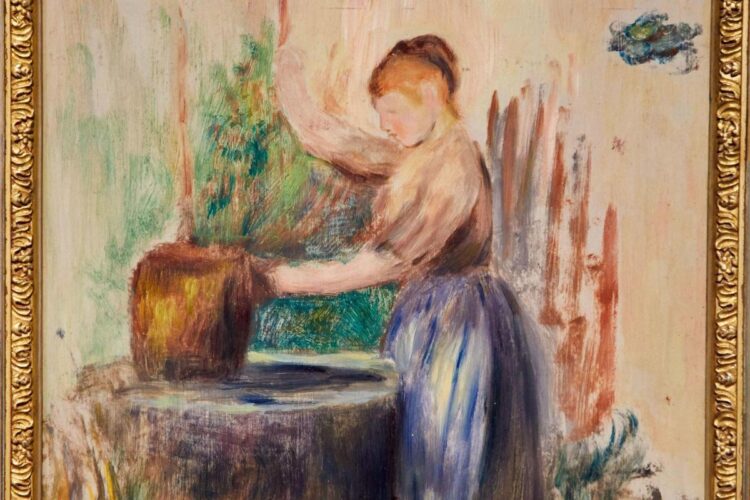
The identities of the stolen paintings have not been officially confirmed. Nice-Matin reported that the four works targeted were Portrait Of Madame Pichon, painted in 1895, Portrait Of Madame Colonna Romano from 1910, Coco Reading from 1905 and Young Woman At The Well, painted in 1886. The newspaper estimated their combined value at about $10.5m (£7.7m).
Whatever their final valuation, the paintings are far more than commodities. They are part of the legacy of one of the defining figures of Impressionism and were displayed inside the very house where Renoir spent the final years of his life.

AD: Oysterian Sea Food Restaurant And Bar
The museum stands in Cagnes-sur-Mer, near Nice, surrounded by the landscape that inspired Renoir after he moved to the region. He lived there during the later years of his career, continuing to paint despite severe arthritis, and died in the town in 1919.
The museum was opened in 1960 and today contains 13 Renoir paintings, together with around 40 sculptures, pieces of furniture and photographs.
Its importance lies not only in the artworks it contains but in the building itself: visitors can step into the surroundings where one of the world’s most celebrated painters lived and worked. Now, that historic setting has become a crime scene.
Town mayor Bryan Masson described the burglary as an attack on the heritage of Cagnes-sur-Mer.
“Attacking the museum is attacking a part of the history and heritage of Cagnes-sur-Mer,” he said, describing the raid as particularly serious.
The stolen paintings could prove almost impossible to sell openly. Christopher Marinello, chief executive of Art Recovery International, said works by an artist as famous as Renoir would be “very difficult to sell” because they are recognisable and would attract scrutiny from auction houses, dealers and collectors.
He said the thieves were unlikely to have acted on behalf of a specific collector and suggested the paintings could eventually be moved abroad, potentially towards Eastern Europe or Russia.
The museum’s location close to the Mediterranean could also make it easier for stolen works to be moved out of France, he warned.
The crime comes at a particularly troubling moment for Europe’s museums. Across the continent, police have warned of a new generation of art thieves who are less likely to resemble the sophisticated professional gangs of the past.
Europol said recently that specialist criminal networks are increasingly being replaced by loosely organised opportunists, including people recruited through social media. And some of the continent’s most spectacular museum robberies have demonstrated just how audacious those criminals can be.
Last October, thieves struck at the Louvre in Paris, threatening guards and visitors before escaping with jewellery worth around €88m (£76m). Among the stolen pieces were jewels associated with Empress Eugénie, wife of Napoleon III.
The robbery sent shockwaves through the international art world, not least because it took place inside one of the world’s most famous and heavily visited museums.
Then, last month, four Renaissance paintings by the 15th-century Italian master Antonello da Messina were stolen from a museum in Sicily during the country’s summer national holiday. The Renoir raid is smaller in scale but potentially just as damaging for the community whose history the museum represents.
Unlike a vast national institution such as the Louvre, the Renoir Museum occupies a historic former home. Its intimacy is part of its charm — but that same setting can present difficult security challenges when millions of pounds’ worth of art is kept behind historic walls and gardens.
The thieves appear to have exploited that vulnerability in the early hours, slipping through a hole in the outer fence before getting inside and taking four paintings.
Two were left behind during the escape. Two remain missing. Police and forensic specialists were examining the scene on Tuesday, including the breach in the museum’s perimeter. Investigators now face a race against time to establish how the thieves entered, where the paintings have gone and whether they had help.
Renoir’s paintings helped redefine the way the world saw colour, light and ordinary life. His work became synonymous with Impressionism, and paintings such as Dance at Le Moulin de la Galette, La Loge and La Parisienne now hang among the great works of European art.
At the Renoir Museum, that history is not simply displayed on a gallery wall. It surrounds visitors.And sometime before dawn on Tuesday, someone broke through the fence and walked away with a piece of it.

AD: Heritage And Restaurant Lounge Bar