
By Aaron Miller-
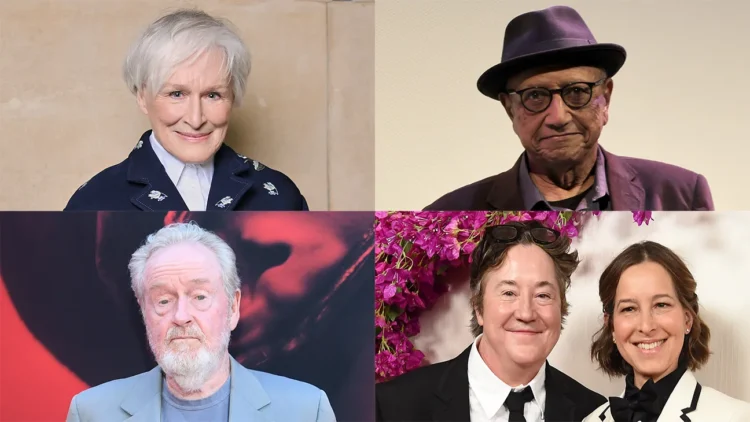
After decades of near-misses, record-setting nominations, and careers that helped define modern cinema, Glenn Close, Ridley Scott, and animator Floyd Norman will finally receive their long-awaited Academy Awards not in the heat of competition, but as honorary recipients.
The Academy of Motion Picture Arts and Sciences announced Wednesday that the three industry figures, along with producers Christine Vachon and Pamela Koffler, will be honored at the 2026 Governors Awards in November.

AD: Capeesh Restaurant
The recognition places them among a select group of filmmakers and artists whose contributions to cinema are considered so significant that the Academy awards them outside the traditional competitive Oscars race.
The announcement immediately reignited discussion around long-running Oscar narratives particularly for Close, who holds the distinction of being one of the most nominated actors in Academy history without a win.

Close’s nominations span a wide range of roles, beginning with her breakout film performance in The World According to Garp (1982) and continuing through acclaimed turns in Fatal Attraction (1987), Dangerous Liaisons (1988), and later The Wife (2017), reflecting a career of sustained critical recognition across several decades.

AD: Oysterian Sea Food Restaurant And Bar
Despite earning eight Academy Award nominations, she has not secured a competitive Oscar win, a distinction frequently noted in film reference accounts of her career.
Through multiple films, Close has also achieved major recognition in other performance arenas, including multiple Tony Awards for her stage work and Emmy Awards for television, underscoring her versatility and longevity across theatre, television, and film.
The Academy’s statement accompanying the announcement described Close’s work as defined by “unparalleled emotional range,” noting her ability to bring complex, often morally ambiguous characters to life across decades of film making.
Ridley Scott’s inclusion carries a different but equally significant weight. The British director has spent more than 40 years shaping blockbuster cinema with films that helped define visual storytelling in Hollywood and beyond. Alienand Blade Runner to Thelma & Louise and Gladiator, Scott’s work has influenced generations of filmmakers and continues to dominate contemporary film aesthetics.
Despite four competitive Oscar nominations, Scott has never won an Academy Award. His honorary recognition, therefore, reflects a career that has consistently shaped the language of modern cinema without receiving its highest competitive prize.
With Floyd Norman, the honour represents recognition not only of artistic achievement but also of historical significance. Norman, now in his 90s, was the first Black animator to work regularly at Walt Disney Animation Studios. His career spans more than six decades, with contributions to landmark films such as Sleeping Beauty, The Jungle Book, Mulan, and Toy Story 2.
His work has often been cited as foundational in diversifying the animation industry, and his presence in Disney’s early production teams marked a quiet but important shift in Hollywood’s creative workforce during the mid-20th century.
The Academy will also present the Irving G. Thalberg Memorial Award to producers Christine Vachon and Pamela Koffler, founders of Killer Films, whose body of work includes influential independent titles such as Boys Don’t Cry and Carol. Their inclusion highlights the Academy’s continued effort to recognize independent filmmaking alongside mainstream studio achievement.
Taken together, the honourees reflect a broad cross-section of cinematic history from blockbuster auteurs to independent producers and animation pioneers.
The honours will be presented at the Governors Awards on November 15, 2026, a ceremony that traditionally takes place ahead of the Oscars season and serves as a quieter counterpart to the televised Academy Awards ceremony.
The Governors Awards, established in 2009, are designed specifically to recognise lifetime achievement and extraordinary contributions to film, often honouring individuals whose influence far exceeds their competitive Oscar record.
The announcement has already reignited discussion about what it means to be “Oscar-worthy” in an industry where competition is often as much about timing, campaigning, and category dynamics as it is about legacy.
The meaning of an honorary Oscar in a changing industry
The honorary Oscar is not a consolation prize in any formal sense, but in practice it often functions as a long-delayed acknowledgement of careers that the Academy believes have already reshaped cinema. Historically, recipients have included performers and filmmakers whose influence was widely recognised but whose competitive Oscar journeys ended in repeated near-misses or category congestion.
In Close’s case, the symbolism is unavoidable. She shares the record for most acting nominations without a win, a distinction that has followed her through decades of awards seasons and repeated Oscar campaigns. That narrative has turned her into something of a perennial presence in Academy conversations a performer whose absence from the winner’s circle has become as notable as her performances themselves.
Scott’s career similarly sits at the intersection of critical acclaim and competitive omission. His films have won multiple Oscars across categories such as production design, visual effects, and cinematography, yet he has never personally received a competitive win as a director.
The Academy Honorary Award itself is often used to recognise exactly these kinds of contributions. It is awarded for “extraordinary distinction in lifetime achievement” or “outstanding service to the motion picture arts and sciences,” according to the Academy’s own definition.
In recent years, the Governors Awards have increasingly become a venue for correcting historical omissions or acknowledging careers that were previously overlooked in competitive voting. Past recipients have included actors, directors, composers, and behind-the-scenes professionals whose work shaped cinema but did not always translate into Oscar wins.
Recent ceremonies have similarly reflected a mix of legacy recognition and industry reflection. In 2025, the Academy honoured figures including Tom Cruise, Debbie Allen, and Wynn Thomas, underscoring a growing emphasis on acknowledging long-term cultural influence rather than single-year achievements.
The 2026 honourees continue that pattern, reinforcing the idea that the Academy’s understanding of achievement is increasingly shaped by historical impact rather than annual competition alone.The announcement highlights an ongoing tension within the Oscars ecosystem: the difference between recognition and victory, between institutional honour and competitive success.
The honorary statuette for Close, Scott and Norman symbolises recognition and contradiction, embodying a connection to Oscar history without ever being entirely characterised by Oscar victories.
The Governors Awards will give them something the competitive Oscars never did: a moment outside the pressure of a campaign, a season, or a race. And for an industry built on both memory and myth, that distinction may be the most meaningful award of all.

AD: Heritage And Restaurant Lounge Bar