
By Charlotte Webster-
As climate change drives more frequent and intense weather events, cities around the world are increasingly turning to artificial intelligence (AI) to predict floods before they occur, giving emergency services valuable extra time to protect communities, infrastructure and lives.
Once viewed as an emerging technology with limited practical application, AI is now becoming a critical tool in disaster management as governments seek smarter ways to prepare for increasingly unpredictable weather patterns.

AD: Capeesh Restaurant
Across Europe, Asia and North America, municipal authorities are investing in AI-powered forecasting systems capable of analysing enormous volumes of weather, river, satellite and infrastructure data in real time. These systems can identify subtle changes in rainfall, drainage networks and water levels that may signal an impending flood, often hours before traditional forecasting methods would issue a warning.
The growing adoption of AI reflects a broader shift in how governments are approaching climate resilience. Rather than relying solely on historical weather records and conventional hydrological models, emergency planners are integrating machine learning algorithms capable of continuously adapting as new information becomes available. The result is a forecasting process that becomes more accurate over time, improving its ability to identify emerging risks.
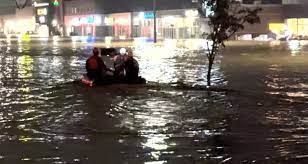
Experts say the technology is particularly valuable in urban environments, where heavy rainfall can overwhelm drainage systems within minutes. Unlike rivers, which often rise gradually, flash floods in densely populated cities can develop with little warning, leaving motorists stranded, damaging homes and disrupting public transport before authorities have sufficient time to respond.

AD: Oysterian Sea Food Restaurant And Bar
Artificial intelligence helps bridge that gap by processing thousands of data points simultaneously. Weather radar, rainfall gauges, river sensors, satellite imagery, traffic cameras and even information from connected infrastructure can all be analysed together, creating a comprehensive picture of conditions across an entire city. When the system detects patterns consistent with previous flooding events, automated alerts can be issued to emergency responders, local authorities and, in some cases, directly to residents through mobile applications.
Several cities have already reported encouraging results. Local authorities using AI-assisted forecasting have been able to deploy flood barriers earlier, redirect traffic away from vulnerable roads and evacuate at-risk neighbourhoods before floodwaters reached dangerous levels. Although the technology cannot prevent flooding itself, supporters argue that every additional minute of warning significantly reduces the potential for injury, property damage and disruption.
Climate scientists have long warned that warmer atmospheric temperatures allow the air to hold more moisture, increasing the likelihood of intense rainfall events. Many urban drainage systems were designed decades ago for weather conditions that are becoming increasingly rare. As a result, cities are experiencing flooding from storms that previously would have posed little threat.
Insurance companies are also paying close attention to the development of predictive technologies. Flooding remains one of the most expensive natural disasters globally, with annual losses running into billions. More accurate forecasting not only enables emergency planning but may also improve long-term risk assessment, allowing insurers to better understand changing patterns of exposure.
The financial implications extend beyond insurance. Businesses forced to close because of flooding often suffer significant economic losses, while transport disruptions can affect regional supply chains and commuter networks. Airports, rail operators and utility providers are therefore exploring ways to incorporate predictive analytics into their own resilience planning.
Despite the enthusiasm surrounding AI, specialists caution that the technology should complement, rather than replace, experienced meteorologists and emergency planners. Forecasting remains inherently uncertain, particularly when weather systems evolve rapidly. Human expertise continues to play a vital role in interpreting model outputs, validating unusual results and making operational decisions during emergencies.
One challenge lies in ensuring the quality of the data feeding AI systems. Machine learning models are only as reliable as the information they receive. Faulty sensors, incomplete historical records or inaccurate rainfall measurements can reduce forecasting accuracy. For that reason, many local authorities are investing not only in software but also in modernising monitoring infrastructure, including additional river gauges, weather stations and remote sensing equipment.
Another consideration is public trust. Emergency alerts are effective only if people believe them and act accordingly. Authorities therefore face the challenge of balancing early warnings with the risk of false alarms. Frequent warnings for floods that never materialise could lead to warning fatigue, reducing public willingness to respond during genuine emergencies. Developers are working to refine prediction models so that alerts are both timely and sufficiently reliable to maintain confidence.
Privacy considerations have also entered the discussion. Some advanced systems incorporate information gathered from traffic networks, connected vehicles or mobile devices to estimate population movements during severe weather. While this data can help emergency responders understand where people may be at greatest risk, civil liberties groups argue that robust safeguards are needed to ensure personal information is protected and used only for legitimate public safety purposes.
The rapid expansion of AI has also prompted debate over access and inequality. Wealthier cities with larger budgets are generally better positioned to deploy sophisticated forecasting systems, while smaller municipalities may struggle to finance the necessary technology or specialist expertise. Researchers have called for greater collaboration between governments, universities and technology companies to ensure that advances in predictive modelling benefit communities regardless of their financial resources.
Developing nations could stand to gain significantly from improved forecasting. In many parts of the world, floods remain among the deadliest natural hazards, particularly where warning systems are limited or emergency infrastructure is underdeveloped. Affordable AI tools that utilise satellite observations and publicly available weather data may provide a practical means of strengthening disaster preparedness without requiring extensive physical infrastructure.
Environmental organisations argue that adaptation technologies must not distract from efforts to reduce greenhouse gas emissions. While AI can improve resilience, it does not address the underlying drivers of climate change. Scientists continue to emphasise that reducing emissions remains essential if the long-term frequency and severity of extreme weather events are to be limited.
Technology companies are increasingly responding to demand by developing specialised climate intelligence platforms tailored to local governments. Many systems are capable not only of forecasting floods but also of predicting landslides, heatwaves, coastal storm surges and wildfire risk. The convergence of satellite technology, cloud computing and artificial intelligence has dramatically expanded the range of information available to decision-makers.
Universities are likewise contributing to innovation through collaborative research projects involving engineers, meteorologists and computer scientists. These multidisciplinary efforts seek to improve both forecasting accuracy and the interpretability of AI models. One longstanding criticism of machine learning has been its tendency to produce predictions without clearly explaining how conclusions were reached.
Researchers are therefore developing more transparent systems capable of providing understandable explanations alongside forecasts, enabling emergency managers to assess confidence levels before taking action.
Public awareness is expected to become increasingly important as forecasting technology evolves. Emergency agencies are encouraging residents to familiarise themselves with local flood plans, understand warning messages and prepare emergency kits well before severe weather occurs. Experts stress that even the most advanced prediction system cannot eliminate all risk, particularly where storms intensify unexpectedly.
Looking ahead, artificial intelligence is likely to become a standard component of urban disaster management rather than a specialist innovation. As climate pressures continue to grow and cities expand, authorities will require faster, more detailed and more accurate information to protect increasingly complex infrastructure networks and densely populated communities.
The technology is unlikely to offer perfect predictions, and significant challenges remain in data quality, funding, governance and public confidence. Nevertheless, the direction of travel is becoming increasingly clear. Artificial intelligence is moving beyond experimental research and into frontline emergency planning, where its ability to process vast amounts of information in seconds is providing authorities with a valuable new tool in the effort to reduce the human and economic impact of flooding.

AD: Heritage And Restaurant Lounge Bar