
By Lucy Caulkett-
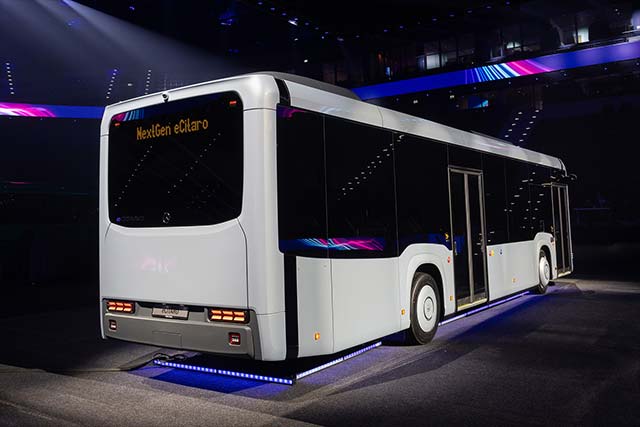
Daimler Buses is preparing to introduce an entirely new generation of the Mercedes-Benz eCitaro in 2028, marking a significant step in its transition towards fully electric urban public transport.
Designed as a battery-electric vehicle from the ground up, rather than adapted from an existing diesel-powered platform, the next-generation bus promises improved efficiency, reduced weight, greater operational flexibility and new technology aimed at meeting the evolving demands of European transport operators.

AD: Capeesh Restaurant
The announcement signals a major development in Daimler Buses’ electrification strategy, as manufacturers face growing pressure to deliver commercially viable zero-emission vehicles capable of meeting the operational demands of increasingly diverse public transport networks. The new eCitaro will succeed the current model, which was developed from the company’s established Citaro platform, and represents a more fundamental redesign around electric propulsion.
At the heart of the new vehicle will be lithium iron phosphate (LFP) battery technology, reflecting the manufacturer’s focus on developing a dedicated electric architecture. Standard-length versions will be equipped with between six and 12 energy storage packs, while articulated models will accommodate between eight and 14 packs.
This configuration is intended to provide operators with greater flexibility when specifying vehicles according to route requirements, passenger demand and operational conditions.

AD: Oysterian Sea Food Restaurant And Bar
One of the most significant developments is the introduction of two distinct electric drive concepts, allowing Daimler Buses to tailor the vehicle’s configuration to different transport applications. The low-floor version will feature electric motors positioned close to the wheels, creating a completely level passenger floor extending to the rear of the vehicle. This arrangement is particularly relevant for urban operations, where accessibility, passenger movement and efficient boarding are essential considerations.
Alongside the conventional low-floor configuration, Daimler Buses will introduce a low-entry version designed to extend the eCitaro’s appeal beyond traditional city bus operations. This variant will use a centrally positioned electric motor and offer maximum speeds of up to 62mph, making it suitable for interurban services and routes involving longer distances or higher operating speeds.
The addition of a low-entry configuration represents an important expansion of the eCitaro concept. While battery-electric buses have become increasingly established in urban transport, extending their capabilities to interurban operations presents different engineering and operational challenges.
Daimler Buses says the drive system will be specifically adapted to the individual vehicle variant and its intended operating profile, allowing transport operators to select a configuration better suited to their service requirements.
Weight reduction will also play an important role in the new generation. By designing the vehicle consistently around its electric drivetrain, rather than adapting an existing platform, Daimler Buses expects to achieve significant improvements in overall vehicle efficiency.
The manufacturer estimates that the articulated eCitaro will weigh approximately 750kg less than its predecessor. Reducing vehicle weight can help improve energy efficiency and potentially provide additional flexibility in passenger and operational specifications.
The next-generation model will also introduce a new electronic architecture designed to support over-the-air software updates and the subsequent activation of optional vehicle functions. This will give operators greater scope to update vehicle systems remotely and potentially introduce additional capabilities throughout the vehicle’s operational life, reducing the need for certain software-related workshop interventions.
The announcement comes as Daimler Buses reinforces its longer-term commitment to eliminating combustion-engine vehicles from its European city bus sales portfolio. The company has reiterated that from 2030 it intends to offer only electrically powered buses in its European city bus range.
This represents a substantial strategic commitment, particularly given the scale of the European bus market and the infrastructure investment required to support widespread electrification.
Daimler Buses has already established a significant presence in the electric bus sector. Since 2018, the company has delivered more than 4,600 eCitaro vehicles across Europe, including to several operators in the United Kingdom.
That experience provides an important foundation for the next generation, particularly as transport authorities and operators increasingly assess the long-term financial and operational implications of transitioning their fleets to zero-emission technologies.
Production of the new eCitaro will continue across Daimler Buses’ established manufacturing locations in the Czech Republic, France and Germany. The decision reflects the company’s intention to maintain its European industrial footprint while developing its electric vehicle manufacturing capabilities.
Daimler Buses chief executive Till Oberwörder has emphasised the importance of retaining industrial value creation within Europe, while also calling on the European Union to establish conditions that allow manufacturers to remain internationally competitive.
The issue highlights a wider challenge facing Europe’s commercial vehicle industry. Although manufacturers are investing heavily in electrification, battery technology and advanced vehicle architectures, they must also contend with manufacturing costs, global competition, supply-chain pressures and the significant investment required to transform production facilities.
Commenting on the significance of the company’s direction, Daimler Buses CEO Till Oberwörder said:: “We are clearly committed to our business locations in Europe, but the European Union must create the right conditions to ensure that industrial value creation here remains competitive.”
A spokesperson for Daimiler buses said to The Eye of Media: ”The new eCitaro will form part of a broader electric vehicle strategy that extends beyond conventional urban buses. It will sit alongside the high-floor eIntouro, developed for interurban applications, while Daimler Buses has also reaffirmed its ambition to introduce battery-electric touring coaches before 2030.
‘Taken together, these developments demonstrate the company’s intention to extend battery-electric technology across an increasingly broad range of passenger transport applications, from dense urban networks to interurban services and, ultimately, long-distance touring operations’.
”The arrival of the next-generation eCitaro in 2028 will represent more than a product replacement. It will be an important test of how far dedicated electric vehicle engineering can improve the efficiency, versatility and commercial appeal of zero-emission public transport, as Daimler Buses moves towards its 2030 European city bus commitment”.

AD: Heritage And Restaurant Lounge Bar