
By Theodore Brown-
Emergency responders were initially told that a call for medical assistance at a Tennessee prison was false after Christa Pike survived two doses of lethal-injection drugs, with recordings revealing confusion that delayed their entry into the facility.
Emergency medical assistance for death row inmate Christa Pike was delayed by confusion between emergency dispatchers and Tennessee prison officials after a failed execution attempt on 30 September, according to newly released 911 recordings obtained by The Associated Press. The recordings reveal that officials spent precious minutes trying to establish whether a request for urgent medical assistance inside Riverbend Maximum Security Institution was genuine, despite reports that Pike was unconscious and struggling to breathe normally.
The first emergency call was made at approximately 8:40 p.m., just over an hour after the attempted lethal injection began. The caller, whose name and position were redacted from the released transcript, told dispatchers that the state had attempted to execute a prisoner but that she remained alive. However, the caller could not provide the verification code required to authenticate the request, triggering confusion among emergency personnel and prison officials.
At 9:03 p.m., a dispatcher stated that supervisors had classified the call as false, saying: “There is no medical assistance needed at Riverbend Prison.” The situation remained unresolved as responders attempted to establish contact with prison personnel and determine whether they were authorised to enter the facility.
It was not until approximately 9:11 p.m. that prison officials confirmed the request was legitimate and began allowing emergency responders through the gates. An Associated Press reporter witnessed an ambulance and fire trucks arriving at the relevant building inside the prison grounds at 9:14 p.m. The recordings raise serious questions about communication procedures during a medical emergency inside a high-security correctional facility.
The recordings show that the initial uncertainty persisted even after emergency personnel sought clarification directly from the prison. At approximately 9:07 p.m., representatives of the institution’s Central Control reportedly told responders they would normally have been responsible for making such a call but had not done so.
Meanwhile, a first responder could be heard over the radio describing a person waiting outside the prison gates who insisted that the emergency was genuine and demanded entry. The individual claimed to be a state official, prompting the responder to request that someone go to the gate to speak with those present.
The conflicting information created a dangerous communication gap at a moment when Pike reportedly required immediate medical attention. Central Control eventually confirmed the call’s legitimacy, clearing the way for emergency crews to enter.
The confusion continued even after Pike was being transported to hospital. At 9:34 p.m., a medic asked dispatchers to ensure prison officials knew where she was being taken, explaining that there had already been considerable confusion. The request underscored the continuing need for clear communication between correctional authorities and emergency services.
Pike Survived Two Doses of Lethal-Injection Drugs
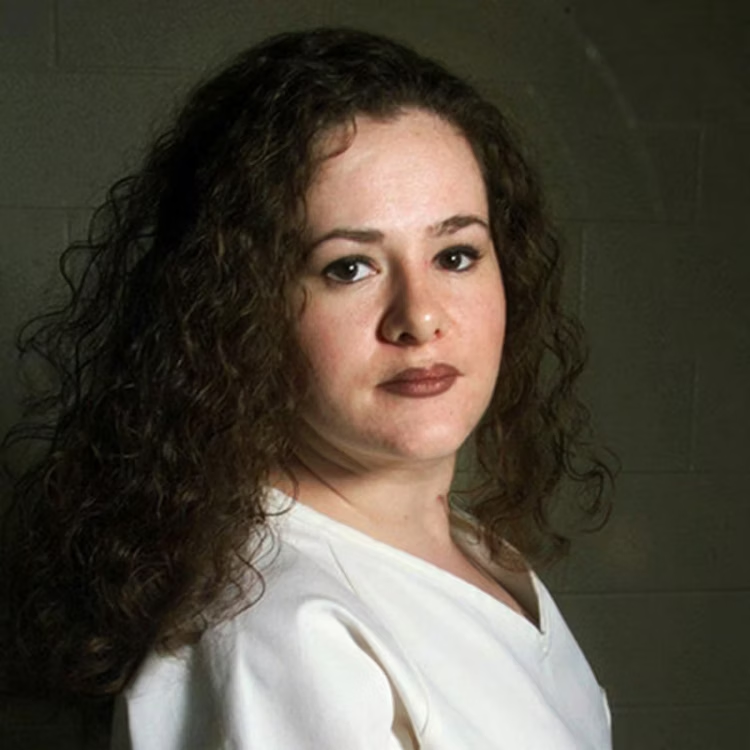
Pike, 50, was hospitalised after surviving two doses of pentobarbital, the drug used in Tennessee’s lethal-injection protocol. She was sentenced to death for the 1995 stabbing murder of her classmate, Colleen Slemmer, whom she tortured and killed alongside her boyfriend when she was 18. Her case made her one of the youngest women sentenced to death in the United States.
Under Tennessee’s protocol, a second dose of pentobarbital may be administered if the first fails to cause death. However, the procedure does not specify what officials should do if an inmate survives the second injection, leaving an apparent gap in guidance for an extraordinary medical situation.
The first 911 call, released only as a written transcript, described Pike as unconscious and not breathing normally. Her attorney, Kelly Gleason, made a separate emergency call at 9:08 p.m., stressing that her client had completed the stages of the execution protocol but remained alive and breathing.
“My client, Christa Gail Pike, is undergoing a state execution,” Gleason told the dispatcher. She added that, according to an attorney present at the prison, Pike needed immediate life-saving care.
Pike was placed on a ventilator for several days after being taken to hospital. Her attorneys initially feared she might not survive. However, they later reported that she regained consciousness on the Tuesday following the attempted execution and began speaking in limited terms and walking with assistance.
According to her legal team, Pike was subsequently discharged from hospital and returned to the women’s prison where she had been incarcerated for approximately three decades. Her recovery has added another extraordinary dimension to a case that has raised questions about both the execution procedure and the state’s response when the process failed.
The Tennessee Department of Emergency Communications released several recordings with redactions following a public records request. The audio of the initial 911 call itself was withheld, with police citing an exemption under state law. Neither the Tennessee Department of Correction nor Pike’s legal team immediately responded to requests for comment on the newly disclosed recordings.
Further Executions Suspended Pending Review
Tennessee Governor Bill Lee has paused further executions while the state reviews what went wrong. The Department of Correction has not publicly established the cause of the failed procedure, and it remains unclear whether authorities will attempt to execute Pike again.
Medical experts have raised possible explanations for her survival, including problems with the quality of the drugs or the placement of intravenous lines, which could cause the medication to collect in surrounding tissue rather than enter the bloodstream as intended. Before the execution attempt, Pike’s attorneys had warned courts and prison officials that she suffered from a blood disorder that could cause clotting at injection sites.
These possibilities have not been established as the cause of the failure. Determining what happened will require a detailed examination of the drugs, medical procedures, execution records and emergency response.
The recordings have shifted attention beyond the failed injection itself to the state’s handling of the aftermath. Even as Tennessee examines why the execution did not result in death, the delay in obtaining emergency assistance raises a separate question about whether officials were adequately prepared to respond when the procedure produced an unexpected medical crisis.
The central issue is whether Tennessee’s execution protocols provide clear instructions for every stage of the process, including the possibility that an inmate survives the administered drugs and requires urgent treatment. Until the review establishes what went wrong and whether safeguards failed, questions will remain about the adequacy of the state’s procedures, the coordination between prison officials and emergency services, and the steps needed to prevent similar confusion in the future.