
By Ben Kerrigan-
SpaceX’s Starship has reached Earth orbit for the first time, marking a major milestone in the development of the enormous spacecraft and its ambitions for future Moon and Mars missions.
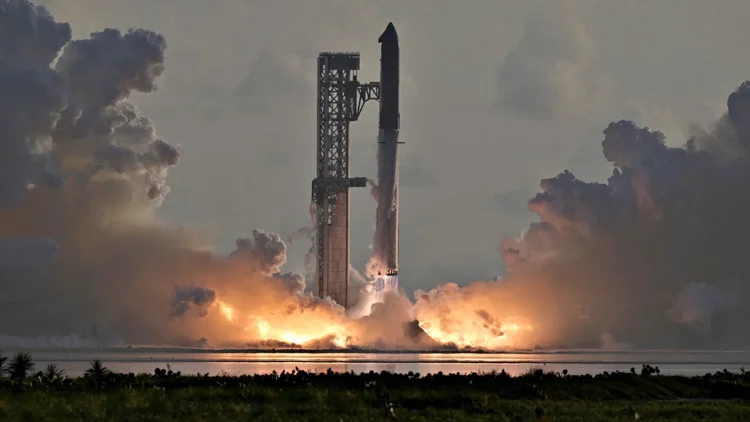
The uncrewed vehicle lifted off from SpaceX’s Starbase facility in South Texas on Monday, September 28, during the company’s 14th integrated flight test. The mission was designed to push Starship beyond its previous test flights by sending the spacecraft into orbit and deploying satellites i

AD: Capeesh Restaurant
Although the flight did not proceed entirely according to plan, Starship successfully achieved orbital flight and deployed 26 next-generation Starlink V3 satellites. The achievement represents a significant step in SpaceX’s effort to develop a fully reusable launch system capable of carrying people and cargo into Earth orbit and, eventually, to the Moon and Mars.
Dramatic moments after liftoff
The nearly 400-foot-tall Super Heavy-Starship vehicle blasted away from Starbase at about 8:49 a.m. Eastern Time, powered by the Super Heavy booster’s 33 Raptor engines.

AD: Oysterian Sea Food Restaurant And Bar
The launch initially appeared to proceed as planned. However, one of Starship’s six upper-stage engines shut down during the ascent. The unexpected engine failure created uncertainty over whether the spacecraft would be able to continue toward orbit.
Flight controllers nevertheless decided to proceed with the mission. Starship continued its climb and eventually performed the orbital insertion burn needed to enter Earth orbit.
The decision demonstrated the importance of flight testing for SpaceX. Rather than simply proving that Starship can launch, the company is gathering information about how the vehicle behaves when individual systems do not perform exactly as expected.
One of the most important objectives of Flight 14 was to demonstrate that Starship could become an operational orbital launch vehicle.
During the mission, the spacecraft deployed 26 Starlink V3 satellites. These satellites represent the next generation of SpaceX’s Starlink communications network and provided an opportunity to test Starship’s ability to carry and release useful payloads in orbit.
This capability is central to SpaceX’s long-term plans. A reusable Starship could eventually transport large numbers of satellites, scientific instruments and other spacecraft into orbit at a scale beyond what is practical with many existing launch vehicles.
From testing to the Moon
Starship’s importance extends beyond commercial satellite launches.
NASA is working with SpaceX on a version of Starship intended to serve as a human lunar lander for the Artemis program. NASA says the Starship Human Landing System is being developed to transport astronauts to the lunar surface, including missions targeting the Moon’s Sou
Before Starship can safely carry astronauts, however, SpaceX must demonstrate numerous technologies, including reliable launches, orbital operations, heat-shield performance, landing systems and the transfer of propellant between spacecraft. Orbital flight is therefore an important step in a much longer development process.
A mission that was cut short
Despite reaching orbit, Flight 14 was not a perfect demonstration. The engine shutdown forced SpaceX to alter its original mission plan. The spacecraft did not complete the approximately six orbits initially envisioned. Instead, engineers brought Starship back toward Earth after a shorter orbital mission.
Starship subsequently completed its atmospheric re-entry and returned to the ocean, providing engineers with additional data about the spacecraft’s performance.
For SpaceX, such imperfections are an expected part of an experimental flight program. Previous Starship missions have progressively tested more advanced capabilities. On Flight 13 in July, for example, Starship successfully deployed 20 Starlink V3 satellites, demonstrated an in-space engine relight and completed a controlled splashdown in the Indian Ocean.
Monday’s achievement does not mean Starship is ready for routine commercial or crewed missions. The vehicle remains under development, and SpaceX must demonstrate greater reliability and repeat the orbital mission profile before Starship can become a regular launch system.
Nevertheless, reaching orbit for the first time changes the significance of the program. SpaceX has now moved Starship beyond its earlier suborbital demonstrations and into a new phase of testing involving extended orbital flight and satellite deployment. Flight 14 represents a crucial moment for a company seeking to transform Starship into a reusable transportation system for Earth orbit, the Moon and eventually Mars, Flight 14 represents a crucial moment.
The spacecraft still has major challenges ahead, but for the first time, Starship has crossed the boundary from an experimental vehicle attempting to reach space to a spacecraft that has successfully reached orbit.

AD: Heritage And Restaurant Lounge Bar