
By Theodore Brown-
Entire communities have been torn apart, families are searching desperately for missing relatives and hundreds of bodies have been recovered after catastrophic flash floods swept through Nepal’s Himalayan valleys, leaving a trail of destruction across one of the country’s most vulnerable regions.
The disaster, which began on Wednesday, 26 August, has become one of Nepal’s deadliest natural disasters in years. Authorities said on Saturday that at least 669 people had died in Nepal, while seven more deaths were reported across the border in Tibet.

AD: Capeesh Restaurant
Nearly 3,000 people remained missing, although officials cautioned that the figures were continuing to change as rescue teams reached previously inaccessible areas. The scale of the disaster has been difficult to comprehend.
Mountain villages have been buried beneath mud and debris. Roads and bridges have disappeared. Hydropower facilities have been devastated. Communications have been disrupted, leaving families unable to establish whether relatives, friends and colleagues are alive.
And as rescuers continue their work, there are fears that the final death toll could rise considerably.The flooding struck communities along the Bhote Koshi and Trishuli river corridors, after an enormous surge of water was unleashed following an ice and rock avalanche in the high Himalayas.

AD: Oysterian Sea Food Restaurant And Bar
The event caused a sudden and violent increase in river levels, sending water, boulders, mud and debris racing through settlements below. What made the disaster particularly deadly was its speed.
There was little time for people living in narrow mountain valleys to escape. Buildings were destroyed and vehicles were swept away. In some places, the floodwaters carried debris with such force that entire sections of communities were transformed within minutes.
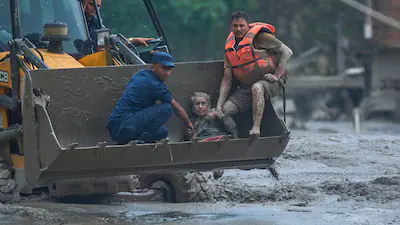
Survivors found the first hours terrifying. Some escaped by climbing onto higher ground or scrambling onto heavy machinery. Others were rescued by helicopters after becoming stranded in isolated areas. More than 7,500 people had been rescued in Nepal, according to figures reported by ABC News, including hundreds of foreign nationals.
But thousands of families remain trapped in uncertainty.At hospitals in Kathmandu, relatives have searched lists of survivors and photographs of the missing, hoping to find some indication that loved ones have survived. In some cases, families have lost several members at once.
The humanitarian tragedy extends far beyond the immediate number of deaths. UNICEF has warned that at least 17,000 children have been affected by the floods.
Children and families need clean water, sanitation, hygiene supplies, shelter and medical assistance, while damaged roads and communications networks are making it difficult to reach some of the worst-hit communities. UNICEF has appealed for $17.2 million to support the emergency response and early recovery.
The destruction has also struck Nepal’s crucial infrastructure.
At least 19 bridges and around 40 kilometres of roads were reported destroyed or swept away during the flooding. Hydropower projects, vital to Nepal’s economy and electricity supply, have suffered severe damage. Reuters reported that damaged power projects represent more than 12% of the The economic consequences could be enormous.
Nepal’s Finance Minister, Swarnim Wagle, said the country may require between $4 billion and $5 billion to rebuild — an amount approaching one-tenth of Nepal’s economy. The disaster therefore represents not only a humanitarian emergency but a potentially profound economic setback for a country heavily dependent on tourism, remittances and hydropower.
Yet the immediate priority remains finding survivors.
More than 13,000 personnel have been involved in rescue operations, according to recent reporting, with military helicopters being used to reach isolated communities. Search teams are concentrating on locations where workers and residents may still be trapped beneath collapsed structures or inside tunnels.
One of the most difficult locations is a hydropower project along the Trishuli corridor. Hundreds of workers were reportedly unaccounted for, raising fears that people could remain trapped in mud-filled tunnels or buildings. The international dimension of the disaster has also become increasingly apparent.
Among those reported missing are foreign tourists, pilgrims and workers from numerous countries. Many people had been travelling through the Himalayan region, including pilgrims making journeys towards Mount Kailash. Britain, India, the United States, Australia, Malaysia and several other countries have reported citizens missing
India has been particularly affected, with hundreds of its nationals reported missing in the aftermath of the disaster. The situation has prompted governments to work with Nepalese authorities as families seek information about relatives who travelled to the region.
Meanwhile, rescuers face another frightening possibility: further flooding. A newly formed lake in the Himalayan region has been closely monitored because a sudden release of its water could send another destructive surge downstream. Rescue operations were temporarily disrupted because of fears that conditions remained unsafe.
Scientists and disaster experts are also examining what the catastrophe reveals about the changing Himalayan environment.
The initial flood appears to have been connected to an ice-rock avalanche and sudden release of water into the river system. Researchers have warned that rising temperatures are destabilising glaciers and high-altitude landscapes, potentially increasing the danger of sudden floods and landslides in the Himalayan region.
Nepal has already experienced substantial glacier ice loss over recent decades. That does not mean climate change alone caused this particular disaster. The precise chain of geological and hydrological events is still being investigated.
But the tragedy has renewed attention on a growing danger: a warmer and increasingly unstable high-mountain environment can create hazards far downstream, where millions of people live, work and travel.
Behind every number is a family waiting for an answer.Every recovered body represents a person whose life ended in the sudden violence of the flood.
Every missing-person photograph represents someone whose relatives are still hoping that the next helicopter, hospital list or rescue operation will bring news. In villages where homes once stood beside rivers, residents are beginning to confront the possibility that there may be little left to return to.
The immediate emergency will eventually give way to a long and difficult recovery. Roads will have to be rebuilt. Bridges reconstructed. Power stations repaired. Homes replaced. Hospitals and schools restored. Families will have to rebuild their livelihoods while mourning those who will never return.
The financial cost will be measured in billions. The human cost cannot be measured so easily. Nepal’s mountains have long drawn visitors from around the world with their extraordinary beauty and scale. But this week, those same mountains have demonstrated another reality: in an instant, rivers fed by the Himalayas can become forces capable of destroying everything in their path.
As rescuers continue searching through mud, wreckage and collapsed infrastructure, the country waits for answers.The search for thousands of families is not simply for survivors.It is a search for the missing pieces of their lives.

AD: Heritage And Restaurant Lounge Bar
-
Share On
- Categories
- Date