
By Aaron Miller-
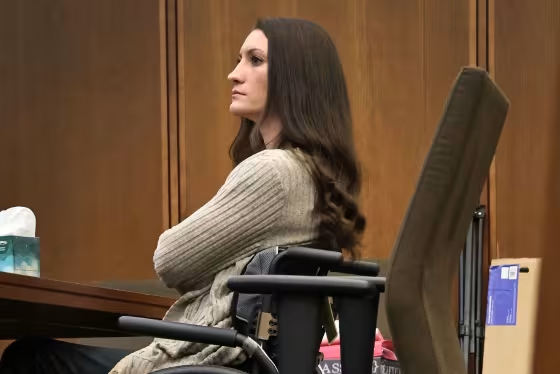
Closing arguments have ended in the murder trial of Lindsay Clancy,(pictured) the Massachusetts mother accused of killing her three young children before attempting to take her own life in January 2023. The case now moves to the jury, which must decide whether Clancy was legally responsible for the deaths of Cora, 5, Dawson, 3, and Callan, 8 months, or whether severe mental illness prevented her from understanding the wrongfulness of her actions.
Supporters of the defendant have filled the pews inside a Plymouth courtroom every day for the last few weeks, keeping track of every aspect of the trial and providing moral support to Clancy and her parents, who have been regular attendees of this gripping trial. At the center of the five-week trial has been Clancy’s mental state. Her defense attorney, Kevin Reddington, has argued that she was suffering from postpartum psychosis and was compelled by a hallucinated voice when she strangled her children. The defense has relied heavily on the testimony of forensic psychiatrist Dr. Phillip Resnick, who told jurors that Clancy was psychotic at the time of the killings. Reddington argued that the prosecution failed to establish beyond a reasonable doubt that she understood what she was doing.

AD: Capeesh Restaurant
Yesterday, (Wednesday 26th August) An FBI psychiatrist, Dr Gregory Saathoff, testified in court in Plymouth that he did not believe Clancy’s account that she heard a voice ordering her to kill the children – five-year-old Cora, three-year-old Dawson and eight-month-old Callan – as her defense team maintains that this occurred while she was suffering from the relatively rare condition of postpartum psychosis.
Prosecutor Jennifer Sprague asked Saathof whether he believed a voice told Clancy where to kill the children, how to kill them, what to use to do it and in what order to kill the
“Having no instructions as to how to do it, but being able to execute those decisions … that is surprising that she’s able to accomplish all of this without any other kind of direction or plan,” Saathoff testified.Saathoff testified that Clancy’s ability to accomplish everything she did without direction indicated she “had control, control of the sequence of what she was doing throughout”. “In the small amount of time that Miss Clancy had in the home without her husband, it was important, in order to carry this out, as well as her suicide [attempt], to do this quickly, methodically and alike,” he added.

AD: Oysterian Sea Food Restaurant And Bar
Under cross-examination by defense attorney Kevin Reddington, Saathoff said he admitted having only treated two women experiencing postpartum psychosis “in the late 1980s and also during the 1990s” when he worked at a state hospital. He subsequently acknowledged that the mental health progression from postpartum depression to psychosis can be “rapid” and the latter can look similar to regular depression, along with sleep problems and suicidal ideation. Saathoff added that changes in a woman’s hormone levels after giving birth can affect neurotransmitters in the brain and lead to “intrusive and hard-to-control thoughts and hard-to-control behaviour”.
In his closing argument, Reddington urged jurors to look at Clancy’s life before the killings and remember the seriousness of her suicide attempt. He described her as a nurse, daughter, wife and devoted mother, and argued that her actions on Jan. 24, 2023, were the result of a devastating psychiatric illness rather than a deliberate decision to murder her children. He also criticized prosecution experts who evaluated Clancy much later, arguing that they could not understand her mental state at the time as well as professionals who treated her in the immediate aftermath.
Clancy became visibly emotional during the defense argument, as did some members of the jury. Reddington emphasized testimony concerning her attempt to die after the killings, describing it as a “legitimate, dreadful, horrific suicide attempt.” He argued that this evidence supported the defense position that Clancy was experiencing a profound psychiatric crisis rather than acting with ordinary criminal intent.
The prosecution presented a sharply different account. Assistant District Attorney Jennifer Sprague acknowledged that Clancy was suffering from mental illness and had attempted suicide, but argued that those facts did not answer the legal question before the jury. According to the prosecution, the central issue is whether Clancy knew the difference between right and wrong when she killed her children.
Sprague portrayed Clancy as a functioning mother who had been able to care for her children, maintain relationships and make decisions in the months leading up to the killings. She told jurors that Clancy had disclosed thoughts of harming herself and her children to family members but had not been forthcoming with some of her health care providers. The prosecution argued that her conduct demonstrated an awareness of right and wrong and that she made deliberate choices despite her mental health struggles.
The prosecution also challenged the defense portrayal of Clancy as someone who had been denied adequate care. Sprague told jurors that Clancy had health insurance, access to multiple doctors and specialized treatment programs, support at home, extensive maternity leave and a nanny. She argued that Clancy had access to substantial resources and was not a woman who lacked opportunities to obtain help.
A significant part of the prosecution’s closing argument focused on what Sprague described as planning in the hours before the killings. She pointed to internet searches involving medication and the travel time required for Clancy’s then-husband, Patrick Clancy, to leave the house, pick up food and return. Prosecutors argued that Clancy also asked him to make an additional stop at CVS and called the pharmacy to check whether medication was available. According to Sprague, those actions showed calculation rather than the behaviour of someone acting entirely under the control of a hallucinated voice. She argued that Clancy needed to know precisely how long her husband would be away and that the decisions surrounding his trip provided her with the time she needed to carry out the killings.
The timing of the events on Jan. 24 has also become a major point of dispute. The defense has argued that Clancy’s alleged hallucinations and the killings began after Patrick Clancy called her. The prosecution contends that the timeline makes that account difficult to reconcile with the sequence of events that followed. Sprague argued that Clancy must have begun killing the children almost immediately after Patrick left the home at about 5:15 p.m.
Sprague also pointed to the phone conversation itself. She argued that if Clancy had already been completely compelled by a voice, as the defense maintains, it would be difficult to explain her ability to participate in a conversation, miss a call and then return it. “A puppet can’t do those things,” Sprague told jurors, using the argument to emphasize her contention that Clancy retained control over her actions.
The prosecution further challenged the account of Clancy’s suicide attempt. Sprague highlighted the superficial nature of her injuries, the amount of medication taken and the height of the window from which she jumped. She argued that the circumstances suggested she had difficulty carrying out the attempt successfully and used that evidence to question the defense’s description of her as being completely compelled by a hallucinated voice. The emotional heart of the prosecution’s closing argument came as Sprague described what Patrick Clancy encountered when he returned home. She told jurors that the house was unusually quiet for a home with three young children during waking hours. Patrick called out for his family and eventually discovered the aftermath of the killings before finding Clancy outside.
Sprague argued that the deaths met the Massachusetts standard of “extreme atrocity and cruelty,” emphasizing the suffering and fear the children may have experienced as they were strangled. She told jurors that the fact that their mother was the person hurting them made the circumstances particularly horrific. “She left them discarded on the basement floor, like broken toys, because she was done playing the game,” Sprague told the jury. “You know, to a moral certainty, she is guilty.”
The prosecutor also offered a theory for why Clancy might have killed her children despite her history of caring for them. Sprague argued that Clancy viewed the children as a protective factor that was keeping her alive when she wanted to end her own suffering. In that account, Clancy decided to remove that protective factor and then attempt to end her own life. Sprague characterized that as a choice, rather than an uncontrollable act dictated by psychosis. At one point, Sprague referenced the case of Andrea Yates, who killed her five children in Texas in 2001. Reddington objected to the comparison, and the judge instructed the prosecutor to move on. The exchange underscored the broader question surrounding the case: how the legal system should distinguish between catastrophic psychiatric illness and criminal responsibility when a mother kills her children.
The prosecution concluded its argument with an unequivocal assertion of guilt, telling jurors that the evidence established Clancy’s responsibility for the killings. Reddington, by contrast, maintained that the state had failed to meet its burden of proving that Clancy was legally responsible for her actions. The jury will now deliberate on charges of first-degree murder, which include allegations of deliberate premeditation and extreme atrocity or cruelty. Jurors may also consider lesser manslaughter charges. Their decision will determine whether Clancy is held criminally responsible for the deaths or whether her mental illness provides a legal defense to the charges.
The trial has drawn intense attention across Massachusetts and beyond, generating widespread discussion on podcasts, social media and in the broader public conversation. Beyond the criminal proceedings, Clancy’s case has also become part of a larger debate over postpartum mental illness, maternal health care and whether vulnerable mothers receive the right treatment at the right time.
Whatever verdict the jury reaches, the case has forced difficult questions into the public spotlight: how severe mental illness can alter a person’s perception of reality, where responsibility begins and ends during a psychiatric crisis, and whether existing systems are equipped to identify and respond to mothers experiencing potentially life-threatening postpartum disorders.

AD: Heritage And Restaurant Lounge Bar