
By Isabelle Wilson-
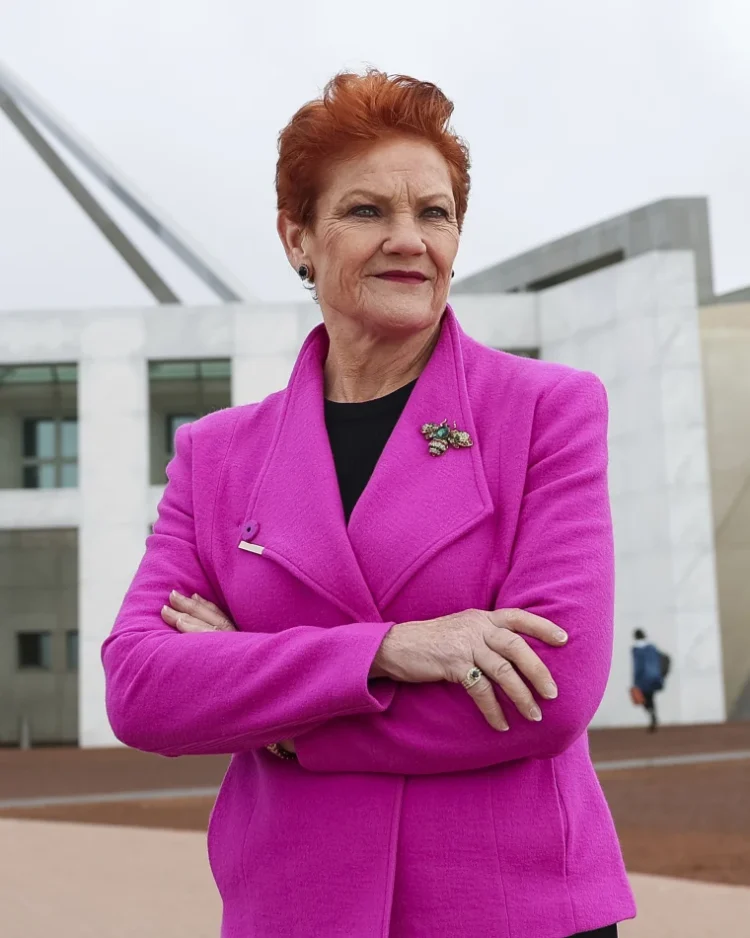
A fresh political storm has erupted in Australia after One Nation leader Pauline Hanson(pictured) described domestic violence as “a two-way street” during a radio interview in Brisbane, prompting fierce criticism from advocates, legal experts, political figures and victim-survivors who argue that such language risks reinforcing dangerous misconceptions about the nature of family violence.
Among the strongest responses came from former political adviser Brittany Higgins, who labelled the remarks “atrocious” and accused Hanson of normalising victim-blaming rhetoric at a time when Australia continues to grapple with persistently high rates of violence against women.

AD: Capeesh Restaurant
The controversy unfolded after Hanson was asked during a Brisbane radio appearance about men who abuse their partners. While acknowledging that violence against women is wrong, she argued that domestic violence should also be viewed as something that can occur in both directions within relationships.
“Domestic violence is a scourge but look … I’ve been through it myself in my life,” Hanson said. “And I just feel if you’re not in a house where you feel safe … then you shouldn’t put up with it. If these women are getting abused by men out there, then don’t put up with it.”
She continued by saying domestic violence was “wrong, but it’s also a two-way street,” a phrase that quickly became the focal point of national debate.

AD: Oysterian Sea Food Restaurant And Bar
Supporters of Hanson argued that her broader point was that anyone experiencing abuse—regardless of gender—should seek safety and remove themselves from violent situations where possible. They noted that men can also be victims of domestic violence and that acknowledging this reality should not diminish the suffering experienced by women.
However, critics contended that Hanson’s comments overlooked the complex dynamics that often trap victims in abusive relationships and risked creating a false equivalence between isolated incidents of conflict and sustained patterns of coercive control.
Few responses were as direct as that of Brittany Higgins, who posted a sharply worded statement on social media condemning the remarks.
“‘Mutual abuse’, ‘two way street’, ‘just leave’ – normalising this victim blaming rhetoric in relation to domestic violence when 38 Australian women have already been lost to femicide is atrocious,” Higgins wrote.
Her comments reflected concerns expressed by many domestic violence organisations that simplistic advice such as “just leave” fails to account for the realities faced by victim-survivors. Research consistently shows that leaving an abusive relationship is often the most dangerous period for victims, with perpetrators frequently escalating threats, stalking, or lethal violence after separation.
Financial dependence, fear for children, housing insecurity, emotional manipulation, immigration status, disability and limited access to support services are among the many barriers that can prevent someone from safely leaving. Advocates working on the front line say language matters because public understanding shapes both policy and community attitudes. They argue that suggesting abuse is routinely mutual can obscure the power imbalances that characterise many abusive relationships.
Domestic violence specialists have long distinguished between occasional relationship conflict and patterns of coercive control. While arguments and unhealthy behaviour can occur in many relationships, coercive control typically involves one partner using intimidation, isolation, threats, financial restriction, surveillance or physical violence to dominate another over an extended period. Australian law and policy have increasingly recognised coercive control as a defining feature of many domestic abuse cases.
Critics say describing domestic violence broadly as “a two-way street” risks conflating these very different situations. While reciprocal violence can occur in some relationships, studies indicate that severe domestic abuse involving ongoing coercion, serious injury or homicide overwhelmingly involves male perpetrators and female victims, although men, people in same-sex relationships and individuals of diverse gender identities can also experience serious abuse.
Hanson’s own experience with domestic violence formed an important part of her remarks. By referring to violence she says she experienced personally, she appeared to draw on her own life in urging people not to remain in unsafe environments. Some supporters argued that her comments reflected lived experience rather than indifference to victims.
Critics maintained that personal experience does not necessarily translate into an accurate description of the broader evidence surrounding family violence. They argued that public figures have a responsibility to communicate carefully, particularly when discussing issues that affect thousands of Australians every year.
The debate also reignited longstanding tensions over how domestic violence should be discussed politically. Some conservative commentators argue that public debate sometimes overlooks male victims and that support services should recognise abuse experienced by all genders. They contend that acknowledging male victims is not incompatible with recognising that women experience the greatest burden of severe domestic violence.
Many advocacy groups agree that all victims deserve protection and support, regardless of gender. However, they caution against language that appears to suggest responsibility for abuse is routinely shared equally between victim and perpetrator. They argue that each case should be assessed individually and that broad generalisations can unintentionally reinforce myths that discourage victims from seeking help.
Higgins’ intervention carried particular symbolic weight because she has become one of Australia’s most recognisable advocates for improving responses to gendered violence and workplace misconduct. Since publicly speaking about her own experiences, she has frequently used her platform to advocate for stronger protections for women and greater accountability across institutions.
Her criticism of Hanson therefore resonated widely across political and social media, quickly becoming part of a broader national conversation about violence against women.Australia has placed renewed focus on domestic and family violence in recent years following a series of high-profile killings and widespread public demonstrations demanding stronger action.
Governments at both federal and state levels have announced funding packages for crisis accommodation, legal assistance, prevention campaigns and frontline support services. Several jurisdictions have also introduced or expanded coercive control legislation in response to recommendations from coronial inquests and expert reviews.
Despite these initiatives, the number of women killed by current or former intimate partners remains a source of national concern. Each new case intensifies scrutiny of government responses and public discourse surrounding domestic violence. Against that backdrop, Hanson’s remarks struck many as particularly insensitive because they coincided with ongoing national efforts to address violence against women as a public policy priority.
The controversy also illustrates the powerful influence political language can have in shaping public perceptions. A phrase such as “two-way street” may be interpreted differently by different audiences. Some hear an acknowledgement that abuse can affect anyone. Others hear an implication that victims share equal responsibility for violent relationships. Likewise, advice to “just leave” may sound practical in principle, yet specialists warn it often underestimates the immense risks and obstacles confronting people trying to escape abuse safely.
The problem is not simply about one politician’s choice of words. It reflects a deeper national discussion about how Australia understands domestic violence, how leaders communicate about it, and how society balances recognition of all victims with evidence showing that women remain disproportionately affected by severe intimate partner violence.
The remarks have once again placed Hanson at the centre of a contentious public debate, with supporters defending her right to express an opinion informed by personal experience while critics argue her language risks undermining decades of education aimed at helping Australians better understand the realities of family violence.
The concern for Higgins and many domestic violence advocates extends beyond politics. They argue that public messaging influences whether victims recognise abuse, seek help and feel believed when they do. In their view, framing domestic violence as a simple matter of mutual conflict or suggesting victims can merely choose to leave overlooks the fear, coercion and danger that often define abusive relationships.
The intense reaction to Hanson’s comments demonstrates how Australians remain deeply divided not over whether domestic violence is unacceptable—a point on which there is overwhelming consensus—but over how best to describe its causes, recognise its patterns and support those who experience it.

AD: Heritage And Restaurant Lounge Bar