
By Isabelle Wilson-
“The Odyssey” has for many years survived as a story of war, survival, temptation and the relentless search for home. Now, Christopher Nolan is attempting something equally ambitious: transforming one of humanity’s oldest tales into one of cinema’s largest modern spectacles.
The filmmaker behind “Oppenheimer,” “Dunkirk” and “The Dark Knight” trilogy has embarked on one of the most ambitious productions of his career with “The Odyssey,” a project that matches the scale and scope of Homer’s ancient epic.

AD: Capeesh Restaurant
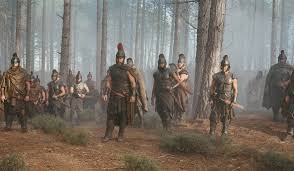
The adaptation represents a global filmmaking effort, with Christopher Nolan and his team filming across six countries during a demanding 91-day production that relied on real locations, practical elements and large-scale set pieces to recreate Odysseus’ legendary journey.
Nolan’s latest film is a “mythic action epic shot across the world” using new IMAX® film technology, bringing Homer’s foundational saga to IMAX screens for the first time and transforming one of literature’s most enduring adventures into a major cinematic event.
The film, scheduled for release on July 17, 2026, is not simply another retelling of an ancient story. It represents Nolan’s attempt to reconnect modern audiences with the emotional power of classical mythology while using the largest possible cinematic canvas.

AD: Oysterian Sea Food Restaurant And Bar
Behind the final images that audiences will eventually see lies a production that stretched across six countries, requiring vast logistical coordination, carefully constructed practical environments and a commitment to filming in real locations rather than relying entirely on digital worlds. The result is a cinematic voyage that has become almost as extraordinary as Odysseus’ legendary journey home.
Nolan’s approach to “The Odyssey” follows a film making philosophy he has developed throughout his career: if an audience can feel the physical reality of a scene, the emotional impact becomes stronger. Instead of creating an entirely computer-generated ancient world, the production travelled across international landscapes to capture the harshness, beauty and unpredictability of the environments that define Homer’s poem.
The film’s journey through multiple countries reflects the geography of the epic itself. From Mediterranean shores connected to the world of ancient Greece to remote landscapes representing mythical dangers, the production team sought locations that could provide an authentic sense of scale. Reports on the production describe filming across six countries during an intense 91-day shoot, with locations including Greece, Iceland, Morocco and other international settings chosen to represent the many stages of Odysseus’ voyage.
This global production was not simply a search for beautiful scenery. Each landscape became part of Nolan’s storytelling strategy. The rocky coastline, open seas and dramatic wilderness were intended to make the journey feel dangerous and unpredictable, reflecting the challenges faced by Odysseus after the Trojan War.
The director also pushed technical boundaries by shooting the entire film with IMAX cameras, marking a significant achievement in large-format filmmaking. The choice continues Nolan’s long relationship with IMAX, a format he has repeatedly used to create immersive theatrical experiences. A story filled with gods, monsters and supernatural challenges, Nolan’s decision to ground the production in physical reality creates an interesting contrast.
The filmmaker is approaching mythology not as fantasy disconnected from reality, but as a world where extraordinary events feel possible because the surroundings feel tangible. That philosophy required enormous preparation. Ships had to be constructed, historical environments recreated and performers placed in demanding outdoor conditions. The production’s ambition meant that cast and crew were not merely filming scenes; they were building an entire ancient world from the ground up.
Matt Damon, who plays Odysseus, described the project as one of the most challenging experiences of his career, highlighting the physical demands created by Nolan’s insistence on practical filmmaking methods. At the centre of Nolan’s “The Odyssey” is a familiar but timeless question: what does it mean to return home after being changed by war?
Homer’s epic follows Odysseus as he struggles to reach Ithaca after the Trojan War, facing storms, monsters, rival forces and personal temptations along the way. While the story is thousands of years old, its themes remain deeply relevant: loyalty, identity, family and the psychological consequences of conflict.
Nolan’s interpretation brings together a major international cast, including Matt Damon as Odysseus, Tom Holland as Telemachus, Anne Hathaway as Penelope, Robert Pattinson and Zendaya among others. The ensemble reflects the scale of the world Nolan is creating, combining established collaborators with some of Hollywood’s most recognisable contemporary stars.
The casting also suggests Nolan’s interest in making the ancient story emotionally accessible. Rather than treating the characters as distant figures from mythology, the production appears focused on presenting them as people experiencing fear, love, ambition and loss.
The challenge for Nolan is balancing the expectations surrounding one of literature’s greatest works with the demands of modern blockbuster cinema. Audiences familiar with Homer’s poem will look for a respectful adaptation, while newcomers will expect the spectacle and emotional intensity associated with Nolan’s previous films.
That balancing act has become one of the defining elements of the project. “The Odyssey” is not only a historical adaptation; it is a statement about the future of theatrical filmmaking. In an era dominated by digital production and streaming releases, Nolan continues to argue that cinema can still be an event built around scale, craftsmanship and shared audience experiences.
The filmmaker’s decision to pursue such a demanding project after the success of “Oppenheimer” demonstrates a willingness to move in a completely different direction. Instead of another historical drama, Nolan has chosen mythology a genre where imagination and reality must exist side by side.
The production’s ambition has already generated global attention, with Christopher Nolan’s “The Odyssey” becoming one of the most closely watched cinematic releases of 2026. The film’s scale has been highlighted through its unprecedented technical achievements, including its status as the first feature film shot entirely with IMAX cameras and its production across multiple international locations.
Reports also highlighted Nolan’s 91-day shoot across six countries, where the filmmaker used real locations, practical elements and large-scale production techniques to bring Homer’s ancient epic to life. In many ways, Nolan’s own film making voyage mirrors the story he has chosen to tell. Like Odysseus navigating unknown waters, the director has taken a familiar legend and set out toward unfamiliar territory.

AD: Heritage And Restaurant Lounge Bar