
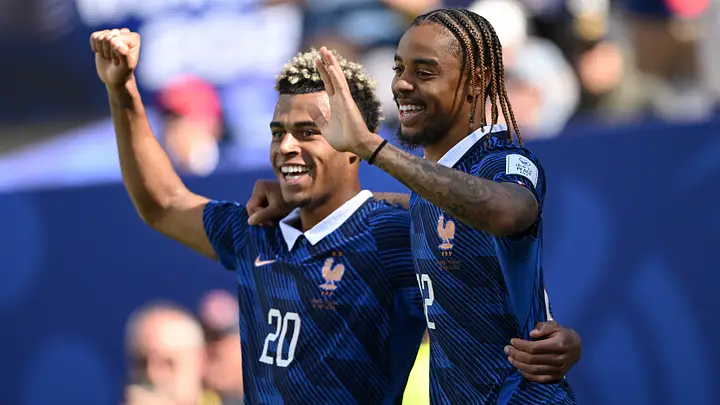
By Tim Parsons-
France have turned to Désiré Doué for one of the biggest tests of their World Cup campaign, with the young forward replacing Bradley Barcola in the starting lineup for a high-pressure quarter-final rematch against Morocco. The decision places Doué at the centre of a defining moment for the reigning world contenders, as Didier Deschamps looks to find the right balance between attacking creativity and tournament experience.
The change comes after Doué’s influential appearance in France’s narrow victory over Paraguay in the previous round, where his introduction helped transform the momentum of the contest.Brought on from the bench, the Paris Saint-Germain forward injected fresh energy into France’s attack with his direct running, close control and willingness to challenge defenders, eventually making the decisive contribution that helped unlock a stubborn Paraguayan defence.

AD: Capeesh Restaurant
Doué’s impact as a substitute strengthened his case for a starting role in the quarter-final, while other reports that Didier Deschamps viewed the youngster’s performance as a key factor in reshaping France’s attacking lineup against Morocco. The decision saw Doué replace Bradley Barcola, with the PSG winger dropping to the bench as France searched for greater creativity and unpredictability in a crucial knockout match.
With France, the quarter-final represents more than another step toward a potential World Cup triumph. It is a reunion with the team that shocked the football world in 2022, when Morocco reached the semi-finals after defeating several European giants before eventually losing to France.
Four years later, the meeting carries the weight of unfinished history, with Morocco returning as a far more confident and experienced side. Doué’s promotion reflects the growing belief inside the French camp that his unpredictable style can provide the attacking spark required against a disciplined Moroccan defence. While Barcola offers explosive speed and direct running, Doué brings a different profile one built around creativity, technical ability and the capacity to operate in tight spaces.

AD: Oysterian Sea Food Restaurant And Bar
The tactical decision also highlights the depth available to Deschamps. France’s squad has been one of the strongest at the tournament, allowing the manager to make bold adjustments without weakening the overall quality of his team. With Kylian Mbappé leading the attack alongside elite attacking talent, the inclusion of Doué gives France another player capable of changing the outcome of a major match.
The 2026 World Cup has already provided several moments that have accelerated Doué’s rise on the international stage. Although he began the tournament competing for minutes behind more established attacking options, his performances have gradually forced his way into the conversation.
His breakthrough moment arrived against Paraguay, where Doué made an immediate impact after replacing Bradley Barcola in the second half. Introduced in the 61st minute, the Paris Saint-Germain forward needed only a few minutes to influence the match, producing a powerful individual run through the Paraguayan defence before winning the penalty that allowed Kylian Mbappé to score the decisive goal in France’s 1-0 victory.
The performance underlined why Didier Deschamps has continued to trust Doué’s development, with the youngster providing the creativity and unpredictability needed to unlock difficult defensive opponents. The pressure surrounding the Morocco match is significant, but Doué has shown throughout his young career that he is comfortable operating in demanding environments.
His ability to remain calm while taking risks has become one of his biggest strengths. Rather than playing cautiously, he attempts to create moments that can change matches a quality that becomes increasingly valuable during the later stages of a World Cup.
France’s decision also represents a shift in attacking priorities. Against Morocco, controlling possession alone may not be enough, with the Atlas Lions having built a reputation for tactical discipline, defensive organisation and the ability to punish opponents through quick transitions. Previous encounters have shown that breaking through Morocco’s compact structure requires more than sustained pressure it demands creativity, movement and players capable of producing something unexpected in tight spaces.
That is where Doué’s skill set offers France a different attacking option, with his close control, improvisation and ability to disrupt defensive lines providing another route to goal.Barcola’s omission should not be viewed as a sign of failure. The winger has played an important role in France’s World Cup campaign, offering pace, direct running and another attacking outlet in a squad filled with elite competition for places.
His ability to stretch defences and attack space behind opposition back lines has provided France with a different dimension, particularly in matches where opponents have attempted to contain the team through a deeper defensive approach.
The Paris Saint-Germain forward also made his contribution felt during the group stage, scoring a crucial goal and demonstrating why Didier Deschamps has continued to trust him among France’s attacking options. At just 23 years old, Barcola remains one of the most exciting players in the national team setup, and his presence in the squad reflects the depth of talent available to the French manager.
However, knockout football often requires decisions based on the specific demands of each opponent rather than reputation or previous performances. Against Morocco, France face a side known for defensive discipline, compact organisation and the ability to reduce the influence of traditional attacking threats.
In such a match, Deschamps appears to have prioritised creativity and unpredictability, qualities that Doué brings through his ability to operate between defensive lines and create opportunities in crowded areas. The decision also highlights the difficult choices facing managers at major tournaments. With so many world-class attacking players available, selection decisions can often come down to tactical details rather than individual form.
A player starting one match and watching from the bench in another does not necessarily represent a decline in importance; instead, it reflects the need for flexibility during a long and demanding competition. The challenge now is to remain ready for another opportunity for Barcola. World Cup campaigns are often decided by moments, and substitutes frequently become decisive figures during the latter stages of the tournament. His speed and attacking instincts could still prove valuable if France need to change the rhythm of a match or chase a goal in the closing stages.
The opportunity represents a major step in his international development for Doué. His promotion into the starting lineup shows the confidence Deschamps has placed in his ability to influence matches at the highest level. The decision is not about replacing one player with another, but about selecting the qualities France believe can provide the greatest advantage against a specific opponent.
France prepare for a demanding quarter-final battle, the contrast between Barcola and Doué underlines the strength of their attacking resources. One offers explosive pace and direct threat, while the other provides creativity and invention. Against Morocco, Deschamps has chosen the player he believes can unlock the next challenge but both remain important pieces of France’s pursuit of World Cup success.

AD: Heritage And Restaurant Lounge Bar