
By Kenneth Williams-
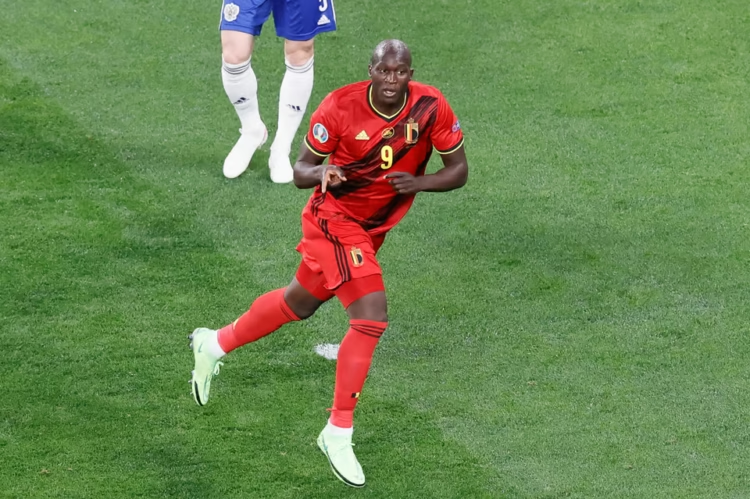
In a match that flickered between frustration and salvation, Romelu Lukaku once again proved why his presence can alter the trajectory of an entire game. Coming off the bench with Belgium trailing and searching for direction, the veteran striker delivered the moment of influence that sparked the Red Devils back into life, setting up the equaliser in a tense international clash that ended in a hard-earned draw.
The match, played under mounting pressure for Belgium in the opening stages of their campaign, had been slipping away from them for long stretches. Their opponents had struck first and then retreated into a disciplined defensive block, forcing Belgium into wide, predictable possession patterns.

AD: Capeesh Restaurant
Much of the first hour, the Red Devils’ attacking rhythm felt fragmented, lacking the cutting edge that has defined their best performances in recent tournaments. That all changed when Lukaku stepped onto the pitch. Lukaku’s introduction immediately altered Belgium’s attacking structure, with his role as a central focal point forcing Egypt’s defensive line deeper and changing the spatial dynamics of the match .
Match reports from the Group G opener also noted a clear increase in Belgian attacking pressure and territorial control following his substitution , a shift consistent with broader analyses of how elite strikers influence defensive shape and tempo within minutes of entering play .
Within minutes, Lukaku was at the heart of Belgium’s most dangerous sequences, using his strength to hold up play and bring advancing teammates into the attack. The equaliser came from one such passage of pressure, with Lukaku playing the decisive role in the build-up, drawing defenders toward him before releasing the ball into the space that ultimately led to Belgium’s breakthrough.

AD: Oysterian Sea Food Restaurant And Bar
Reported in live coverage of the match, Lukaku scored “with his first touch” after coming on in the second half, turning a stagnant Belgian performance into a contest suddenly alive with possibility. The goal did more than level the score; it redefined the momentum of the match entirely.
With Belgium supporters, it was a familiar sight. For opponents, it was a warning they have seen repeatedly over the past decade: Lukaku does not need long to change a game.
The draw itself may not have been the result Belgium originally envisioned, but it reflected a resilience that had been absent for long stretches of the contest. The Red Devils had struggled to convert possession into meaningful chances, with their creative midfielders often isolated from their attacking reference point. Lukaku’s arrival immediately corrected that imbalance, giving Belgium a focal point around which their attack could reorganise.
His influence also extended beyond technical contribution. There was a visible psychological shift across the team. Passes became more direct. Runs more purposeful. Even the tempo of Belgium’s pressing increased as they sensed an opportunity to salvage the match.
In international football, where margins are often decided by moments rather than sustained dominance, Lukaku’s ability to tilt the emotional balance of a game remains one of his defining traits.
Belgium’s reliance on Lukaku in crucial moments is not new, but this match reinforced how central he remains to their identity. Despite tactical evolutions and a new generation of attackers emerging around him, the Red Devils continue to turn to their record goalscorer when games demand authority in the final third.
His career with Belgium has long been defined by numbers that place him among Europe’s elite international strikers. He has scored consistently across multiple major tournaments and qualification cycles, establishing himself as the team’s all-time leading scorer and one of the most prolific forwards in international football history. Yet beyond statistics, it is the timing of his contributions that continues to define his legacy.
Even when not starting, Lukaku is widely regarded as one of football’s most effective impact forwards, with his ability to change games immediately after introduction well documented in both club and international contexts. Tactical analysis shows that his physical presence and hold-up play force opposition defenders deeper and reshape defensive structures, often compressing back lines and altering spacing across the pitch.
His role as a central pivot also improves attacking flow, opening passing lanes and bringing midfield runners into play more effectively. Combined with his reputation as a clinical penalty-box finisher who punishes even small defensive lapses, these qualities make him particularly influential against organised, low-block opposition.
This match also highlighted the strategic dilemma facing Belgium’s coaching staff. Starting Lukaku provides structure from the first whistle, but using him as an impact substitute maximises his ability to exploit tiring defences. The decision is no longer purely tactical—it is psychological, shaping how opponents prepare and react during the match.
Opposition teams are forced to adjust knowing Lukaku could appear at any stage. That uncertainty alone can alter defensive discipline. In this match, it was evident how quickly concentration levels shifted once he entered the pitch. The defensive line, previously comfortable, began to retreat earlier, compressing their own attacking outlets and effectively conceding territorial advantage.
The result is a subtle but significant tactical transformation that often goes unnoticed in match statistics but is clear to those watching the flow of play.
With Belgium, the draw carries broader implications beyond the immediate result. In a tightly contested group environment, dropped points can reshape qualification scenarios quickly. Yet the performance also offered reassurance: even when out of rhythm, they possess a player capable of restoring balance almost instantly.
Lukaku himself, the moment reinforced a career narrative built on resilience and adaptation. Over the years, he has faced scrutiny, tactical reshuffling, and shifting expectations, yet his influence in decisive moments has remained constant. Matches like this continue to define why he is still regarded as central to Belgium’s ambitions on the international stage.
The final whistle approached, Belgium pushed forward with renewed urgency, sensing that a comeback was still within reach. While they ultimately had to settle for a draw, the momentum shift initiated by Lukaku ensured that they left the pitch with renewed belief rather than disappointment.
On this occasion, Romelu Lukaku provided exactly that an intervention that turned a faltering performance into a salvaged result, and reminded once again that for Belgium, the story is never complete until their number nine has had his say.

AD: Heritage And Restaurant Lounge Bar