
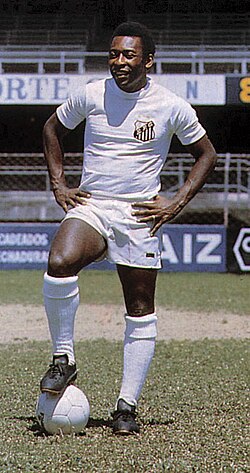
By Marcus Allen-
The debate over the greatest footballer in history has endured for generations. Every era produces new contenders, each supported by passionate fans and compelling statistics.
In recent years, discussions have been dominated by modern superstars such as Lionel Messi and Cristiano Ronaldo, whose remarkable achievements have redefined expectations for individual excellence. Yet despite the extraordinary accomplishments of the modern era, there remains a powerful argument that no player has surpassed the enduring legacy of Pelé.

AD: Capeesh Restaurant
In order to understand why Pelé remains central to the greatest-of-all-time debate, it is necessary to appreciate the context in which he played. Modern footballers benefit from advanced sports science, sophisticated nutrition, state-of-the-art pitches, detailed video analysis, and carefully managed schedules. Pelé achieved his success in an era when football was often far more physical, medical treatment was less advanced, and international travel posed significant challenges.
FIFA official records confirm that Pelé is the only player in history to have won the FIFA World Cup three times, achieving the feat with Brazil in 1958, 1962, and 1970, a record that remains unmatched in men’s international football. It similarly documents his participation in Brazil’s World Cup–winning squads across those three tournaments, underscoring his central role in one of the sport’s most dominant national teams.
Guinness World Records also recognises him as the only footballer to have won the World Cup three times, highlighting the rarity and historical significance of the achievement. As football’s most prestigious international tournament, the FIFA World Cup represents the highest competitive stage in the sport, and Pelé’s unmatched record of three titles has cemented his status as one of the most influential figures in the history of the game.

AD: Oysterian Sea Food Restaurant And Bar
His breakthrough in Sweden in 1958 remains one of football’s defining moments. At just 17 years old, Pelé scored six goals in the knockout stages, including a hat-trick in the semi-final and two goals in the final. Few teenage athletes in any sport have ever transformed a global tournament so dramatically.
Pelé is widely credited with scoring more than 1,000 career goals when combining official matches with friendlies and exhibition games, with encyclopaedic records estimating a total in excess of 1,200 goals across his career, placing him among the most prolific scorers in football history. However, modern statistical standards typically separate competitive fixtures from non-competitive matches, meaning his official recognised tally is significantly lower, though still historically elite.

Accounts of football in his playing era also describe a more physical style of defending, with fewer substitutions and less stringent disciplinary protections for attackers than in the modern game, a factor often cited in debates suggesting many of the challenges he faced would likely be penalised more harshly under today’s rules.
What further strengthens Pelé’s case is the completeness of his game. He was not merely a goalscorer. He possessed exceptional vision, creativity, dribbling ability, aerial strength, technical skill, and tactical intelligence. Former opponents often described him as a player without obvious weaknesses. He could score with either foot, dominate in the air despite not being exceptionally tall, and create opportunities for teammates with remarkable consistency.
Perhaps most importantly, Pelé changed football’s global status. Before his emergence, football was already popular, but Pelé helped transform it into a truly global phenomenon. His performances with Brazil captivated audiences across continents, making him one of the first worldwide sporting superstars. In many countries, he became synonymous with football itself.
This cultural influence distinguishes him from many modern players. While today’s stars benefit from social media and global broadcasting networks, Pelé achieved worldwide fame in a vastly different media environment. His reputation spread primarily through performances, newspaper coverage, television highlights, and word of mouth. The fact that his name remains instantly recognisable decades after his retirement illustrates the scale of his impact.
Supporters of modern legends point to stronger leagues, higher athletic standards, and more sophisticated tactics. These are legitimate arguments. Football has undoubtedly evolved. Yet greatness is not solely about who would win in a hypothetical match between different eras. It is also about dominance relative to contemporaries, influence on the sport, and sustained excellence.
Through those measures, Pelé’s achievements remain extraordinary. He was not simply one of the best players of his generation; many contemporaries considered him unquestionably the best. His influence extended beyond statistics and trophies into the cultural fabric of football itself.
The debate will never be settled definitively. Every generation views greatness through its own experiences. Fans who watched Messi mesmerise defenders or Ronaldo shatter scoring records understandably regard them as the pinnacle of football achievement. Others will continue to champion Diego Maradona’s genius, particularly his unforgettable performances at the 1986 World Cup.
When the discussion turns to the most complete combination of success, influence, longevity, skill, and international achievement, Pelé’s case remains exceptionally powerful. More than half a century after his greatest triumphs, he continues to provide the benchmark against which every football superstar is measured. That, perhaps, is the strongest evidence of all. Football has produced countless legends, but the fact that every new contender is still compared to Pelé demonstrates the enduring strength of his claim to be the greatest player the sport has ever known.
Even decades after his retirement, Pelé’s name remains a reference point in debates that span generations, continents, and radically different styles of football. Whether the discussion centres on Lionel Messi, Cristiano Ronaldo, Diego Maradona, or emerging talents of the modern era, the comparison almost inevitably circles back to Pelé as a baseline for greatness. That persistence is not merely nostalgia; it reflects how deeply his achievements are embedded in the sport’s collective memory.
Part of this endurance comes from timing. Pelé’s peak coincided with football’s transformation into a truly global spectacle, particularly through the FIFA World Cup, where his performances helped elevate the tournament into a cultural phenomenon. His success with Brazil in 1958, 1962, and 1970 gave him a unique historical footprint that has never been replicated.
But legacy in sport is not built on trophies alone. It is sustained through storytelling, myth-making, and the way generations interpret what they have seen or inherited through footage and testimony. Pelé occupies a rare position where all three reinforce each other. His highlights circulate endlessly, his records are constantly re-evaluated, and his influence is cited by players who never saw him play live.
There is also the symbolic weight of his career. Pelé became more than an athlete; he became a global ambassador for football itself at a time when the sport was expanding beyond its traditional European and South American strongholds. That global recognition has helped preserve his status even as the game has evolved tactically, physically, and commercially.
The persistence of comparison may matter more than any single statistic. Greatness in football is often measured not only by what is achieved, but by what continues to define the conversation long after the final whistle. On that measure, Pelé’s place at the centre of football’s hierarchy remains remarkably secure.

AD: Heritage And Restaurant Lounge Bar