
By Aaron Miller-
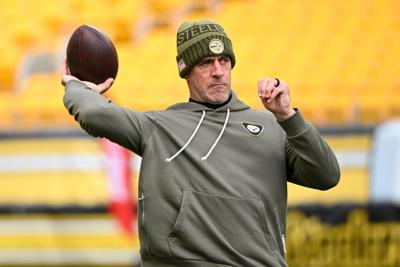
Aaron Rodgers has officially announced that the 2026 NFL season will be the final chapter of one of the most accomplished and polarising careers in professional football, confirming months of speculation about his future and signalling the approaching end of an era that reshaped modern quarterback play.
“This is it,” Rodgers told reporters Wednesday at the Pittsburgh Steelers’ organised team activities, ending weeks of uncertainty surrounding whether the four-time NFL MVP would return for a 22nd season.

AD: Capeesh Restaurant
The 42-year-old quarterback said he made peace with the decision during the offseason and wanted to finish his career on his own terms rather than prolong retirement speculation into another year.
Rodgers’ declaration instantly became one of the defining storylines of the upcoming NFL season. More than two decades, he has been one of the league’s most influential and scrutinised figures, admired for his extraordinary arm talent and football intelligence while also generating controversy through public comments, tense relationships with teams, and unconventional views outside the sport.
The veteran quarterback enters the season with the Pittsburgh Steelers after signing a one-year contract extension earlier this month worth up to $22 million. The deal reunited Rodgers with head coach Mike McCarthy, who replaced longtime Steelers coach Mike Tomlin earlier this year and previously coached Rodgers for more than a decade with the Green Bay Packers.

AD: Oysterian Sea Food Restaurant And Bar
Their partnership produced one Super Bowl title and helped define one of the NFL’s most successful quarterback-coach combinations of the 2010s.
Rodgers acknowledged that McCarthy’s arrival played a major role in his decision to continue playing. Earlier in the offseason, he reportedly considered retirement after uncertainty surrounding Pittsburgh’s coaching situation. But conversations with McCarthy, Steelers general manager Omar Khan, and his family convinced him to return for one final campaign.
Rodgers’ future had become an annual NFL offseason obsession in recent years, with speculation surrounding his retirement or return dominating headlines almost every spring. After leaving Green Bay following the 2022 season, his career took several dramatic turns, including an injury-marred and turbulent spell with the New York Jets before a revival in Pittsburgh.”
The quarterback said Wednesday that he wants his final season to be defined by “love, fun and peace,” a notable shift in tone for a player whose career often unfolded amid public disputes and relentless scrutiny. Rodgers did not provide extensive details about why he ultimately decided to retire, though he acknowledged that the physical and mental demands of the league played a role in the decision-making process.
A Career That Changed the NFL
Rodgers’ retirement announcement has already prompted an outpouring of reaction across the sports world, with current players, former teammates and analysts reflecting on a career that transformed expectations for quarterback efficiency and improvisation.
Selected by Green Bay with the 24th pick in the 2005 NFL Draft, Rodgers spent his early years waiting behind Hall of Fame quarterback Brett Favre before eventually taking over as the Packers’ starter in 2008. What followed was one of the most statistically dominant quarterback careers in league history.
Over 21 completed seasons, Rodgers accumulated more than 66,000 passing yards and over 500 touchdown passes while consistently ranking among the NFL’s most efficient passers. He won four Most Valuable Player awards and led Green Bay to victory in Super Bowl XLV, earning Super Bowl MVP honors in the process.
Analysts frequently credited Rodgers with redefining off-platform quarterback play. His ability to throw accurately while moving outside the pocket influenced a generation of younger quarterbacks and accelerated changes in offensive strategy throughout the league. Former coaches often described Rodgers as one of the most gifted passers they had ever seen, capable of making throws few others would attempt.
With Rodgers’ career was never defined solely by football excellence. Over time, he became one of the NFL’s most polarizing public figures. His criticism of league policies, comments about media coverage, and highly publicized disputes with management in Green Bay turned him into a lightning rod for debate both inside and outside sports.
His departure from Green Bay in 2023 marked the symbolic end of one of the NFL’s most iconic franchise-player relationships. After years of friction involving roster decisions and organisational direction, Rodgers was traded to the Jets in a blockbuster move intended to restore New York’s playoff relevance.
Instead, his time there became turbulent and disappointing. Injuries, coaching instability and inconsistent performances prevented the Jets from becoming legitimate championship contenders.
Many observers believed Rodgers would retire after leaving New York. Instead, he revived his career in Pittsburgh, helping stabilize a franchise searching for long-term direction after the decline of veteran quarterback Ben Roethlisberger. Rodgers’ first season with the Steelers exceeded expectations and briefly revived discussions about whether he might play beyond age 42.
The Steelers now enter the upcoming season under intense national attention, knowing every game could represent one of Rodgers’ final appearances. Television ratings, ticket demand and media coverage are expected to surge as fans across the country follow what many are already calling a farewell tour.
Pittsburgh’s championship hopes will depend heavily on whether Rodgers can remain healthy over a full season. While still capable of elite performances, the quarterback has battled mounting injuries in recent years, including hamstring, ankle and knee issues during previous campaigns. Critics have questioned whether age and durability will ultimately prevent him from making one final Super Bowl run.
Still, Rodgers insisted he is not returning merely for nostalgia. He told reporters that he believes Pittsburgh has a roster capable of competing in the AFC and emphasised that his focus remains entirely on winning rather than celebrating his legacy.
Legacy Beyond the Statistics
Rodgers’ retirement announcement also reignites debates about where he ranks among the greatest quarterbacks in NFL history. Supporters point to his unmatched efficiency, arm talent and ability to perform under pressure. Critics argue that despite extraordinary regular-season success, Rodgers reached only one Super Bowl during his long tenure as a starter.
That tension has followed Rodgers throughout his career. He consistently produced elite numbers but often faced questions about postseason disappointments and fractured relationships with coaches, executives and teammates. Some analysts believe his legacy will resemble that of other historically gifted quarterbacks whose careers generated as much debate as admiration.
Even so, few dispute Rodgers’ impact on the modern game. His influence is visible in today’s generation of quarterbacks who combine mobility, creativity and aggressive downfield passing. Many younger players openly studied his mechanics and improvisational style while growing up.
Rodgers also leaves behind one of the most complicated public legacies in professional sports. His outspoken personality made him enormously compelling to fans and media alike, but also deeply divisive. In an era where athletes increasingly shape public discourse beyond sports, Rodgers became both a cultural figure and a sports icon admired, criticised and constantly analysed.
The NFL itself now faces the symbolic end of another generational era. Over the past decade, legendary quarterbacks including Tom Brady, Drew Brees and Peyton Manning have retired, gradually passing the league into the hands of a younger generation led by players such as Patrick Mahomes and Josh Allen.
Rodgers’ departure will further close the chapter on an era dominated by pocket passers who defined the NFL during the 2000s and 2010s. His final season is expected to draw intense national attention not only because of his accomplishments, but because it represents one of the league’s last connections to that generation of superstar quarterbacks.
Rodgers says he is focused entirely on the months ahead rather than on retirement ceremonies or legacy discussions. But with every snap during the 2026 season, the NFL will be watching one of its most fascinating careers move toward its conclusion.
Whether Rodgers finishes with another playoff run, a final championship appearance, or simply a quiet farewell in Pittsburgh, his influence on professional football is already secure. The player who once sat patiently behind Brett Favre in Green Bay now prepares to leave the game as one of the defining quarterbacks of his generation brilliant, controversial and impossible to ignore.

AD: Heritage And Restaurant Lounge Bar