
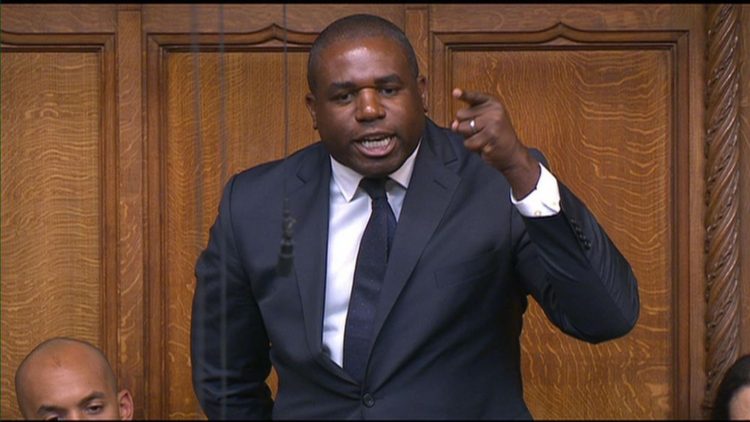
Lammy signalled that the government believes the Crown court backlog has reached such a critical level that increased funding and extended court sitting days alone will not be enough to restore public confidence in the criminal justice system.
The remarks amounted to the clearest indication yet that the government intends to pursue structural reform of jury trials even as political resistance intensifies around Prime Minister Keir Starmer and his administration.
The issue has rapidly evolved into a defining test of Labour’s approach to criminal justice reform. While ministers insist that no proposal exists to abolish jury trials altogether, critics argue that any curtailment of the right to trial by jury risks undermining a foundational principle of English law

AD: Capeesh Restaurant
. The debate has become particularly politically charged because of growing speculation that Starmer, already facing pressure on multiple fronts, may eventually retreat from the proposals to avoid a wider internal party conflict.
Last week’s King’s Speech, however, appeared to confirm that the reforms remain an active legislative objective, despite expectations among some MPs and campaigners that the government might quietly abandon the plan.

AD: Oysterian Sea Food Restaurant And Bar
The clash inside the Commons laid bare the depth of opposition now gathering against Lammy’s proposals. Labour MP Karl Turner launched one of the most direct attacks yet on the justice secretary, accusing him of clinging stubbornly to an increasingly isolated position.
Turner mocked Lammy during exchanges in parliament, telling him that “it must be absolutely exhausting holding on to an idea that only he, the justice secretary, still pretends is a good one.” The remark captured the increasingly personal tone of the debate, with critics portraying Lammy as politically overcommitted to a reform agenda that many legal professionals and campaigners regard as deeply flawed.
Turner went further by invoking the opposition of Andy Burnham, the mayor of Greater Manchester, whose criticism of the reforms has added another layer of political sensitivity for Labour. Burnham is widely viewed as an influential voice within the party and has been repeatedly linked to speculation about future leadership ambitions.
Turner noted that Burnham is expected by some observers to challenge Starmer for the party leadership should political conditions shift following the Makerfield by-election.
Against that backdrop, Turner accused Lammy of allowing personal pride to override sound judgement, asking bluntly when the justice secretary would “let his ego get out the way and bin this ludicrous idea of curtailing jury trials.”
The exchange illustrated how what began as a technical discussion about court efficiency has become entangled with broader questions about Labour’s political direction, internal unity and commitment to civil liberties.
Jury trials occupy a uniquely symbolic position within British legal culture. Defenders of the current system argue that allowing ordinary citizens to determine guilt in serious criminal cases is one of the most important democratic protections against state overreach. Any suggestion of limiting access to jury trials therefore inevitably provokes fears that efficiency is being prioritised over justice.
Lammy, however, has attempted to frame the debate in starkly pragmatic terms. Responding to Turner’s criticism, he acknowledged the force of the objections but argued that opponents had failed to provide a realistic alternative for reducing the enormous backlog crippling the Crown courts.
The justice secretary insisted that the government was not abolishing jury trials and sought to reassure MPs that reform proposals would preserve the central role juries continue to play in the criminal justice system. Yet his response also underlined the government’s increasingly urgent concern about the scale of the crisis facing the courts.
The backlog in Crown court cases has become one of the defining institutional pressures confronting the justice system in England and Wales. Years of underfunding, pandemic disruption, staff shortages and rising case complexity have produced severe delays, with some defendants and victims waiting years for trials to take place.
Legal professionals have repeatedly warned that prolonged delays damage evidence quality, increase emotional strain on victims and defendants alike, and undermine confidence in the rule of law itself. The government argues that without structural reform, the system risks remaining trapped in permanent crisis.
Liberal Democrat MP Jess Brown-Fuller attempted to challenge the government’s rationale by pointing to examples where increased investment appeared to be producing measurable improvements. Brown-Fuller highlighted reductions in backlogs at major court centres including the Old Bailey as well as courts in Chelmsford and Maidstone, arguing that additional government funding and uncapped sitting days were already helping to ease pressure on the system.
Her intervention reflected the view of many critics that the answer lies not in reducing jury trials but in committing sustained resources to expand court capacity and judicial staffing.
Lammy accepted that the additional investment had contributed to “a small reduction” in waiting times and backlogs. He also pointed to broader modernisation measures involving listing procedures and the use of artificial intelligence technologies to improve court administration and efficiency.
Yet the justice secretary insisted that such measures alone would not be sufficient given the sheer size of the outstanding caseload. “If we’re serious about bringing down the backlog over the next few years given its size, we will need reform as well,” he told MPs, making clear that the government sees structural change as unavoidable.
The reference to artificial intelligence is itself likely to generate significant discussion within the legal profession. Across the justice system, policymakers are increasingly exploring the use of AI tools to streamline case management, scheduling, document analysis and administrative processes. Supporters argue that technological modernisation could reduce delays and free legal professionals to focus on substantive work.
Critics, however, warn that overreliance on automated systems in criminal justice raises profound concerns about transparency, accountability and fairness. Lammy’s comments suggest the government intends to combine technological modernisation with procedural reform in an attempt to tackle the backlog crisis from multiple directions simultaneously.
The political stakes are exceptionally high because jury reform touches not only on legal administration but also on public trust in democratic institutions. Jury trials are deeply embedded in British constitutional tradition and are often portrayed as a safeguard against excessive state power.
Historically, attempts to limit or reshape jury participation in criminal cases have attracted fierce resistance from civil liberties groups, defence lawyers and parts of the judiciary. Critics fear that even modest reductions in eligibility for jury trials could establish precedents for more substantial changes in future.
At the same time, ministers face relentless pressure to demonstrate that the justice system can function effectively. Victims’ groups have repeatedly raised concerns about delays causing trauma and discouraging witnesses from participating in prosecutions. Defence lawyers have also warned that prolonged waits leave defendants living under severe uncertainty for years at a time. The government’s argument is that preserving traditional procedures means little if the system becomes incapable of delivering timely justice at all.
The controversy also exposes broader tensions inside Labour over balancing institutional reform with civil liberties protections. Starmer, himself a former director of public prosecutions, has often sought to project competence and pragmatism on law-and-order issues.
Yet, proposals perceived as restricting traditional legal protections risk alienating parts of Labour’s progressive base as well as sections of the legal community. Critics inside and outside parliament increasingly frame the debate as a test of whether efficiency concerns are being allowed to erode longstanding constitutional safeguards.
Burnham’s intervention has intensified those tensions. As one of Labour’s most recognisable regional political figures, his criticism carries symbolic weight beyond the immediate policy dispute. Some party members view Burnham as representing a more traditional Labour emphasis on civil liberties and public accountability, contrasting with what critics characterise as Starmer’s more technocratic leadership style.
Although leadership speculation remains hypothetical, the fact that the jury reform debate has become entangled with internal party positioning demonstrates how politically combustible the issue has become.
Legal observers note that any eventual reform package will likely face intense scrutiny not only in parliament but also among judges, barristers, solicitors and campaign groups. Questions remain about what specific offences or case categories might be affected, how defendants’ rights would be protected and whether proposed alternatives would command public confidence.
Without detailed legislative proposals, much of the debate currently revolves around principle and political signalling rather than settled policy detail. Nevertheless, Lammy’s insistence that reform remains necessary indicates that the government is preparing for a prolonged confrontation over the future shape of criminal justice.
As things stand, ministers appear determined to argue that the scale of the backlog crisis leaves them with little choice. Opponents, however, continue to insist that the solution lies in investment rather than constitutional change.
With pressure building on the courts and political tensions deepen inside Labour, the argument over jury reform is likely to become one of the defining legal and political battles of the coming parliamentary session.
Whether the government can persuade the public that reform is compatible with protecting fundamental legal rights may ultimately determine not only the future of the proposals themselves but also wider confidence in the justice system’s ability to balance efficiency with fairness

AD: Heritage And Restaurant Lounge Bar
-
Share On
- Categories
- Date