
By Ben Kerrigan-
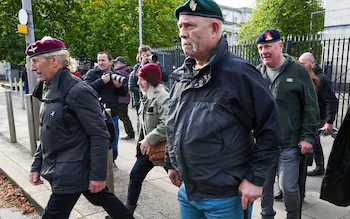
The UK government has formally acknowledged that British military veterans who served during the Northern Ireland Troubles cannot be treated as equivalent to IRA terrorists, a statement that has intensified political debate over how the past should be investigated and judged.
The admission comes amid mounting controversy surrounding proposed changes to legacy legislation, which aims to address unresolved cases from the decades-long conflict.

AD: Capeesh Restaurant
Ministers have sought to draw a clearer moral and legal distinction between state forces and paramilitary groups, stating there is “no equivalence” between those who served in the armed forces and organisations responsible for widespread violence.
The issue has re-emerged as Parliament considers new safeguards for veterans facing potential investigation or prosecution over incidents dating back more than half a century. Critics of earlier legislation argue that previous frameworks risked placing soldiers on the same footing as members of the Irish Republican Army (IRA), fuelling anger among veterans’ groups and sections of the public.
The renewed debate is unfolding against a volatile security backdrop in Northern Ireland. A recent attempted bombing outside a police station in Belfast, attributed to dissident republicans, has served as a reminder that the legacy of the Troubles remains unresolved and politically sensitive.

AD: Oysterian Sea Food Restaurant And Bar
Legal reforms and political fault lines
At the centre of the controversy is the government’s effort to replace or amend the Northern Ireland Troubles (Legacy and Reconciliation) Act.
The legislation had previously included provisions that could grant conditional immunity from prosecution to individuals involved in Troubles-related offences, including paramilitaries. However, those provisions were widely criticised and ultimately rolled back following court challenges.
In outlining its revised approach, the government has emphasised a commitment to the rule of law while introducing protections for former service personnel. These include safeguards against repeated investigations and measures designed to prevent elderly veterans from being drawn into lengthy legal processes.
Ministers argue that these changes restore balance to a system that had lost public confidence. They also stress that the overwhelming majority of deaths during the Troubles were caused by paramilitary organisations, a point often cited to justify the distinction between state actors and terrorist groups.
Nevertheless, the proposed reforms have exposed deep divisions across the political spectrum. Some lawmakers and advocacy groups contend that any attempt to limit prosecutions risks denying justice to victims’ families. Others insist that pursuing aging veterans through the courts decades after the events amounts to a form of “lawfare” that undermines the armed forces.
The debate has also placed pressure on senior ministers, including those with military backgrounds. The absence of Armed Forces Minister Al Carns from a crucial parliamentary vote on the legislation has drawn attention to internal tensions within government ranks, as well as the broader challenge of reconciling legal accountability with political pragmatism.
The Troubles, which lasted roughly from the late 1960s until the 1998 Good Friday Agreement, claimed more than 3,500 lives and left deep scars across Northern Ireland and beyond. While the peace process brought an end to large-scale violence, questions surrounding accountability have persisted, with many cases remaining unresolved.
The government’s recent statement represents a long-overdue recognition of what they see as a fundamental moral distinction. They argue that British soldiers were deployed under orders to uphold law and order, in contrast to paramilitary groups that carried out bombings, shootings and other acts of terrorism.
Opponents, however, caution against drawing overly simplistic lines. Human rights organisations and some legal experts maintain that all actors, including state forces, must be subject to the same legal standards where credible evidence of wrongdoing exists. They warn that creating perceived hierarchies of culpability could undermine confidence in the justice system.
The political sensitivity of the issue is reflected in broader tensions within Northern Ireland itself. While some unionist voices have welcomed the government’s stance, nationalist representatives have expressed concern that the reforms could disproportionately shield state actors from scrutiny. These disagreements mirror long-standing divisions over how the past should be remembered and addressed.
The ongoing debate has also intersected with contemporary security concerns. The attempted attack in Belfast, believed to involve the New IRA, underscores the enduring threat posed by dissident groups, even as the vast majority of society remains committed to peace.
The question of how to deal with the past continues to shape the present, and while the government’s latest intervention may mark a turning point in the debate, it is unlikely to be the final word.
In the months ahead, the focus will shift from political messaging to the practical realities of implementation, as ministers attempt to design investigative processes that can withstand legal scrutiny while also commanding public confidence across deeply divided communities.
Much will depend on whether these mechanisms are seen as genuinely balanced, given that earlier efforts to address unresolved cases from the Troubles struggled to gain legitimacy among victims’ families and former service personnel alike.
Legal challenges are widely expected, particularly from those who fear that any new framework could curtail avenues for justice, and the courts may once again play a decisive role in shaping or delaying the government’s plans.
The issue will continue to resonate strongly within Northern Ireland, where political leaders interpret legacy questions through sharply contrasting narratives of accountability, victimhood and historical responsibility.
These tensions are not confined to those who lived through the conflict; younger generations are increasingly engaging with how the Troubles are remembered and taught, meaning the outcome of today’s decisions will have lasting implications for how history itself is understood.
International legal principles and human rights obligations are also likely to remain part of the conversation, adding another layer of complexity to an already sensitive issue.
In this context, the government’s assertion that British veterans should not be equated with paramilitary actors may clarify its position, but it does not resolve the deeper challenges of balancing justice with reconciliation.

AD: Heritage And Restaurant Lounge Bar