
By Aaron Miller-
A California-based artist has said that her father the real-life subject of her widely exhibited painting The New American Gothic has been detained by U.S. Immigration and Customs Enforcement (ICE), sparking renewed debate over immigration enforcement and the human stories behind contemporary political art.
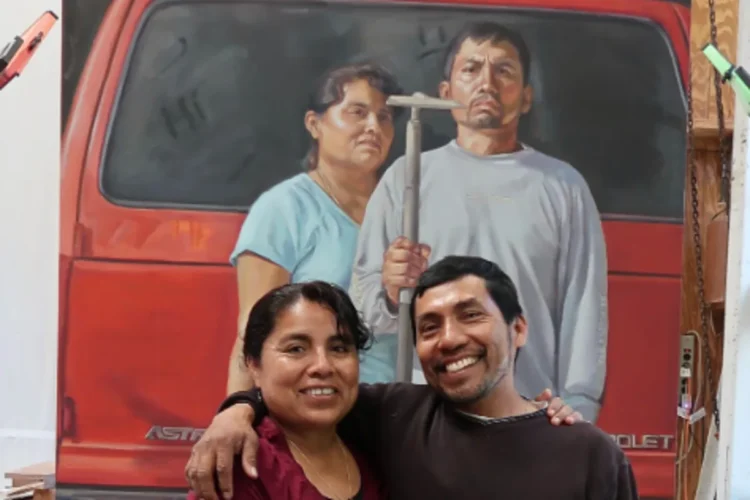
Criselda Vasquez, whose 2017 work re-imagines Grant Wood’s iconic American Gothic through the lens of a Mexican-American family, said her father was taken into custody on 31 March while travelling to work.

AD: Capeesh Restaurant
The painting, which depicts her parents standing in front of a red pickup truck holding gardening tools, has been displayed in major U.S. collections and was acquired by the Lucas Museum of Narrative Art in 2021.
The case has quickly gained attention in the U.S. arts and immigration communities, with Vasquez describing her family as “heartbroken” and her mother as “completely devastated” following the arrest. Reporting indicates the family patriarch had lived in the United States for around four decades and is the father of four U.S. citizen children.
The arrest comes amid a broader wave of immigration enforcement activity under the Trump administration, which has seen increased workplace and street-level detentions, according to recent enforcement data compilations tracking ICE activity nationwide.

AD: Oysterian Sea Food Restaurant And Bar
Iconic Artwork To Real World Detention
Vasquez’s The New American Gothic is itself a reinterpretation of one of the most recognisable paintings in American art history. Grant Wood’s original 1930 American Gothic depicts a stern Midwestern farmer and a woman posed in front of a rural house and has become a cultural shorthand for American identity and rural life.
In Vasquez’s version, however, that symbolism is reframed through the lens of immigrant labour and family life. The painting portrays her parents as working-class figures tied to agricultural and domestic labour, reflecting what she has previously described as “the invisible reality” of Mexican-American life.
According to interviews and posts attributed to the artist, the father depicted in the painting was detained by ICE during what she described as a routine journey to work, with agents reportedly stopping him near a residential street before taking him into custody.
The family has since launched a public fundraising campaign to support legal costs and lost income, with supporters contributing tens of thousands of dollars within days, according to reporting on the case. Art critics and immigration advocates say the detention has created a rare collision between cultural symbolism and lived experience, with the subject of a celebrated artwork now becoming part of the very system of enforcement the piece implicitly comments on.
Family Caught In Immigration Debate
The detention has also reignited broader conversations about immigration enforcement practices in the United States, particularly the targeting of long-term residents with deep family ties. Advocacy groups have pointed to similar cases in which individuals with decades-long residence and U.S. citizen children have faced detention proceedings under expanded enforcement priorities.
While ICE has not publicly detailed the reasons for the arrest in this specific case, reporting suggests the family has been unable to obtain clear explanations for the detention or immediate legal status decisions.
The emotional impact, Vasquez has said, has been severe. She has described her father not only as a subject of her artwork but as the central figure in her understanding of immigrant labour, sacrifice, and resilience themes that have defined her artistic practice.
The case has also drawn attention from other artists and commentators who see parallels between the symbolism of American Gothic and contemporary debates over national identity. The original painting has long been reinterpreted and parodied as a reflection of American hardship, identity, and social change, making Vasquez’s modern version part of a broader artistic lineage.
The arrest highlights how immigration enforcement continues to intersect with cultural representation in unexpected ways. While The New American Gothic was intended as a visual commentary on immigrant labour and family resilience, its subject has now been drawn into the enforcement system it implicitly critiques.

AD: Heritage And Restaurant Lounge Bar
Legal observers say the unfolding situation may also become relevant in broader discussions about due process within immigration enforcement, particularly in relation to transparency around detention decisions and access to timely legal representation.
While the specifics of the case remain subject to ongoing proceedings, the broader pattern it reflects is likely to be scrutinised in policy discussions and, potentially, in future legislative debates on immigration reform.
In the cultural sphere, the case has already begun to reshape interpretations of Criselda Vasquez’s work, with critics and curators re-examining The New American Gothic not only as a symbolic reinterpretation of a canonical American image but as a living document now directly entangled with the realities it sought to depict.
Art historians note that while political art often engages with social issues from a distance, this instance collapses that distance entirely, placing the subject of the artwork at the centre of an active political and legal struggle.
Museums and galleries that have previously exhibited the work are also expected to face renewed interest in how they contextualise politically charged pieces, particularly those dealing with immigration, labour, and identity.
Some curators have suggested that the case may influence future programming decisions, with increased emphasis on community engagement and the ethical dimensions of displaying works tied so closely to real individuals and ongoing legal circumstances.
Commentators in the art world have pointed out that the situation underscores a longstanding tension in representational art: the extent to which images intended as commentary can become inseparable from the lives they depict. In this instance, the artwork has not only reflected social reality but has become part of its unfolding narrative.
Legal proceedings continue and public attention remains high, the case is likely to persist as a reference point in both fields. In immigration discourse, it embodies the personal stakes of enforcement policy. In contemporary art, it challenges conventional boundaries between observer and subject, raising difficult questions about what happens when art stops representing life and instead becomes directly embedded within it.