
Isabelle Wilson-
NASA has fuelled its most powerful rocket in preparation for humanity’s first crewed journey to the Moon in more than half a century, marking a pivotal step toward a new era of deep-space exploration.
The operation, carried out at the Kennedy Space Center in Florida, signals that the long-awaited Artemis II mission is entering its final countdown phase, with four astronauts poised to travel farther from Earth than any humans in modern history.

AD: Capeesh Restaurant
The fuelling process began early Wednesday as engineers loaded more than 700,000 gallons of super-cooled liquid hydrogen and oxygen into the towering Space Launch System rocket. The delicate procedure one that has previously been plagued by hydrogen leaks and technical delays proceeded smoothly this time, easing concerns that had threatened to postpone the mission earlier this year.
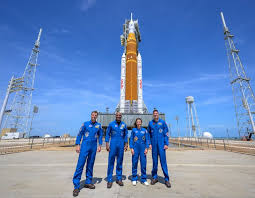
Rocket stood fully fuelled on the launch pad, the four-person crew three Americans and one Canadian prepared for liftoff with a mixture of anticipation and emotion.
Commander Reid Wiseman, along with astronauts Victor Glover, Christina Koch and Jeremy Hansen, waved to cheering crowds and family members before boarding the transport vehicle that would take them to the launch site. The sendoff marked not only a personal milestone for the astronauts but also a historic moment for international collaboration in space exploration.

AD: Oysterian Sea Food Restaurant And Bar
The Artemis II mission will not land on the Moon but instead carry the crew on a 10-day journey around it, reaching distances of roughly 4,000 miles beyond the lunar surface before returning to Earth for a Pacific Ocean splashdown. It will be the first time humans have ventured beyond low-Earth orbit since the Apollo 17 mission in 1972, effectively ending a more than 50-year gap in crewed lunar exploration.
NASA officials describe the mission as a critical test of systems that will be required for future lunar landings, including life support, navigation and communication technologies. The success of Artemis II is expected to lay the groundwork for subsequent missions that aim to return astronauts to the Moon’s surface later in the decade and eventually establish a sustained human presence there.
A Mission That Redefines Lunar Exploration
The Artemis program represents a significant evolution from the Apollo missions of the 20th century. While Apollo was driven largely by Cold War competition, Artemis is designed as a long-term, multinational effort involving government agencies, private companies and international partners.
The inclusion of Canadian astronaut Jeremy Hansen underscores the collaborative nature of the mission, making him the first non-American to participate in a lunar voyage.
The crew itself reflects NASA’s commitment to expanding representation in space exploration. Christina Koch is set to become the first woman to travel to the Moon, while Victor Glover will be the first Black astronaut assigned to a lunar mission. Their participation marks a shift toward a more inclusive vision of spaceflight, one that aims to inspire a broader range of future explorers.
Technologically, Artemis II is a proving ground for the Orion spacecraft, which will carry the astronauts through deep space. The mission will test everything from onboard life support systems to the spacecraft’s ability to withstand the extreme heat of reentry into Earth’s atmosphere.
Engineers will also evaluate how astronauts adapt to extended periods in deep space, gathering data that will be essential for longer missions, including those to Mars.
The flight path itself is carefully designed to maximize both safety and scientific value. The spacecraft will loop around the Moon in a figure-eight trajectory, allowing astronauts to observe the lunar surface including regions near the south pole that are of particular interest for future exploration.
These areas are believed to contain water ice, a resource that could support long-term human habitation and serve as a source of fuel for deeper space missions.
Beyond its technical objectives, Artemis II carries symbolic significance. It represents a renewed commitment by the United States and its partners to leadership in space at a time when other nations, including China, are advancing their own lunar ambitions. By returning astronauts to the Moon, NASA aims to reassert its role at the forefront of exploration while fostering international cooperation.
Despite the excitement surrounding the mission, NASA’s path to this moment has been far from smooth. Technical challenges have repeatedly tested the program, including earlier hydrogen fuel leaks and mechanical issues that forced delays and required extensive troubleshooting.
Even in the final hours before launch, engineers remained vigilant for potential problems, knowing that even minor anomalies could result in a last-minute scrub.
Weather conditions also play a critical role in determining whether the launch proceeds as planned. While forecasts have been largely favorable, space launches are notoriously sensitive to environmental factors, and NASA officials have emphasized that safety will always take precedence over schedule.
Financial and logistical challenges continue to loom over the Artemis program as well. The development of the Space Launch System and Orion spacecraft has required significant investment, prompting ongoing debate about the cost of returning humans to the Moon.
However, proponents argue that the program’s benefits including technological innovation, economic growth and scientific discovery justify the expense.
The broader vision for Artemis extends far beyond this single mission, forming a central part of NASA’s long-term strategy for human exploration beyond Earth. According to NASA’s Artemis overview , future missions are expected to include crewed lunar landings and the development of systems that will support a sustained human presence on and around the Moon.
The agency has outlined plans to build the capabilities needed for astronauts to live and work on the lunar surface for extended periods, moving beyond the short-duration missions of the Apollo era.
NASA also emphasises in its Moon-to-Mars strategy that these efforts are critical steps toward even more ambitious goals, particularly sending humans to Mars.
In this framework, the Moon serves not only as a destination but as a vital testing ground for technologies, operations, and human endurance in deep space, allowing scientists and engineers to refine the systems necessary for longer missions deeper into the solar system.
While the astronauts aboard Artemis II, the mission represents both an extraordinary opportunity and a profound responsibility. They will become the first humans in generations to leave Earth’s orbit and venture into deep space, carrying with them the hopes of scientists, engineers and millions of people around the world. Their journey will test not only the capabilities of their spacecraft but also the resilience and adaptability of the human spirit.
While the countdown continues, anticipation is building across the globe. Crowds have gathered near the launch site, while millions more are expected to watch the liftoff online and on television.
The moment carries echoes of the Apollo era, when humanity first set foot on another world, but it also signals something new a shift toward sustained exploration and the possibility of a future where humans live and work beyond Earth.
NASA stands on the threshold of history once again. The successful fuelling of the rocket marks a crucial milestone, bringing the agency one step closer to launching a mission that could redefine what is possible in space exploration. Artemis II has already captured the imagination of a new generation, reminding the world that the quest to explore the unknown is far from over.

AD: Heritage And Restaurant Lounge Bar