
By Ben Kerrigan-
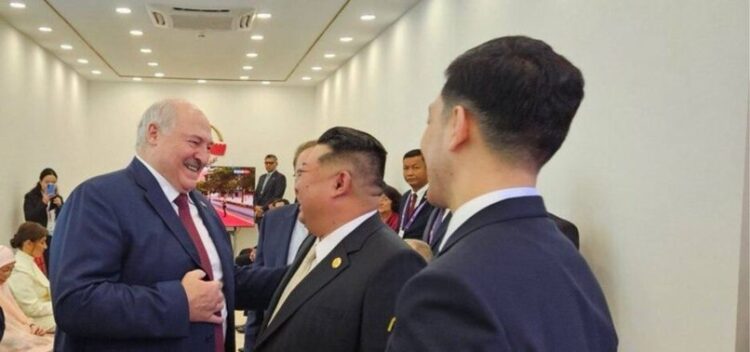
Belarusian President Alexander Lukashenko arrived in Pyongyang on Wednesday for an official visit and talks with North Korean leader Kim Jong Un, marking a rare high‑level diplomatic engagement between two long‑sanctioned allies. Lukashenko was greeted at the capital’s airport by North Korea’s First Vice Premier Kim Tok‑hun and Belarusian Foreign Minister Maxim Ryzhenkov, signaling the start of what both sides describe as an effort to expand cooperation across political, economic and strategic fronts. The visit Lukashenko’s first to North Korea follows their last meeting in Beijing last September and comes amid broader geopolitical alignment with Russia.
Belarus and North Korea have a history of mutual support on the world stage, often aligning against Western criticism and sanctions. Lukashenko, who has ruled Belarus for over three decades, has maintained close ties with Moscow, allowing Russian military operations to operate from Belarusian territory and later agreeing to host tactical nuclear weapons.

AD: Capeesh Restaurant
Likewise, Kim has reinforced Pyongyang’s ties with Russia, including reportedly providing personnel and munitions support in the conflict in Ukraine. Observers see the Pyongyang meeting as part of a broader pattern of cooperation among Russia’s closest partners.
The talks between Lukashenko and Kim are expected to focus on strengthening diplomatic and economic ties and finalising a friendship and cooperation treaty that Belarusian officials say will lay a legal foundation for future collaboration. Belarus has said the agreement could lead to additional accords possibly up to 10 covering areas of mutual interest and institutional cooperation.
According to state media commentary reported by Anadolu, Ryzhenkov stressed that “the time has come to more actively develop our relations,” reflecting momentum on both sides to deepen bilateral engagement.

AD: Oysterian Sea Food Restaurant And Bar
North Korea’s invitation to Lukashenko followed the pair’s previous encounter in China last year, where both leaders attended a military parade in Beijing celebrating shared geopolitical interests. That meeting, which included Russia’s leadership, highlighted Pyongyang’s strategic efforts to foster relations beyond its immediate region.
Analysts note that deepening ties with Belarus complements North Korea’s expanding foreign policy posture and reinforces its network of diplomatic partners that contest U.S. influence.
To Pyongyang, formalising its relationship with Belarus carries symbolic value, highlighting North Korea’s role as an active player in international affairs beyond its usual partners, China and Russia, and signalling a willingness to diversify its diplomatic outreach. With Minsk, the visit provides another platform to assert sovereignty and showcase global partnerships amid shifting geopolitical alignments.
Some analysts interpret this outreach as part of Lukashenko’s broader efforts to balance relations with Moscow while cautiously engaging with Western interlocutors in recent months.
However, the visit is not without controversy. Both North Korea and Belarus are long‑subject to international sanctions Pyongyang for its nuclear weapons program and Lukashenko’s government for its human rights record and support for Russia’s actions in Ukraine.
The two states’ alignment has drawn criticism from Western capitals that view their cooperation as part of broader resistance to international norms and pressure.
International reaction to the meeting has been cautious. Western governments and analysts warn that increased cooperation between Pyongyang and Minsk could complicate sanctions enforcement and raise concerns about potential sanctions evasion or military cooperation outside established multilateral frameworks.
Both countries’ willingness to engage more openly with one another, however, also signals a possible recalibration of diplomatic postures that could affect broader regional dynamics.
U.S. and European officials have historically expressed concern about improved ties between sanctioned states and emphasised the importance of upholding sanctions regimes while encouraging diplomatic engagement where possible.
How Washington and Brussels react to the Lukashenko‑Kim meetings and any ensuing agreements will likely shape subsequent foreign policy approaches in Eastern Europe and Northeast Asia alike.
The visit also takes place against the backdrop of evolving geopolitical alignments. North Korea, once largely isolated, has periodically engaged in high‑profile summits with global leaders, underscoring its nuanced foreign policy that balances relationships with China, Russia and, periodically, other capitals to advance its strategic interests.
Belarus, similarly, has engaged with a range of partners including a recent easing of some U.S. sanctions tied to political concessions while maintaining its longstanding security ties to Russia.
To Lukashenko, the Pyongyang visit serves both diplomatic and domestic political objectives. Securing agreements with North Korea adds to his government’s narrative of resilience in the face of Western criticism, and it projects Belarus as an independent actor on the global stage.
With Kim, hosting a foreign head of state in Pyongyang underscores North Korea’s ability to maintain and expand its diplomatic footprint despite its international seclusion.
While the talks unfold over the next two days, observers will be watching closely for the details of any agreements signed and statements issued by both leaders, as these could set the tone for Belarus‑North Korea relations for years to come.
Analysts note that while both countries are long‑standing allies of Russia and frequently find themselves at odds with Western governments, formalising and expanding bilateral ties may signal a more structured approach to cooperation.
Such agreements could span economic collaboration, cultural exchanges, scientific and technological cooperation, or even joint initiatives in sectors such as energy, transportation, and education. The precise scope of these deals is likely to be closely monitored by international observers, as they could indicate how Minsk and Pyongyang plan to leverage their partnership amid sanctions and global isolation.
The statements issued during and after the summit will also be scrutinized for language that signals alignment on broader geopolitical issues. Given both countries’ past support for Russia’s military objectives, some analysts are speculating whether the discussions will touch on military cooperation, intelligence sharing, or diplomatic coordination in multilateral forums.
Observers will be particularly attentive to any references to United Nations resolutions, sanctions regimes, or emerging conflicts in Eastern Europe and East Asia, as such statements could provide insight into how Minsk and Pyongyang intend to position themselves on the global stage. The summit appears to offer a platform for symbolic messaging. The optics of the two leaders meeting in Pyongyang underscores both nations’ desire to project resilience and sovereignty despite international pressure.
Lukashenko will view it as reinforcing Belarus’s image as an independent actor capable of engaging with a diverse set of international partners, while for Kim Jong Un, hosting a foreign head of state highlights North Korea’s diplomatic agency and its ongoing efforts to diversify foreign relations beyond China and Russia.
The outcomes of these talks could provide deeper insights into the trajectory of Belarus‑North Korea relations and their respective roles in an increasingly complex global landscape, revealing not only their strategic priorities but also how both countries seek to navigate a world shaped by sanctions, shifting alliances, and rising geopolitical tensions.

AD: Heritage And Restaurant Lounge Bar