
By Sheila Mckenzie-
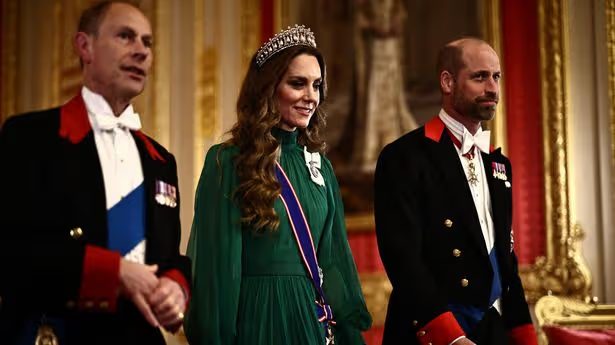
In the candlelit splendour of Windsor Castle, where centuries of monarchy have unfolded in ritual and pageantry, a modern form of diplomacy quietly took shape on the evening of 18 March 2026. The occasion—a state banquet honouring the president and first lady of Nigeria—was already steeped in historical significance, marking the first visit of its kind by a Nigerian head of state to the United Kingdom in 37 years. Yet amid the choreography of toasts, speeches, and ceremonial precision, it was a single visual gesture that captured global attention: the carefully considered attire of Catherine, Princess of Wales.
Dressed in a striking green and white ensemble that mirrored the Nigerian flag, the Princess of Wales delivered a message that required no translation. In a room filled with diplomats, ministers, and dignitaries, her choice of colour became a form of non-verbal communication—one that blended respect, awareness, and subtle political signalling. Within hours, images of the evening circulated widely, with commentators and observers noting how the gown transcended fashion to become an emblem of cultural recognition. Kate paired the gown with iconic jewels and royal insignia, including Queen Mary’s Lover’s Knot Tiara, a cherished piece worn by generations of royals, and historically significant earrings from the late Queen Elizabeth II’s collection.

AD: Capeesh Restaurant
The significance of the moment lies not merely in the aesthetic appeal of the garment, but in the context in which it appeared. State visits are among the most carefully orchestrated instruments of diplomacy, designed to project stability, mutual respect, and shared purpose. Every detail—from seating arrangements to menu selections—is deliberated upon, and attire is no exception. For senior members of the British royal family, clothing has long functioned as a tool of what might be termed “soft diplomacy,” conveying messages that are at once subtle and powerful.
In this instance, the Princess’s choice resonated particularly strongly because of the historical and contemporary ties between the United Kingdom and Nigeria. The relationship, shaped by colonial history and decades of post-independence engagement, is complex and evolving. Today, Nigeria stands as one of Africa’s largest economies and most influential nations, with deep cultural, economic, and diasporic links to the UK. Against this backdrop, the symbolism of green and white—representing Nigeria’s national identity—carried a weight that extended beyond mere courtesy.
Observers of royal protocol noted that such gestures are rarely accidental. The Princess of Wales has, over the years, developed a reputation for thoughtful sartorial decisions that align with the themes of the events she attends. Whether through the incorporation of national colours, the selection of designers with ties to specific communities, or the subtle referencing of cultural motifs, her wardrobe has become an extension of her public role. In doing so, she follows a tradition established by previous generations of royals, yet adapts it for a media landscape that amplifies and scrutinizes every detail.

AD: Oysterian Sea Food Restaurant And Bar
What distinguished this particular moment was the clarity of the message. Unlike more abstract references, the green and white palette offered an immediate visual connection to Nigeria. It required no explanation, no accompanying statement. In a world where diplomacy is often conducted through dense communiqués and carefully worded speeches, such immediacy can be strikingly effective. It allows for a form of engagement that is accessible not only to those present in the room, but to a global audience following the event through images and headlines.
The banquet itself was a showcase of both tradition and renewal. Held within the historic walls of Windsor Castle, the evening blended the grandeur of royal ceremony with the forward-looking ambitions of contemporary diplomacy. Speeches emphasized shared interests in trade, security, and cultural exchange, reflecting a mutual desire to deepen ties in an increasingly interconnected world. Yet it was the visual dimension of the event—the interplay of uniforms, decorations, and formal attire—that provided some of its most memorable moments.
In this context, the Princess’s gown can be understood as part of a broader narrative about the role of symbolism in international relations. While policy discussions and agreements form the backbone of diplomatic engagement, the success of such efforts often depends on the cultivation of goodwill and mutual understanding. Symbolic gestures, when executed with care and authenticity, can contribute to this process by signalling respect and attentiveness.
Critically, the effectiveness of such gestures depends on their perceived sincerity. In an age of heightened awareness and sensitivity to cultural representation, there is a fine line between meaningful recognition and superficial appropriation. The positive reception of the Princess’s attire suggests that, in this instance, the balance was struck successfully. Commentators highlighted the elegance of the execution, noting that the design avoided overt theatricality while still making a clear statement.
The response from Nigerian observers and members of the diaspora was particularly noteworthy. For many, the gesture was seen as an acknowledgment of Nigeria’s importance on the global stage and a recognition of its cultural identity. In the UK, where the Nigerian diaspora constitutes one of the largest and most dynamic African communities, such moments can carry additional resonance. They offer a sense of visibility and inclusion, reinforcing the idea that diplomatic relations are not only conducted between governments, but also experienced by people.
Beyond the immediate context of the state visit, the moment also speaks to the evolving role of the British monarchy in the 21st century. As an institution that operates within both domestic and international spheres, the monarchy has increasingly embraced forms of engagement that extend beyond traditional ceremonial functions. Members of the royal family are often called upon to act as cultural ambassadors, using their visibility to foster connections and promote shared values.
This role involved a careful balancing act for the Princess Of Wales On one hand, she is expected to uphold the traditions and expectations associated with her position. On the other, she must navigate a contemporary landscape in which authenticity, relatability, and cultural sensitivity are highly valued. Her approach to fashion—combining classic elegance with thoughtful symbolism—has emerged as one of the ways in which she negotiates these demands.
The choice of green and white at the Windsor banquet can thus be seen as part of a broader strategy of engagement. It reflects an understanding that, in a globalized media environment, images can carry as much weight as words. A single photograph, shared and re-shared across platforms, can shape perceptions and influence narratives in ways that formal statements cannot. By harnessing this dynamic, the Princess contributes to the broader objectives of British diplomacy in a manner that is both subtle and effective.
At the same time, it is important not to overstate the impact of such gestures. While they can enhance the atmosphere of goodwill surrounding a state visit, they do not substitute for the substantive work of diplomacy. The long-term success of UK–Nigeria relations will depend on concrete actions and agreements, addressing issues ranging from economic cooperation to security challenges. Symbolism, however powerful, remains only one component of a much larger process.
Nevertheless, moments like this have a way of capturing the public imagination, precisely because they operate at the intersection of the personal and the political. They humanize the often abstract world of international relations, providing a tangible expression of respect and connection. In doing so, they remind us that diplomacy is not solely the domain of policymakers and negotiators, but also involves gestures that resonate on a cultural and emotional level.
As the evening at Windsor Castle drew to a close, the immediate business of the state visit continued. Meetings, discussions, and engagements followed, each contributing to the broader objectives of the visit. Yet the image of the Princess in green and white lingered, becoming one of the defining visual narratives of the occasion. It served as a reminder that, even in the most formal and tradition-bound settings, there is room for innovation and expression.
In the days that followed, analysis of the state visit extended beyond the usual focus on policy outcomes to include a consideration of its symbolic dimensions. Commentators reflected on the ways in which the event balanced continuity and change, tradition and modernity. Within this analysis, the role of the Princess’s attire emerged as a focal point, illustrating how even the smallest details can contribute to the overall impact of a diplomatic occasion.
Looking ahead, the significance of this moment may lie not only in its immediate reception, but in its potential to influence future approaches to statecraft. As global audiences become increasingly attuned to issues of representation and cultural awareness, the ability to communicate respect and understanding through symbolic gestures will likely become ever more important. In this sense, the Windsor banquet offers a case study in how such communication can be achieved.
The evening represented another step in the evolution of the Princess’s public role. Through a single, carefully chosen outfit, she demonstrated an awareness of the broader context in which she operates, and a willingness to engage with it in a thoughtful and nuanced manner. In doing so, she contributed to a moment that was at once visually striking and diplomatically meaningful.
Ultimately, the story of the Windsor Castle banquet is one of convergence—of history and modernity, ceremony and symbolism, national identity and international engagement. It confirms that diplomacy, at its most effective, operates on multiple levels, combining the formal with the informal, the spoken with the unspoken. And sometimes, as this evening so clearly demonstrated, it is the unspoken elements—the colours, the choices, the gestures—that leave the most lasting impression.
The state visit itself carries weighty political and cultural meaning the first of its kind in nearly four decades and images from the banquet show Charles and President Tinubu exchanging remarks on the shared history and future cooperation between the United Kingdom and Nigeria. Her emerald green gown, carefully selected to echo the colours of the Nigerian flag, was more than a striking visual; it was a deliberate nod to the visiting President Bola Ahmed Tinubu and First Lady Oluremi Tinubu. At a state banquet attended by royals, diplomats, and dignitaries, Kate’s sartorial choice became a central point of attention, blending style with symbolic respect for Nigeria’s national identity.
Her look was not simply a fashion moment but a symbolic embrace of Nigeria’s heritage at a pivotal celebratory event a careful balance of timeless elegance and cultural sensitivity.
Observers from Commonwealth circles, fashion commentators, and diplomatic insiders alike noted that such sartorial gestures small in execution but large in symbolic reach can help set the tone for cooperation and mutual respect. With cameras capturing every detail and social media amplifying the moment worldwide, Kate’s emerald gown conveyed a message that extended beyond jewellery and silk: one of honour, attentiveness, and shared celebration between nations.
In the historic setting of Windsor Castle, against the backdrop of centuries-old tradition and statecraft, the Princess of Wales demonstrated that fashion, when chosen with intention, can serve as a subtle form of diplomacy. Amidst a season of state visits and global engagements for the British monarchy, this banquet stood out as both a festive occasion and a nuanced act of cultural recognition. In this context, the Princess of Wales’s choice to match her gown to the colours of Nigeria’s flag elevated the evening’s ambience, reaffirming the power of thoughtful style in the realm of international relations.
:max_bytes(150000):strip_icc():focal(746x315:748x317)/Kate-Middleton-031826-722b199b147841798b88592d5d6262a6.jpg)
Kate’s Emerald Green Gown and white palette of the Nigerian flag
Fashion As A Tale Of Diplomacy
In the age of instant global media, Kate’s appearance was quickly amplified across news outlets and social platforms, sparking discussion not just about fashion but about the role of symbolism in international relations.
Her choice demonstrated that royals can wield influence through visual and cultural intelligence, using their visibility to honour traditions, respect national identities, and reinforce relationships. Observers noted that the careful coordination of style, colour, and historical jewellery elevated the event, showing how even seemingly small gestures carry significant diplomatic weight.
Ultimately, the Princess of Wales’s emerald ensemble at Windsor Castle exemplifies the subtle yet profound role of cultural appreciation and symbolic gestures in modern diplomacy. Beyond the sparkle of jewels and the cut of a gown lies a message of respect, friendship, and attentiveness to the heritage of visiting nations.
In this moment, fashion became more than personal expression; it became a bridge between cultures, a statement of unity, and a reminder that in international engagement, symbolism and style continue to shape how leaders communicate across borders.
Kate’s appearance will be remembered not only for its elegance but for the quiet, diplomatic power embedded in her choice to honour Nigeria through her wardrobe.