
By Ben Kerrigan And Lucy Caulkett-
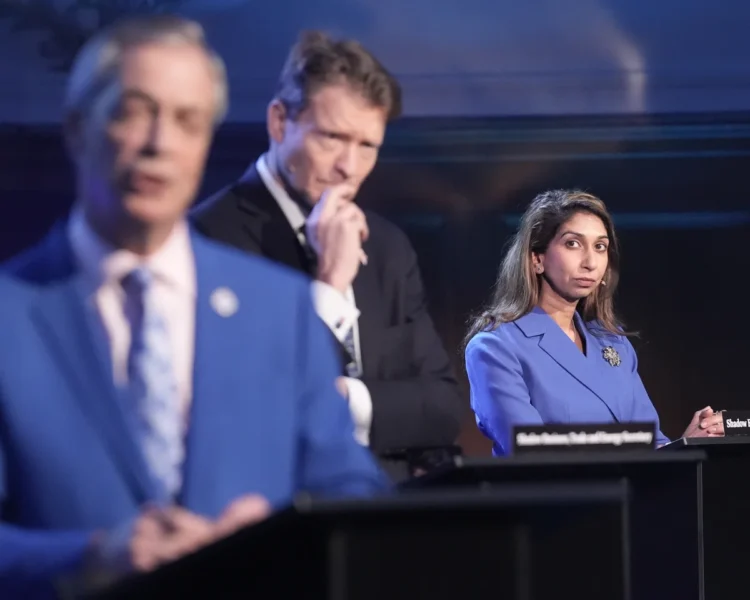
Reform UK leader Nigel Farage clashed with a female journalist at a London press conference — an incident that has reignited debate about his conduct toward women in the media and whether his responses crossed the line from combative to dismissive.
The confrontation took place as Farage unveiled his party’s newly appointed frontbench team, positioning Reform UK as a credible electoral force ahead of upcoming local contests. Among the reporters present was Anna Gross of the Financial Times, a seasoned political correspondent whose coverage of populist movements has been closely followed in Westminster circles. During the Q&A session, Gross posed two questions that were direct but hardly extraordinary in the context of British political journalism.

AD: Capeesh Restaurant
First, she asked whether Reform UK intended to establish what she described as an “ICE-style migrant deportation unit,” drawing a comparison with enforcement agencies in the United States. The question sought clarification on how far the party would go in operationalising its tough rhetoric on immigration control — an issue central to its platform. But her main question, addressed to Suella Braverman, the new Reform UK education spokesperson, was what her message would be to people worried about the party’s commitment to state education, given that all five people on the platform today – comprising the party’s core leadership team – were educated at private schools. This was a reasonable question about representation and social background in a party that has frequently styled itself as the voice of ordinary people.
Farage did not provide a substantive answer to either question. Instead, he appeared irritated by the line of inquiry. He reportedly said he “loved” the Financial Times in a tone described by observers as sarcastic, and suggested Gross should “just write some silly story.” He then moved on without addressing the substance of her points.

Multi- faceted journalist Anna Gross Anna was unjustifiably insulted by Nigel Farage who could not answer her questions

AD: Oysterian Sea Food Restaurant And Bar
In isolation, a politician declining to answer a question would not be remarkable. Leaders regularly deflect, reframe or sidestep. However, what made this exchange notable was the combination of tone and dismissal. Gross’s questions concerned two matters of public interest- immigration enforcement policy and the socio-economic background of senior party figures. Whether one agrees with the framing, both questions fall squarely within the remit of political scrutiny.
A proposed enforcement unit resembling American immigration operations would represent a significant policy step. Asking about it is neither fringe nor personal. Likewise, examining whether a party’s leadership reflects the backgrounds of its supporters is a standard line of journalistic inquiry, particularly in a country where educational privilege remains politically sensitive.
There is no formal requirement for a party leader to respond to every question at a press event. Yet, in a representative democracy, press conferences exist precisely to test rhetoric against detail. When a leader invites media coverage of a new team, scrutiny of that team’s credentials and composition is inevitable. To refuse engagement may be a tactical choice, but it carries reputational consequences.
The episode fits a broader pattern in Farage’s media appearances, particularly in exchanges with prominent female journalists. The most cited example occurred in October 2025 during a televised interview with Mishal Husain, then presenting a high-profile current affairs programme. In a discussion about NATO and Britain’s foreign policy stance toward Russia, Husain pressed Farage on perceived inconsistencies in his previous remarks. At one point, he responded with the phrase “Listen, love, you’re trying ever so hard,” a remark that triggered immediate backlash on social media and from several broadcasting figures.
The term “love” is used colloquially in parts of Britain and is not inherently sexist. However, context matters. Addressed to a senior journalist in a formal interview setting, particularly during a moment of challenge, many viewers interpreted the phrase as patronising. Husain did not visibly react, continuing the interview with composure, but the clip circulated widely. Media commentators argued that the remark diminished the professional standing of the interviewer by shifting the exchange from policy disagreement to personal tone.
Farage later dismissed the criticism, suggesting that robust debate should not be sanitised and that offence was being taken where none was intended. Supporters of Farage echo this line, characterising his style as plain-spoken and resistant to what they see as metropolitan sensitivity. His detractors, however, argue that such language, especially when directed at women, reinforces long-standing patterns of condescension in political discourse. Stephanie Madubunyi- a psychologist and researcher who contributes to this publication said: ”Farage needs to understand that this is no way to address any professional, let alone a woman. His conduct was totally unacceptable and indicative of a superiority complex he has which he may not be aware of. As a political leader, he needs to seriously re-examine himself”.
The latest press conference episode has revived these concerns. While Farage did not use overtly gendered language in his exchange with Gross, critics contend that telling a female reporter to “write some silly story” amounts to belittling her professional role. The phrase implies frivolity or bad faith rather than acknowledging a legitimate line of inquiry. Several journalists present described the moment as awkward, noting that the room fell briefly silent before the next question was taken.
To assess whether there is a gendered pattern requires caution. Farage has clashed with numerous male journalists over the years, often in equally heated terms. His political persona has long been built on confrontation — with European Union officials, with rival party leaders, and with sections of the British press. As a leading figure in the Brexit campaign and later as head of Reform UK, he has framed parts of the media as hostile to his agenda. Supporters argue that his brusque manner is consistent regardless of the interviewer’s gender.
However, patterns in public perception are shaped not only by frequency but by symbolism. When a male political leader appears to belittle or patronise a female journalist, it resonates within a broader social context in which women in media have documented experiences of being talked over, interrupted or undermined. Studies by organisations monitoring parliamentary discourse have repeatedly found that female MPs and journalists receive disproportionate online abuse. Against that backdrop, tone carries weight.
Were Gross’s questions reasonable? On immigration, Reform UK has signalled support for stringent border controls and accelerated removals of those without legal status. The comparison to U.S. Immigration and Customs Enforcement — often abbreviated as ICE — is contentious but intelligible shorthand for a muscular enforcement model. Clarifying whether the party envisages a dedicated deportation unit with expanded powers is a legitimate request for specificity. Voters deserve to know whether rhetoric translates into institutional design.
On education, the query about private schooling touches a nerve in British politics. Parties across the spectrum have grappled with accusations that their leadership is socially unrepresentative. If all five senior figures at a launch event share elite educational backgrounds, it is foreseeable that a journalist would ask how that squares with claims to champion the working class. The question was not about personal lives but about public positioning.
Should Farage have answered? From a democratic accountability perspective, engagement would have served him better. A concise rebuttal — rejecting the ICE comparison while outlining his own proposal, or defending his colleagues’ backgrounds while emphasising merit — would have shifted the focus back to policy. By declining and adding a dismissive remark, he ensured that headlines would centre on his tone rather than his platform.
There is also a strategic dimension. Politicians often calculate that attacking the premise of a question energises their base. Portraying mainstream outlets as out of touch can reinforce an outsider narrative. In that sense, telling a Financial Times reporter to write a “silly story” may resonate with supporters who distrust establishment media. Yet, such tactics carry risk when they appear to single out individual journalists rather than institutions.
It is important, too, to avoid overstating the evidence. Two prominent incidents — one involving Husain, one involving Gross — do not constitute proof of systemic misogyny. Farage’s defenders argue that he treats tough questioning as a political contest and that any journalist, male or female, who presses him can expect pushback. They point to combative exchanges with male broadcasters and rival politicians as evidence of consistency.
Nevertheless, consistency of abrasiveness does not nullify the impact of particular words. Calling a male interviewer “love” in the middle of a tense exchange would likely provoke similar criticism. The asymmetry lies in historical usage: diminutives directed at women have a long record of being used to signal inferiority. In modern broadcast settings, where professionalism is paramount, such language can jar.
The broader question raised by this week’s episode is about the health of political discourse. Britain’s press culture thrives on adversarial questioning; it is a cornerstone of scrutiny. But that model depends on mutual recognition of roles. Journalists ask uncomfortable questions; politicians respond, deflect or rebut. When the exchange slips into personal disparagement, it risks eroding the substance beneath.
For The Eye Of Media, the issue is less about scoring partisan points and more about examining standards. Public figures are entitled to challenge what they perceive as unfair framing. They are not obliged to validate every premise put before them. Yet dismissing a question as “silly” without explanation sidesteps engagement. When that dismissal is directed at a female journalist, in a political culture already grappling with gender equity, it invites heightened scrutiny.
Farage is a seasoned communicator who understands the power of theatre. He has built a career on moments that cut through and command attention. The question is whether this latest moment advances his political objectives or reinforces concerns about respect. In an era when trust in institutions — political and media alike — is fragile, tone can be as consequential as policy.
Ultimately, the exchange with Anna Gross will likely fade from the news cycle. But it leaves behind a familiar dilemma. How should political leaders respond when pressed on uncomfortable details? The reasonable expectation in a democracy is not deference, but dialogue. Whether Farage adjusts his approach in future encounters with female journalists, or doubles down on confrontation as a badge of authenticity, will shape not only his public image but the tenor of the debates to come.

AD: Heritage And Restaurant Lounge Bar