
By Tim Parsons-
FIFA has launched a wide-ranging disciplinary case against the Argentine Football Association (AFA), several of the country’s players and members of its coaching staff following a dramatic conclusion to the 2026 FIFA World Cup that has left the runners-up facing the prospect of significant sanctions.
The governing body confirmed it has opened formal proceedings after reviewing incidents surrounding Spain’s 1-0 extra-time victory over Argentina in the World Cup final at MetLife Stadium in New York, together with separate events that occurred earlier in the tournament.

AD: Capeesh Restaurant
The investigation centres on the disorder that erupted immediately after the final whistle, when tensions boiled over following Spain’s victory in one of the most emotionally charged World Cup finals in recent memory.
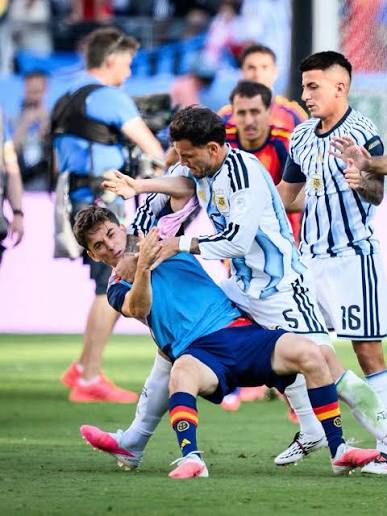
FIFA alleges that several Argentine players and officials became involved in confrontations with Spanish players during a mass melee on the pitch. The governing body has now referred multiple individuals to its independent Disciplinary Committee under Article 14 of the FIFA Disciplinary Code, which covers violent conduct and assault.
Among those facing the most serious allegations is midfielder Leandro Paredes, who has been charged with three counts of assault after video footage allegedly showed him grappling with Spain defender Eric García and midfielder Gavi during the post-match confrontation.

AD: Oysterian Sea Food Restaurant And Bar

Assault Charge: Leandro Parodes in World Cup brawl
Defender Nahuel Molina has been charged with two counts of assault—one completed and one attempted—after allegedly striking Spain captain Rodri, while also facing an additional charge of unsporting conduct.
Argentina assistant coach Roberto Ayala has also been charged with one count of assault relating to his alleged involvement in the altercation, while Argentina winger Thiago Almada and Spain midfielder Gavi have both been charged with unsporting conduct arising from the same incident.
Under FIFA regulations, players or officials found guilty of assault face mandatory suspensions of at least three matches, while unsporting conduct offences carry minimum one-match bans, although the disciplinary panel has discretion to impose more severe penalties depending on the circumstances.
The disciplinary proceedings extend well beyond the scenes witnessed after the final whistle. FIFA has also opened a separate case against the AFA over the display of a political banner following Argentina’s 2-1 victory over England in the World Cup semi-final.
During the post-match celebrations, members of the Argentina squad held up a large banner reading “Las Malvinas son Argentinas” (“The Malvinas are Argentine”), referring to the long-running sovereignty dispute between Argentina and the United Kingdom over the Falkland Islands.
FIFA rules prohibit the use of football matches for political demonstrations, and the governing body has charged the federation with using a sporting event for non-sporting political messaging.
The incident attracted widespread criticism beyond football. British government representatives called for FIFA to investigate the display, reiterating the United Kingdom’s long-standing position that the future of the Falkland Islands rests on the principle of self-determination for the islanders.
The Falkland Islands Government also criticised the banner, saying it was disappointed to see politics brought into football and urging FIFA to apply its regulations consistently.
The controversy was further amplified when Argentina’s Vice-President, Victoria Villarruel, publicly defended the message, writing on social media that “The Malvinas are Argentine” and claiming the issue remained deeply embedded in the nation’s identity.
The political display was not without precedent. Argentina previously found itself in conflict with FIFA over the same slogan during the 2014 World Cup, when the AFA received a fine after players displayed an identical banner following a friendly against Slovenia.
That earlier punishment established FIFA’s position that political messages, regardless of their origin, have no place on the international football stage.
FIFA is also reviewing allegations relating to spectator behaviour involving Argentina supporters throughout the tournament. These include claims of discriminatory chanting, racist abuse, objects being thrown onto the field of play and security breaches across several match venues.
The governing body confirmed that all parties involved have been given an opportunity to respond before its independent Disciplinary Committee reaches a final decision. Potential sanctions range from financial penalties and player suspensions to restrictions on future international fixtures involving Argentina.
The disciplinary investigation comes at the end of another memorable World Cup campaign for Argentina, whose modern football history has been built upon some of the sport’s greatest triumphs and heartbreaks. Argentina first lifted the World Cup on home soil in 1978 before Diego Maradona inspired the nation to a second title in Mexico in 1986 with one of the greatest individual performances ever seen at the tournament.
Since then, Argentina have regularly remained among football’s elite, reaching finals in 1990, 2014 and 2026, while finally ending a 36-year wait for another title by winning the 2022 World Cup in Qatar under Lionel Scaloni, with Lionel Messi leading one of the most celebrated victories in the country’s sporting history.
Their appearance in the 2026 final represented yet another chapter in a remarkable World Cup tradition that has consistently placed Argentina among the competition’s most successful nations.
Spain, meanwhile, have enjoyed a different but equally significant journey in World Cup history. For decades, despite producing technically gifted teams, Spain struggled to fulfil their potential on football’s biggest stage, often exiting tournaments earlier than expected. That narrative changed spectacularly in South Africa in 2010 when Vicente del Bosque’s side, featuring stars such as Andrés Iniesta, Xavi
Hernández, Iker Casillas and Sergio Busquets, claimed the nation’s first World Cup title with a 1-0 victory over the Netherlands after extra time. Although Spain endured disappointing campaigns in 2014, 2018 and 2022, their triumph in the United States in 2026 restored them to the summit of world football, underlining the country’s continued ability to develop elite talent and compete for the game’s biggest prizes.
The World Cup final itself had promised to be remembered as a contest between two footballing heavyweights with rich international pedigrees, but the events that unfolded afterwards have instead dominated headlines around the world.
FIFA’s disciplinary action ensures that the legacy of the tournament will now be shaped not only by Spain’s return to world football’s pinnacle but also by the unprecedented scrutiny facing Argentina in the weeks ahead.
With the Disciplinary Committee yet to issue its verdict, uncertainty remains over the severity of any sanctions. However, the breadth of the charges illustrates FIFA’s determination to enforce its disciplinary code at the highest level of the international game.

AD: Heritage And Restaurant Lounge Bar