
By Gabriel Princewill-
International law needs to become stronger and have real substance to be worth the paper it is written on. Ambiguities and contradictions in any system or framework weaken its underpinning essence, often times rendering it somewhat futile.
One truth many legal experts raging in criticism against Donald Trump’s decision to unilaterally invade Venezuala and brazenly capture its sitting president and his wife do not say is that the inherent structure of international law is legally incoherent and porous.

AD: Capeesh Restaurant
In the opening days of 2026, a seismic geopolitical event shook the foundations of the post–World War II legal order. On the one hand, On the one hand is a mandatory framework governing the rights of all sovereign nations, but on the other hand is the an established practise by the courts that it is not concerned with the process through which a person charged with a criminal matter is brought before it. The latter state of affairs seemingly endorses whatever process culminates in a defendant being charged with criminal offences.
On January 3, 2026, a large scale U.S military operation struck deep into Venezualan territory. President Nicolas Maduro and his wife, Cilia Flores, were captured by U.S forces and transported to the United States to face justice as indicted ‘narco terrorists”, according to the Trump administration.
At the heart of this controversy are deep questions about how global legal rules governing the use of force are interpreted, enforced and, in some scholars’ views, manipulated.

AD: Oysterian Sea Food Restaurant And Bar
The crisis has exposed structural weaknesses within the system that was meant to restrain aggression, protect sovereignty and prevent the rule of might over law. Reformers argue that without coherent legal standards and more robust enforcement mechanisms, international law risks being perceived as fragile or selectively applied.
International law’s core principles were largely codified in the aftermath of the most destructive war in history, centred around the United Nations Charter, which prohibits the use of force against another state except in very narrow circumstances.
Article 2(4) of the Charter requires all U.N. members to refrain from the threat or use of force against the territorial integrity or political independence of any state. Only two narrow exceptions exist: self‑defense when an armed attack occurs and collective action authorised by the U.N. Security Council. Yet in early January, the world witnessed a powerful state using force without either condition present.
Legal experts describe the Venezuela operation as a clear violation of these foundational norms. According to authoritative legal analysis, the U.S. action constituted an unlawful use of force lacking Security Council authorisation and without a credible imminent threat that would justify self‑defence.
Commentators have gone further, classifying it as a “crime of aggression,” one of the gravest offences under the legal doctrines established at Nuremberg after World War II.
United Nations rights officials echoed these criticisms, asserting that the use of military force against Venezuela undermined fundamental international principles and heightened global instability.
They emphasised that no state has the right to unilaterally enforce sanctions or engage in armed blockades without international approval. Such actions, they warned, jeopardise not only regional peace but also basic human rights in the targeted country and neighbouring regions.
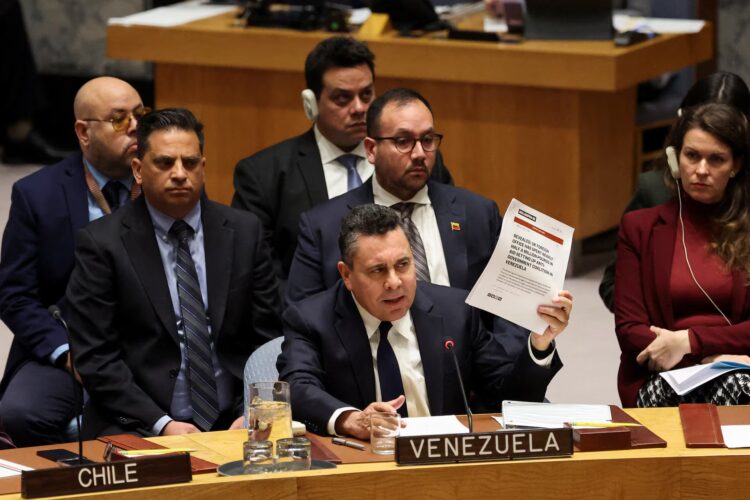
The legal fragility is further exposed in the way the U.S. blocks accountability. At the U.N. Security Council, Washington can wield its veto to prevent any punitive resolution or action against itself, underscoring the problem of enforcement when a powerful state violates norms yet remains insulated from collective censure.
Critics have noted that when permanent council members break the rules, the body’s purpose as guardian of peace is compromised and its legitimacy eroded.
Ambiguity in the law compounds the problem. The U.N. Charter’s exceptions were never intended to be exploited to justify offensive force disguised as self‑defence or “law enforcement.” Yet powerful states can defensively stretch legal language to suit strategic aims, whether in Cold War interventions or more recent military actions.
The Venezuelan case, in which Washington described its actions as targeting “narco‑terrorists,” illustrates how legal justifications can be framed to appeal to domestic audiences while contradicting accepted international standards.
The international response highlights the fragile nature of norms that lack binding enforcement. Global reaction ranged from condemnation by Russia, China and many Latin American governments to calls for multinational sanctions, yet no powerful mechanism exists to compel compliance or reverse illegal actions.
Critics argue that when powerful states treat international law as optional, they transform the legal order into a hierarchy where the most powerful can act with impunity and smaller states remain vulnerable.
The vulnerabilities exposed by the Venezuelan episode have prompted renewed calls for reform. Legal scholars and diplomats argue that preserving a functioning international legal system requires structural changes that limit selective enforcement and fortify accountability.
One major area of discussion is reform of the U.N. Security Council, particularly the veto power held by permanent members. Critics assert that the ability of a veto wielding state to shield itself from accountability undermines the entire purpose of the Council as a body dedicated to peaceful resolution of disputes and collective action.
Proposals include restraining veto use in cases involving clear violations of the charter, requiring automatic review or binding arbitration when vetoes block accountability efforts. Such reforms could enhance consistency and legitimacy in how the Council operates.
Another priority is clarifying and tightening the legal exceptions that permit the use of force. Scholars suggest updating or augmenting the U.N. Charter to narrow the definitions of self‑defense and collective security action. Clearer criteria could reduce opportunistic interpretations that transform legal provisions into loopholes that powerful states exploit for unilateral actions.
Revisions could require concrete evidence of imminent threats and forbid the use of nebulous labels like “transnational crime” or “narco‑terrorism” as justifications for military action against sovereign states. Absent such clarity, loosely defined exceptions will continue to blur the lines between legitimate defence and unlawful intervention.
Strengthening international courts and accountability mechanisms is another significant reform avenue. The International Court of Justice (ICJ) and International Criminal Court (ICC) play crucial roles in interpreting and enforcing international law, yet they face limitations in jurisdiction and political pressures that weaken their impact.
Advocates argue for broader acceptance of compulsory ICJ jurisdiction and expansion of ICC mandates to cover unlawful uses of force more effectively, regardless of the origins or nationality of perpetrators. Robust judicial avenues could offer consistent legal recourse and dissuade states from acting with impunity.
In addition, empowering regional organisations could offer more immediate responses to breaches of international norms when global institutions lag.
Regional bodies such as the Organization of American States (OAS), African Union, and others possess contextual understanding and legitimacy that can be leveraged to mediate disputes, coordinate peaceful solutions and, where necessary, undertake collective security operations.
Had such regional mechanisms been stronger, they might have provided alternative channels to address Venezuela’s political crisis without military intervention.
Such ideas respond to a broader philosophical critique about the nature of international law itself. At present, the system depends on state consent and voluntary participation in treaties and enforcement frameworks. Without a central enforcement body or global police force, law depends on the willingness of countries to uphold agreed norms.
This consent‑based system is easily manipulated when major powers choose to disregard or reinterpret rules without meaningful repercussions. Reformers argue that reinforcing legal obligations with clearer enforcement mechanisms would make international law less fragile and more coherent as a system that genuinely binds all states.
None of these reforms is simple. They involve negotiating among states with vastly divergent interests, power imbalances and histories. Reforming the Security Council, for instance, would require agreement among current permanent members who are unlikely to support changes that dilute their power.
Strengthening judicial enforcement mechanisms may face pushback from states wary of ceding sovereignty. Despite these obstacles, proponents emphasise that without meaningful change, international law risks being seen not as a system of universally binding rules, but as a collection of guidelines that powerful states can ignore when inconvenient.
The Venezuela crisis is not just a geopolitical flashpoint. it is a test of the integrity of the international legal order. Within weeks of the U.S. operation, diplomats, legal scholars and civil society activists around the world have emphasised the necessity of a coherent, resilient legal framework capable of constraining unilateral force and ensuring accountability.
Without robust structures that bind powerful and weak states alike, international law becomes fragile more rhetoric than rule.
Efforts to reinvigorate the legal order must focus on clarifying legal standards, curbing avenues for unilateral military action treated as law enforcement, reinforcing accountability mechanisms and strengthening the capacity of international and regional bodies to respond to breaches of legal norms. Such reforms are essential if the aspiration of a world governed by law rather than power is to endure.
The events unfolding in Venezuela have laid bare how fragile international law can become when strategic ambitions eclipse legal constraints. Yet they also create an opportunity for reflection and reform at a moment when global leaders are confronting the limitations of the current system.
The challenge now is whether those leaders can convert crisis into constructive change, choosing a path that makes international law coherent, durable and truly universal in its application. If not, the ideal of a rules‑based world order risks fading into an era defined more by might than by right.

AD: Heritage And Restaurant Lounge Bar