
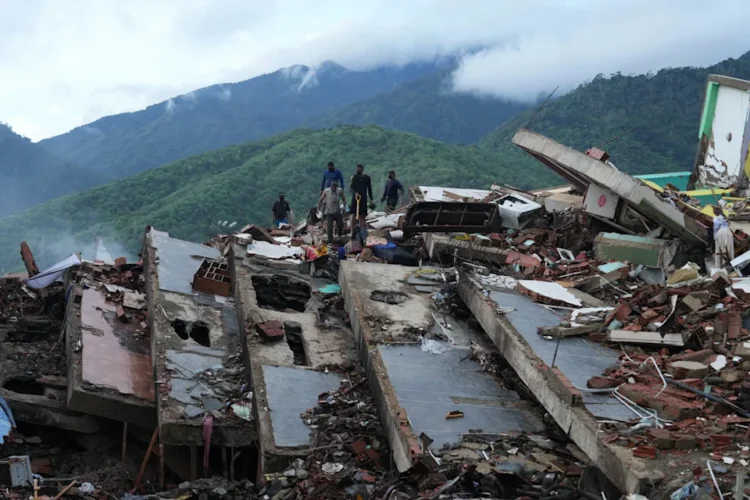
In the broken coastal state of La Guaira, where entire apartment blocks now resemble collapsed stacks of concrete and rebar, the rescue effort that followed Venezuela’s twin earthquakes has become a story of contrast as much as catastrophe.
On one side of the streets are exhausted civilians, volunteers, and international teams clawing through debris with borrowed tools and bare hands. On the other stand government personnel in crisp, spotless uniforms often visible at cordoned-off sites, sometimes observing, sometimes directing traffic, and frequently accused by residents of doing far less than the moment demands.
The earthquakes, which struck on June 24, 2026, with magnitudes of 7.2 and 7.5, have left thousands dead and tens of thousands missing, according to early estimates compiled by international agencies and humanitarian monitors. But beyond the staggering toll, what has emerged is a deeper public anger over how the response has been handled in the critical hours and days that followed. The most enduring image is not of destruction alone, but of stalled cranes beside collapsed towers, and emergency crews standing in clean uniforms while families sift through rubble for loved ones.

AD: Capeesh Restaurant
In disaster response, time is everything. The first 72 hours after a major earthquake are widely considered decisive for locating survivors trapped beneath debris. In Venezuela, that window closed with growing frustration among locals who say heavy machinery arrived late, if at all, in some neighbourhoods.
Across La Guaira and parts of Caracas, residents describe scenes of paralysis: excavators positioned near collapsed buildings but not operating, rescue convoys delayed by logistics bottlenecks, and coordination gaps between municipal authorities and national emergency services. In several districts, civilians formed human chains to remove debris while waiting for official support that never fully materialised.
International reporting has highlighted how civilians and foreign rescue teams took on much of the early-life-saving work, while official responses were often limited or poorly coordinated. In some locations, specialised search-and-rescue units with trained dogs and cutting equipment became the difference between life and death, while state resources lagged behind.

AD: Oysterian Sea Food Restaurant And Bar
The optics of Venezuela’s earthquake response have become a growing point of public frustration, with reporting that survivors in hard-hit areas like La Guaira described a stark contrast between exhausted civilians and international volunteers actively digging through rubble, and state personnel often seen in comparatively orderly conditions, sometimes focused on perimeter control rather than direct extraction efforts .
This visual divide, widely circulated through news photography and social media, has reinforced perceptions among residents that the early rescue response lagged behind the urgency on the ground. However, have pushed back against criticism, with reporting highlighting their emphasis on severe logistical constraints, including damaged infrastructure, dangerous aftershocks, and restricted access to collapsed zones that have slowed rescue operations and complicated coordination efforts.
Still, frustration persists in communities where survivors say they have waited days for machinery that never arrived. In one coastal neighbourhood, residents used hand tools to dig through reinforced concrete while cranes remained idle less than a kilometer away.
The scale of destruction has made logistics even more complex. Entire districts of La Guaira have been cut off by landslides and fractured roads. International aid has begun to flow in, including specialised urban search-and-rescue teams, but access remains uneven across affected regions.
Official response efforts in Venezuela have struggled to regain public confidence following the twin earthquakes, with reporting indicating that emergency services were initially limited and unevenly deployed, leaving civilians to carry out much of the early rescue work in collapsed buildings. Residents in affected areas including teachers such as Alexander Delgado organised improvised rescue crews and searched through rubble using shovels, ropes, and bare hands due to the slow and incomplete official response in some districts.
The same reporting notes that civilians effectively filled gaps where state forces and equipment were absent or delayed, while frustration grew over allegations of mismanagement and obstruction in parts of the response effort. It also describes residents digging through rubble in the first days after the disaster, with limited heavy machinery available and foreign rescue teams arriving later to assist overwhelmed local systems .
International assistance has also played a visible role. Search-and-rescue units from multiple countries have deployed alongside local volunteers, often working in improvised coordination systems built on necessity rather than formal command structures. In some cases, survivors have been pulled from rubble after more than 100 hours trapped beneath collapsed concrete rare but powerful reminders of why speed matters so urgently.
Tensions have grown over the role of security forces. Reports from humanitarian observers and journalists describe allegations of misallocated resources, restricted access to certain disaster zones, and accusations denied by officials of aid being obstructed or mishandled in some areas.
The government maintains that it is operating under extraordinary conditions and has pointed to ongoing coordination with international partners as evidence of progress. Officials have also emphasised that equipment shortages and infrastructure collapse have slowed even well-planned efforts. Residents point to empty streets where rescue vehicles should be, and to government personnel who appear more focused on perimeter control than extraction efforts. The result is a widening gap between official messaging and lived reality.
Experts note that when communities lose confidence in institutions, they tend to rely more heavily on informal networks—family groups, neighbourhood collectives, and spontaneous volunteer teams. That dynamic is now visible across Venezuela’s quake zone, where the rescue effort has become decentralised, improvised, and heavily dependent on civilian initiative.
The human cost continues to rise as aftershocks complicate recovery and medical facilities remain overwhelmed. Makeshift morgues have been established in some districts, while hospitals struggle with supply shortages and damaged infrastructure. International aid agencies warn that the coming weeks may bring secondary crises, including disease outbreaks and water shortages.
Still, amid the dysfunction, moments of solidarity persist. Neighbours share food in collapsed streets. Volunteers rotate through dangerous rubble sites in shifts. International rescue teams work side-by-side with local crews who know the terrain block by block.
The image that may define this disaster is not only the devastation of the quakes themselves, but the uneasy juxtaposition that followed: gleaming uniforms against grey rubble, stalled cranes beside urgent hands, and a nation forced to confront not just what it lost in seconds of seismic violence, but what it struggles to rebuild in its aftermath.
In the streets of La Guaira and the fractured outskirts of Caracas, the contrast has become part of the landscape itself rescue teams stepping carefully over shattered concrete while civilians continue to dig with improvised tools, refusing to wait for certainty that may never arrive. Above them, cranes stand motionless against the skyline, sometimes because roads are impassable, sometimes because coordination has broken down in the chaos of overlapping command structures and damaged infrastructure.
Aftershocks continue to ripple through already weakened districts, the sense of suspension grows more acute, as if the country is caught between disaster and recovery but fully inhabiting neither. Aid convoys arrive unevenly, hospitals strain beyond capacity, and every hour becomes a negotiation between urgency and limitation.
In this liminal space, symbolism takes hold quickly: the visible order of uniforms, the visible disorder of ruins, and the uneasy question of what preparedness truly means when the machinery of response does not move as fast as human desperation.

AD: Heritage And Restaurant Lounge Bar