
By Theodore Brown-
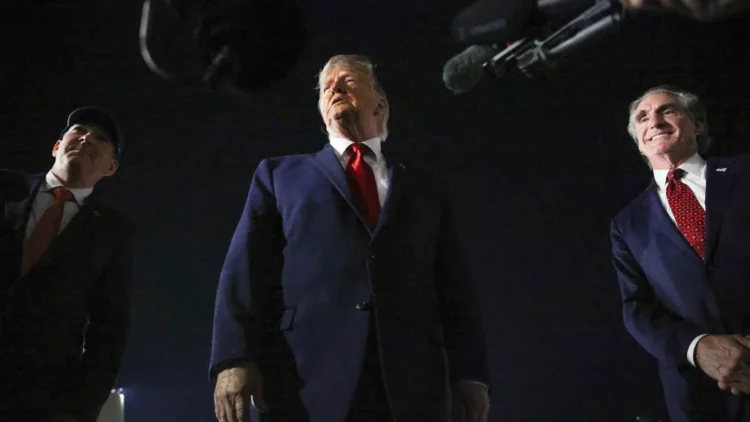
A sharp escalation in already volatile US-Iran tensions unfolded on Tuesday after former US President Donald Trump said the United States “must respond” to what he described as an Iranian attack on a US Army Apache helicopter near the Strait of Hormuz.
The incident, which took place in one of the world’s most strategically sensitive waterways, has intensified fears of a broader regional confrontation at a time when fragile ceasefire arrangements in the Middle East are already under strain.

AD: Capeesh Restaurant
According to US Central Command, the helicopter went down during a patrol mission off the coast of Oman in the early hours of Monday night into Tuesday morning. Both crew members were later rescued in a complex operation involving a US Navy unmanned surface vessel, marking a rare deployment of drone technology in a live recovery mission.
Trump, speaking shortly after the incident was reported, blamed Iran directly for the downing of the aircraft and warned that Washington could not ignore what he called an act of aggression. “The United States must, of necessity, respond to this attack,” he said in a statement posted on social media, according to multiple reports.
Iranian officials have not yet issued a formal response to the allegation, and independent verification of the cause of the crash remains pending.

AD: Oysterian Sea Food Restaurant And Bar
The Strait of Hormuz, a narrow maritime passage linking the Persian Gulf to the Gulf of Oman, has long been a flashpoint in US-Iran relations. Roughly a fifth of global oil supplies pass through the waterway, making it one of the most economically sensitive chokepoints in the world.
Any escalation in military activity in the area risks immediate ripple effects across global energy markets and international shipping routes. Tensions between Washington and Tehran have steadily escalated over the past months amid intermittent clashes involving drones, missiles, and naval patrols.
Recent weeks have seen exchanges of fire between Iranian forces and US-led coalition assets in and around the Gulf, including reported drone interceptions and retaliatory strikes on radar sites.
Analysts say these incidents reflect a pattern of controlled but increasingly dangerous confrontation, where both sides are testing limits without fully committing to open war.
The latest helicopter incident appears to have occurred during one such patrol operation. While early US military statements did not confirm hostile action, Trump’s assertion that Iran shot down the aircraft has significantly raised the political stakes.
The US military has said the cause of the crash is still under investigation, though it confirmed that the two pilots were recovered safely and are in stable condition.
The episode comes against the backdrop of broader regional instability involving Iran, Israel, and allied militia groups across Lebanon and Syria. A fragile ceasefire arrangement brokered earlier this year has repeatedly come under strain, with sporadic missile and drone exchanges continuing despite diplomatic efforts to stabilise the region.
In Washington, the political reaction has been swift. Senior figures aligned with Trump’s position have called for a firm response, arguing that failure to act would embolden further attacks on US forces operating in the region. Others, however, have warned that rapid escalation could trigger a wider conflict in an already unstable Middle East.
Strategic risks in the Gulf
The most direct and authoritative backing comes from energy security institutions and geopolitical analysis centers, which consistently describe the Strait of Hormuz as a critical chokepoint carrying roughly one-fifth of global oil supplies and therefore highly sensitive to disruption.
The U.S. Energy Information Administration notes that “around 25% of the world’s seaborne oil trade transits the Strait of Hormuz,” and that “any disruption to flows through the Strait would have huge consequences for world oil markets,” underscoring how even limited incidents can rapidly affect global energy prices and supply stability.
Similarly, the International Energy Agency highlights the Strait as one of the world’s most important oil chokepoints, stressing that in 2024–2025 it handled around 20 million barrels per day about 20% of global petroleum liquids consumption and that there are “very few alternative options” to reroute exports if it is blocked or threatened. This lack of redundancy is a key reason analysts treat even small escalations there as globally significant.
A more recent S&P Global analysis further explains the structural vulnerability: before the current regional war environment, more than 100 vessels per day passed through Hormuz, but since conflict escalation, traffic has dropped sharply due to “physical security risks and the exorbitant cost of shipping insurance,” making commercial operations more fragile and reactive to threats or incidents.
Geopolitical analysis from the Council on Foreign Relations also directly frames the Strait as a persistent U.S.–Iran maritime flashpoint, noting that Iran has repeatedly threatened shipping in the area and that Gulf states and global importers depend heavily on uninterrupted passage.
It highlights that even partial disruptions such as threats, seizures, or naval incidents can trigger immediate economic and strategic consequences because the Strait is both geographically narrow and economically irreplaceable.
Taken together, these sources support the claim that the Strait of Hormuz is widely assessed by military and energy analysts as one of the world’s most dangerous escalation points, where even limited military exchanges can produce outsized consequences due to concentrated global energy flows, limited alternative routes, and highly sensitive shipping and insurance conditions.
The reported use of unmanned systems in the rescue operation highlights the growing role of autonomous military technology in modern conflict zones. US forces deployed a naval drone to retrieve the helicopter crew, underscoring a shift toward remote and lower-risk recovery and surveillance operations in contested waters.
Markets reacted quickly to the news, with early trading showing increased volatility in oil futures amid concerns over potential disruptions to shipping through the Strait. Energy analysts have warned that any sustained escalation could drive significant price spikes, particularly if maritime traffic is restricted or insurance costs for tankers rise sharply.
Despite the heightened rhetoric, Trump has also suggested in recent remarks that diplomatic engagement with Tehran remains possible, even as he insists that any attack on US forces will be met with a response. That dual-track messaging reflects the broader uncertainty shaping US policy in the region, where military deterrence and diplomatic negotiation continue to run in parallel.
The situation remains fluid and the US military investigation into the helicopter incident is ongoing, while international observers watch closely for any sign of Iranian retaliation or further escalation. What is clear, however, is that the Strait of Hormuz has once again become the focal point of a confrontation with the potential to extend far beyond its narrow waters.

AD: Heritage And Restaurant Lounge Bar