
By Ben Kerrigan-
Thailand is confronting mounting concerns over construction safety after a second crane collapse in as many days killed at least two people near Bangkok, compounding national shock over a catastrophic train derailment caused by a similar crane accident the day before.
The back-to-back tragedies one in the capital’s outskirts and another in the northeast have drawn widespread public outcry and intensified scrutiny of infrastructure project safety standards across the country.

AD: Capeesh Restaurant
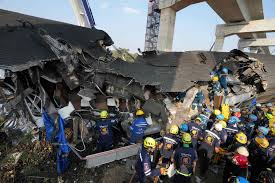
Thursday’s construction site accident occurred on Rama II Road in Samut Sakhon province, where a crane being used in the building of an elevated highway collapsed onto vehicles below, crushing at least two and injuring several others in the wreckage. Rescue workers rushed victims to hospitals as local authorities halted part of the road to assess ongoing risks at the unstable site.
The second fatal collapse came just 24 hours after a crane used on a high-speed rail project fell onto a moving passenger train in Nakhon Ratchasima province, causing a derailment that killed at least 32 people and injured dozens more one of the deadliest rail disasters in recent Thai history.
Together, the incidents have cast a spotlight on Thailand’s booming construction sector and raised urgent questions about workplace safety, regulatory oversight, and contractor accountability as the country pursues ambitious infrastructure development.

AD: Oysterian Sea Food Restaurant And Bar
The Thursday incident unfolded at about 9:15 a.m. local time on Rama II Road, a major artery leading out of Bangkok that has, in recent years, become associated with frequent construction accidents and earned a grim reputation among residents.
According to authorities, the crane and its attached concrete segment part of the elevated highway project known officially as Motorway No. 82 (Bang Khun Thian–Ban Phaeo Elevated Highway) gave way and tumbled onto the road below, crushing two civilian vehicles and killing their occupants. At least five other people were reported injured and rushed to nearby hospitals, including some with serious injuries.
Emergency responders initially hesitated to enter the immediate wreckage due to dangling steel plates and unstable construction materials, according to rescue workers, who said that safety risks prevented a full search until the area could be secured.
Transport Minister Phiphat Ratchakitprakarn confirmed the fatalities on national television and linked the project to the same contractor involved in the previous day’s train disaster. The firm Italian-Thai Development Plc (ITD) is a major construction player in Thailand, with involvement in several large-scale infrastructure projects across the country.
The coincidence of two fatal crane collapses allegedly tied to the same contractor within 48 hours has sparked alarm among Thai citizens and safety advocates, who are now pressing for a thorough review of construction practices nationwide.
Nakhon Ratchasima Train Disaster: Broader Impacts and Safety Scrutiny
Just a day earlier, a separate crane accident in Sikhio district, Nakhon Ratchasima province unleashed one of the most tragic rail incidents Thailand has seen in years. A launching gantry crane used in constructing a segment of the Thai–Chinese high-speed rail project collapsed onto Special Express Train No. 21 as it was traveling from Bangkok to Ubon Ratchathani, causing a derailment and a fire in one of the carriages.
The death toll from that incident has been confirmed at 32 people, with around 64 to 66 others injured, including several in critical condition. Among the victims were commuters, families heading to work, and students beginning their day.
Emergency responders faced harrowing conditions at the Sikhio site. Rescue teams used hydraulic cutters and heavy machinery to free trapped passengers from mangled carriages, while smoke and flames complicated efforts to reach victims in the impacted mid-section of the train.
The severity of the train disaster has drawn national and international attention, partly because the project is linked to the ambitious Thai–Chinese high-speed railway network, aimed at connecting Bangkok with Kunming in China via Laos as part of the Belt and Road Initiative.
Thailand’s Prime Minister Anutin Charnvirakul has demanded full accountability for the crash, with officials launching a detailed investigation into engineering practices, safety protocols, and the circumstances that allowed construction to proceed beneath an active rail line.
Critics have also accused the contractor, ITD, of ignoring safety advisories that prohibited heavy lifting operations while trains were scheduled to pass below allegations the company has not publicly addressed in detail. Some engineers and public figures have described the disaster as a “national embarrassment” resulting from inadequate planning and poor adherence to safety standards.
In the days following the derailment, search and rescue operations transitioned to site clearance and recovery, focusing on removing the collapsed crane base — weighing up to 20–30 tons — and restoring rail services on the crucial northeastern line. Thailand’s State Railway has diverted 14 train services via alternative junctions while cleanup continues.
The emotional toll on local communities has been profound. Families who lost loved ones at Sikhio have received condolences from Thai officials, and foreign governments including China and South Korea, whose citizens were among the victims have expressed concern and offered support.
The near-simultaneous nature of these disasters has prompted critics to call for a comprehensive audit of construction safety standards in Thailand.
Experts argue that rapid infrastructure expansion including expressways, elevated highways, and high-speed rail links must be matched with strict oversight, rigorous training, and transparent enforcement of safety regulations.
Transport Minister Ratchakitprakarn has said authorities will investigate both sites thoroughly and consider measures such as blacklisting contractors with poor safety records. The government is also exploring enhanced monitoring mechanisms for major infrastructure projects, particularly those involving heavy mobile cranes and elevated work zones.
Public pressure has also mounted for a safety “report card” system for contractors, a proposal that gained traction after the railroad accident. Proponents say such a system could help ensure accountability and prevent repeat tragedies by flagging firms with histories of violations or subpar practices.
In Samut Sakhon, local residents have expressed fear of further collapses, especially as construction crews struggle to stabilise remaining segments of the damaged site. Traffic advisories remain in place, with several outbound lanes closed while engineers assess risk and plan reconstruction.
Experts note that Thailand’s construction sector has faced criticism for years over workplace safety, with industrial accidents and fatalities occurring at project sites across the country. The recent spate of crane disasters could become a turning point, prompting deeper systemic reform.

AD: Heritage And Restaurant Lounge Bar