
By Ben Kerrigan-
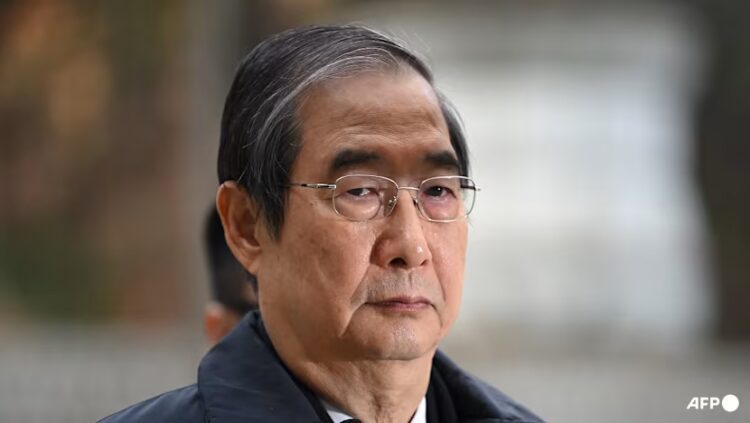
In a dramatic and precedent-setting verdict today, a South Korean court sentenced former Prime Minister Han Duck-soo to 23 years in prison, ruling that his role in the 2024 martial law crisis constituted participation in a rebellion against the constitutional order.
The decision marks a pivotal moment in South Korea’s modern political history, as the nation reckons with the fallout from a constitutional crisis that reverberated across its democratic institutions.

AD: Capeesh Restaurant
The Seoul Central District Court handed down the lengthy sentence to Han, 76, in what was described by judges as the first major conviction linking a former senior official to the insurrection tied to former President Yoon Suk Yeol’s declaration of martial law in December 2024.
Han, who served as prime minister during the tumultuous days of the crisis, became the first official from Yoon’s administration to be convicted of rebellion-related charges.
Prosecutors had argued that Han played a central role in giving procedural cover to what the court ultimately deemed an unlawful declaration of martial law actions that involved mobilising troops and attempting to suppress the normal functioning of parliamentary and electoral institutions.

AD: Oysterian Sea Food Restaurant And Bar
The court’s ruling declared that the martial law declaration was not merely a miscalculation or administrative error, but constituted a self-coup or riot that threatened the democratic framework of the Republic of Korea.
The judges found that Han attempted to legitimise the martial law decree by orchestrating a fabricated Cabinet Council meeting, falsifying official documents, and subsequently lying under oath.
In delivering the verdict, Judge Lee Jin-gwan stated that Han’s actions placed South Korea “in danger of returning to a dark past when basic rights and the liberal democratic order were trampled upon.” This language echoes the nation’s historical memory of authoritarian rule and underscores the gravity of what was at stake.
The sentencing of Han Duck-soo comes as part of a broader legal and political reckoning that has gripped South Korea since the chaotic events of December 2024. It was during that period that then-President Yoon Suk Yeol attempted to impose martial law, ostensibly to quell political gridlock and maintain public order amid severe opposition from lawmakers.
The martial law declaration lasted only a matter of hours before it was overridden by the National Assembly and a wave of public outcry. However, the constitutional breach it represented set in motion impeachment proceedings, mass protests, and subsequent criminal investigations that have engulfed the country’s leadership.
In a related but separate legal development, Yoon himself was recently sentenced to five years in prison on charges linked to his conduct around the martial law issue, including obstructing official duties and fabricating official documents.
The Han ruling is significant not only for its severity exceeding prosecutorial requests but also because it explicitly frames the martial law declaration as an act of rebellion. Under South Korean law, rebellion is among the most serious offenses, typically associated with armed attempts to overthrow the government.
This interpretation could have profound implications for the ongoing legal battles facing Yoon, whose own rebellion trial is set for 19 February 2026.
Prosecutors have even sought the death penalty in Yoon’s insurrection case, an extraordinary measure in a country that has not carried out capital punishment since 1997, although legal experts have noted that life imprisonment or very long sentences are more likely outcomes.
Han’s conviction also sets the tone for how South Korea will handle other senior officials implicated in the crisis. The courts and independent counsel have pursued charges against a number of former defence officials, police leaders, and political operatives connected to the martial law episode, signalling a sweeping effort to hold accountable those perceived to have undermined democratic norms.
Han Duck-soo, for his part, maintains that he opposed the martial law plans and did not participate willingly in unconstitutional acts claims that were rejected by the court. His defence and potential appeal to higher courts will be closely watched, though the immediate impact is that he will begin serving his sentence without bail.
The conviction of Han and the ongoing prosecution of Yoon Suk Yeol mark an extraordinary chapter in South Korea’s democratic evolution. What began as a short-lived political crisis has morphed into a long-term legal and constitutional test, one that could reshape public trust, party politics, and the balance of power in the years ahead.
Observers suggest that the rigorous legal response by courts, independent prosecutors, and civil society institutions reflects an enduring commitment to maintaining democratic norms, even when doing so entails punishing high-ranking statesmen.
Others caution that protracted political litigation could deepen societal divisions and distract from pressing economic and foreign policy priorities.

AD: Heritage And Restaurant Lounge Bar