
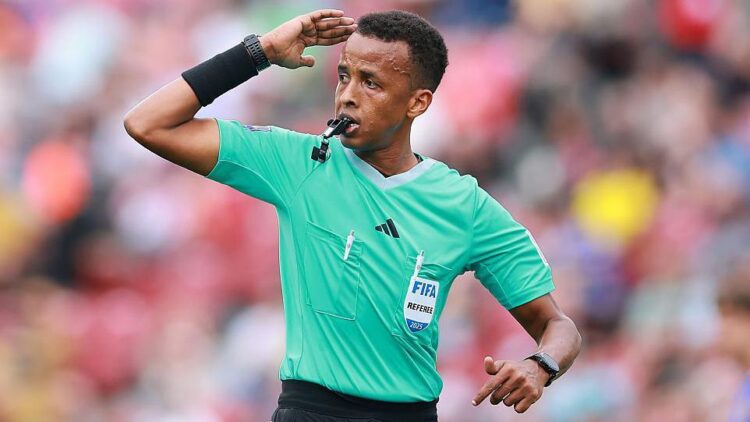
By Kenneth Williams-
A Somali football referee poised to make history at the FIFA World Cup has been denied entry into the United States, abruptly ending what was set to be a landmark moment for both his career and his country.
Omar Abdulkadir Artan, widely regarded as one of Africa’s top referees, was stopped upon arrival in Miami despite holding a valid visa and being selected among FIFA’s elite officials for the tournament. His exclusion has triggered diplomatic concern, sporting disappointment, and renewed scrutiny over US immigration procedures ahead of the global competition.

AD: Capeesh Restaurant
Artan had been scheduled to become the first Somali referee to officiate at a World Cup finals, a breakthrough widely celebrated in Somalia’s sporting community. Instead, after arriving at Miami International Airport from Istanbul over the weekend, he was subjected to extended questioning by US border authorities before being deemed inadmissible.
According to US Customs and Border Protection, the decision followed “vetting concerns,” though officials did not elaborate further on the specifics. FIFA later confirmed he would not be able to participate in the tournament due to the ruling by US authorities.
The case has quickly become one of the most talked-about incidents in the build-up to the 2026 World Cup, not only because of Artan’s professional standing but also because of what his absence represents for Somali sport on the world stage.

AD: Oysterian Sea Food Restaurant And Bar
Somalia has never had a referee officiate at a senior men’s World Cup match, and Artan’s selection had been hailed as a symbolic step forward for representation in international football.
Instead, the decision has raised questions about how immigration policy intersects with global sporting governance, particularly when host nations retain ultimate control over entry decisions.
A historic appointment cut short at the border
Artan’s selection by FIFA placed him among 52 referees chosen for the expanded 2026 tournament, which will be hosted across the United States, Mexico, and Canada. His inclusion was seen as part of FIFA’s broader push to diversify officiating talent and reward top-performing referees from emerging football nations.
Somali officials and African football bodies had celebrated his appointment as a milestone, noting his rise through CAF competitions and his recognition as one of the continent’s standout referees.
That trajectory came to an abrupt halt when he landed in the United States and was stopped for secondary inspection. Multiple reports indicate he was questioned for several hours, with officials reviewing his travel history and asking detailed questions before ultimately refusing entry.
US authorities later stated that all arriving passengers are subject to security screening and admissibility assessments, and that decisions are made on a case-by-case basis based on national security and immigration databases.
FIFA has emphasised that it does not control visa or immigration decisions, reiterating that responsibility lies solely with the host country. In a statement, the governing body confirmed that Artan would not be able to train or officiate at the tournament, effectively removing him from the World Cup roster.
With Somalia, the ruling carries significant symbolic weight. President Hassan Sheikh Mohamud had previously highlighted Artan as a role model for young Somali athletes, and his appointment had been framed domestically as evidence that Somali professionals could reach the highest levels of global sport despite long-standing structural challenges in the country’s football infrastructure.
The decision has also reignited debate over the wider political context shaping travel access to the United States. Somalia is among several countries affected by restrictions linked to US immigration policy changes, including broader travel bans introduced under recent administrations.
Critics argue that such policies can have unintended consequences when applied to international sporting events that depend on global participation.
The incident has underscored the tension between FIFA’s global tournament model and the sovereign immigration systems of host countries. While FIFA selects officials based on merit and performance, entry into host nations remains subject to domestic security vetting, which can override sporting appointments even at the highest level of competition.
US Customs and Border Protection has maintained that its officers acted within standard procedures, stating that admissibility determinations are routine and based on law enforcement and security information available at the time of inspection.
Similar explanations have been used in other high-profile entry cases involving athletes and officials travelling to the United States for international competitions.
The fallout from Artan’s denial has also drawn attention within football governance circles, with commentators warning that the integrity of international tournaments can be affected when selected officials are unable to participate due to immigration barriers.
Somali sports officials have expressed disappointment, arguing that the decision undermines the principles of fairness and merit-based selection that FIFA claims to uphold.
Supporters of Artan have described the ruling as a personal and national setback, with some calling on FIFA and diplomatic actors to intervene or seek clarification. However, FIFA has limited capacity to challenge host government decisions once visa rulings are made, a structural limitation that has repeatedly complicated tournament logistics in politically sensitive environments.
The broader context adds further complexity. The 2026 World Cup is the largest in history, expanding to 48 teams and requiring a significantly larger pool of referees, assistants, and support staff. That expansion was intended to promote inclusivity, yet cases like Artan’s highlight how external political and administrative systems can still determine who ultimately participates.
Artan remains in Istanbul, according to multiple reports, reflecting on an opportunity that once placed him on the brink of global recognition but ended before he could step onto the world stage. His exclusion leaves a gap not only in FIFA’s refereeing roster but also in Somalia’s sporting history, one that had briefly seemed ready to be rewritten on football’s biggest stage.
A referee who had steadily climbed through CAF competitions and earned a place among FIFA’s selected officials for the expanded 2026 World Cup, the sudden reversal represents not just a professional setback but a deeply personal disappointment after years of progression through regional and international ranks.
Those close to Somali football have described Artan’s selection as a landmark moment that carried meaning far beyond sport, symbolising the gradual emergence of Somali officials in elite global competitions despite limited infrastructure and decades of instability at home. His absence now interrupts that narrative at a moment when visibility at the highest level of football was within reach.
In Istanbul, where he is believed to be staying while the situation is reviewed, the sense of uncertainty underscores how quickly international careers can be reshaped by administrative decisions beyond the pitch.

AD: Heritage And Restaurant Lounge Bar