
By Ben Kerrigan-
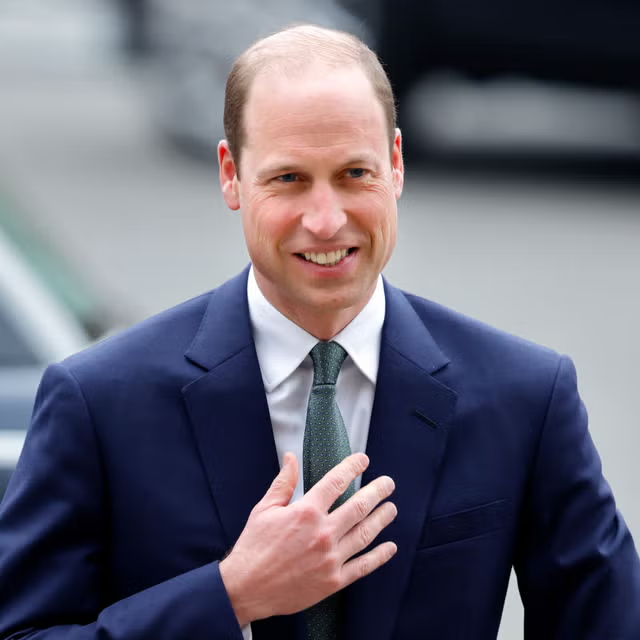
In a development that underscores deepening divisions within the British royal family, Prince William is reportedly taking an uncompromising stance when it comes to his uncle, Prince Andrew. According to multiple reports circulating in royal circles, the Prince of Wales has made it unequivocally clear that the Duke of York will have no role in the lives of his children—Prince George, Princess Charlotte, and Prince Louis. The decision, described by insiders as “final” and “non-negotiable,” signals a hardening of attitudes within the monarchy as it continues to navigate the fallout from one of its most persistent controversies, particularly Andrew’s association with Epstein.
The reported move is not merely a private family matter—it reflects a broader effort by Prince William to protect both the future of the monarchy and the public image of his immediate family. As the heir to the throne, William has increasingly stepped into a leadership role, shaping not only the institution’s public-facing strategy but also its internal boundaries. His alleged refusal to allow Prince Andrew any proximity to his children highlights a generational shift in how the royal family confronts reputational risk and personal accountability.

AD: Capeesh Restaurant
Prince Andrew’s public standing has been under intense scrutiny for years, particularly following his withdrawal from official royal duties amid widespread criticism and legal controversies. While he has consistently denied wrongdoing, the damage to his reputation has proven difficult to contain. For many observers, his continued association with the royal family presents an ongoing challenge—one that Prince William appears determined to address head-on.
Sources close to the situation suggest that William’s decision is rooted in a desire to shield his children from potential controversy and to ensure that their upbringing remains free from the complexities surrounding their great-uncle. The Prince and Princess of Wales have long emphasized the importance of providing as normal a childhood as possible for their children, despite the extraordinary circumstances of royal life. This reported boundary may be seen as an extension of that philosophy—prioritizing stability, clarity, and moral consistency.
At the same time, the move is likely to reverberate throughout the royal household. Prince Andrew, once a prominent figure within the monarchy, has already experienced a dramatic reduction in his public role. However, being effectively excluded from contact with the next generation of royals marks a further step toward isolation. It also raises questions about how other family members may navigate their relationships with him moving forward.

AD: Oysterian Sea Food Restaurant And Bar
A Royal Rift That Signals a Changing Monarchy
The reported decision by Prince William is emblematic of a broader transformation within the royal family—one in which tradition is increasingly balanced against the demands of modern public life. In previous generations, internal disputes were often handled discreetly, with an emphasis on maintaining a united front. Today, however, the intense scrutiny of media and public opinion has made such an approach more difficult to sustain.
William’s stance can be interpreted as a reflection of this new reality. As a future king, he is acutely aware that the monarchy’s legitimacy depends not only on its historical legacy but also on its ability to align with contemporary values. By drawing a clear line regarding Prince Andrew, he may be seeking to demonstrate a commitment to accountability and to signal that certain issues cannot be overlooked or quietly managed.
This approach contrasts with the more cautious handling of the situation in earlier stages, when the royal family appeared to adopt a strategy of gradual distancing rather than outright exclusion. While Prince Andrew stepped back from public duties, he has remained a member of the family, occasionally appearing at private gatherings and events. William’s reported decision suggests that, at least for his immediate household, even that limited level of inclusion is no longer acceptable.
The implications extend beyond family dynamics. For the monarchy as an institution, moments like this can serve as defining tests of its ability to adapt. Public trust, once eroded, is difficult to rebuild, and the actions of senior royals play a crucial role in shaping perceptions. By taking a firm and visible stance, William may be attempting to reinforce the idea that the monarchy is capable of self-regulation and moral clarity.
However, such decisions are rarely without consequence. Within the family, they can deepen existing tensions and create new fault lines. Prince Andrew’s position has already been a source of discomfort and disagreement, and a move of this magnitude is unlikely to be universally supported. It may place other senior royals in a delicate position, as they navigate their own relationships while maintaining a sense of cohesion.
For the public, the story adds another layer to the ongoing narrative surrounding the royal family—a narrative that has become increasingly complex in recent years. From generational differences to questions of accountability and relevance, the monarchy is undergoing a period of introspection and change. William’s reported stance on Prince Andrew can be seen as part of this broader evolution, reflecting a willingness to make difficult decisions in pursuit of long-term stability.
As the situation continues to unfold, it remains to be seen how it will ultimately shape the future of the royal family. What is clear, however, is that Prince William is positioning himself as a decisive and forward-looking figure—one who is prepared to make tough choices, even when they involve close relatives. In doing so, he is not only defining his own leadership style but also setting the tone for the next chapter of the monarchy.
The reported exclusion of Prince Andrew from the lives of William’s children is more than a personal boundary—it is a statement. A statement about values, about priorities, and about the kind of institution the monarchy aims to be in the years ahead. Whether it will strengthen public confidence or deepen internal divisions remains to be seen, but it undeniably marks a significant moment in the ongoing story of Britain’s royal family.

AD: Heritage And Restaurant Lounge Bar