
By Gabriel Princewill-
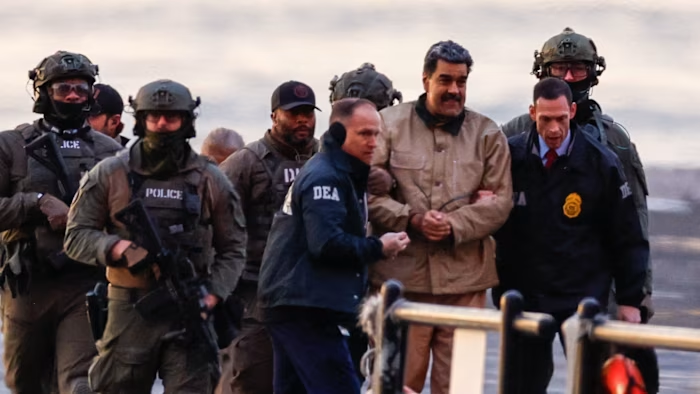
The 2026 seizure of Venezuelan President Nicolás Maduro by United States forces has become one of the most contentious legal and diplomatic incidents of the decade. While U.S.
Although officials and a minority of legal experts argue that the operation did not break international law, a broad consensus among international law scholars and many nations holds that the arrest violated fundamental principles of the United Nations Charter.

AD: Capeesh Restaurant
At the heart of the debate are differing interpretations of self‑defence, state sovereignty, head‑of‑state immunity, and the legality of unilateral use of force.
The United Nations Security Council has engaged in intense debate over the legality of the U.S. action, with some member states condemning the operation as a breach of international norms and others focusing on shared concerns about organised crime and narcotics trafficking.
United Nations Secretary‑General António Guterres has expressed deep concern over the implications of the seizure, warning that it could set a “dangerous precedent” for global security if the UN Charter’s prohibition on the use of force is undermined.

AD: Oysterian Sea Food Restaurant And Bar
Critics at the council, including China and Russia, have called for Maduro’s immediate release and stressed that unilateral military action against a sovereign nation violates established norms.
Despite this international scrutiny, U.S. officials have defended the operation as a law enforcement action targeting an indicted criminal, not as an act of war. Backed by domestic legal doctrines and historical precedent, this defence forms the core of arguments suggesting that the seizure was legal or at least could be interpreted in ways that do not violate domestic law, even if international legality remains disputed.
Article 51 of the UN Charter affirms the inherent right of individual or collective self‑defence if an armed attack occurs against a member state. The Trump administration invoked this provision to justify the seizure, arguing that Maduro’s alleged involvement in large‑scale narcotics trafficking and ties to armed groups constituted a long‑term threat to U.S. national security.
Under this interpretation, actions harming the United States and regional stability could be viewed as comparable to an armed attack, thereby triggering a right to defensive measures. However, numerous legal analysts argue that this stretches the meaning of “armed attack” well beyond its traditional application to kinetic military aggression.
Cases of transnational crime and drug trafficking have not historically been accepted as a trigger for unilateral military intervention under Article 51. In fact, both international courts and legal scholars emphasise a high threshold for qualifying an incident as an armed attack under international law.
Relatedly, the question of sovereignty and head‑of‑state immunity has been central to debates over legality. International law normally grants heads of state immunity from prosecution abroad, reflecting the sovereign equality of states and the principle that one nation cannot punish the leader of another without consent or international authorisation.
The United States argues that Maduro was not entitled to such protections because his 2024 reflection was widely deemed fraudulent by Washington and several allied governments, which no longer recognised his legitimacy.
Arguments regarding the legality of the Trump administration’s seizure and extraction of Nicolás Maduro (as of January 2026) are divided between domestic justifications and international law violations.
While most international experts consider the action a breach of sovereign norms, the administration and some legal scholars provide several “legitimate” arguments within the framework of U.S. domestic law and executive authority.
Arguments regarding the legality of the Trump administration’s seizure and extraction of Nicolás Maduro (as of January 2026) are divided between domestic justifications and international law violations. While most international experts consider the action a breach of sovereign norms, the administration and some legal scholars provide several “legitimate” arguments within the framework of U.S. domestic law and executive authority.
Inherent Presidential Authority (Article II)
The administration argues that the President has inherent constitutional authority under Article II to use military force to protect U.S. personnel and interests.
Protection of Personnel: Supporters argue the kinetic action used during the mission was necessary to “protect and defend those executing the arrest warrant” from imminent attack.
Law Enforcement Mandate:
The mission is framed as a judicial extraction intended to bring a fugitive to justice for domestic crimes (narco-terrorism and cocaine importation) rather than an act of war.
A central argument for the legality of Maduro’s subsequent trial in U.S. courts is that he does not hold the status of a recognized head of state. Since 2019, the U.S. has officially refused to recognize Maduro as the legitimate president of Venezuela, characterizing him instead as a “usurper”.
This creates a “legal grey area” where he is treated as a private citizen or leader of a criminal enterprise rather than a sovereign official entitled to immunity.
Even if the method of capture violated international law, U.S. courts have a long-standing principle that the legality of a defendant’s capture does not affect the court’s jurisdiction to try them.
Ker-Frisbie Doctrine: This legal doctrine holds that U.S. courts may exercise jurisdiction regardless of whether a defendant was abducted or forcibly brought into the country.
Inherent Presidential Authority (Article II)
The administration argues that the President has inherent constitutional authority under Article II to use military force to protect U.S. personnel and interests.
Protection of Personnel: Supporters argue the kinetic action used during the mission was necessary to “protect and defend those executing the arrest warrant” from imminent attack.
The mission is framed as a judicial extraction intended to bring a fugitive to justice for domestic crimes (narco-terrorism and cocaine importation) rather than an act of war.
A central argument for the legality of Maduro’s subsequent trial in U.S. courts is that he does not hold the status of a recognized head of state. Since 2019, the U.S. has officially refused to recognize Maduro as the legitimate president of Venezuela, characterizing him instead as a “usurper”.
This creates a “legal grey area” where he is treated as a private citizen or leader of a criminal enterprise rather than a sovereign official entitled to immunity.
Domestic Law and Judicial Precedent
Even if the method of capture violated international law, U.S. courts have a long-standing principle that the legality of a defendant’s capture does not affect the court’s jurisdiction to try them.
Ker-Frisbie Doctrine: This legal doctrine holds that U.S. courts may exercise jurisdiction regardless of whether a defendant was abducted or forcibly brought into the country.
Under this view, Maduro was not a lawful head of state with full sovereign immunities, and his alleged criminal actions such as narcotics trafficking and crimes against humanity fell outside official functions, removing claims of immunity.
U.S. courts have previously applied similar reasoning in the case of Manuel Noriega, a former Panamanian leader whose extraterritorial capture and prosecution were upheld despite challenges to jurisdiction.
However, many international law experts reject the notion that legitimising U.S. actions based on non‑recognition of leadership equates to a legal removal of sovereign protections. Even if a government is widely unrecognised, the principle of sovereignty remains intact unless displaced by valid UN Security Council authorisation or clear self‑defence criteria.
Without either, critics argue, the operation violated Article 2(4) of the UN Charter, which forbids the use of force against the territorial integrity or political independence of any state.
Historical precedent and the limits of legal justification
Proponents of the U.S. position also point to historical precedent, most notably the 1989 capture of Panamanian leader Manuel Noriega.
Noriega was wanted on criminal charges in the United States, and U.S. forces extraterritorially snatched him from Panama. U.S. courts upheld jurisdiction using the Ker‑Frisbie Doctrine, which holds that the manner in which a defendant is brought before a court does not divest the court of jurisdiction.
This domestic legal doctrine has been cited to argue that judicial proceedings against Maduro are legitimate even if the method of his capture is contested. Critics counter that while such domestic precedents may apply within U.S. courts, they do not provide a valid basis for evading international legal obligations.
Yet, the substantive value of any international law is only as meaningful as the consequences for breaching it. If breaches are inconsequential, the fundamental essence of international law may be futile, as far as pragmatism is concerned.
Another element of the U.S. defence is the characterisation of the operation as a law enforcement action rather than a military intervention. Senior U.S. officials described the seizure as a mechanism to execute an arrest warrant under federal indictments against Maduro for narcotics‑related offences, emphasising that the goal was not to occupy Venezuela or pursue regime change.
Despite these assertions, many states at the United Nations, including Brazil, Mexico, and Colombia, condemned the operation as crossing an “unacceptable line” and undermining norms against externally imposed use of force.
Most countries argue that law enforcement responses to transnational crime must be pursued via international cooperation mechanisms, extradition treaties, or Security Council mandates, not unilateral military action.
Ultimately, while the U.S. position draws on domestic legal principles and asymmetric interpretations of self‑defence, it does not align with the traditional framework of international law as codified in the UN Charter and supported by the majority of legal scholars and state practice.
Forces acting in the territory of another sovereign state without consent are generally considered a breach of neutrality and sovereignty, even if motivated by criminal allegations or regional security concerns.
Nevertheless, the legal controversy illustrates deep disagreements about how international law should adapt to modern threats like transnational organised crime. Supporters of the U.S. rationale argue that traditional legal frameworks may need evolution to address non‑state and hybrid threats affecting national security.
Critics, however, tress that eroding the prohibition on unilateral use of force risks undermining the foundational principles of collective security and state sovereignty that underpin the modern international order.
The debate over Maduro’s capture has not only legal implications but also geopolitical ones, as nations around the world weigh the balance between rule‑based order and unilateral action.
One certainty that emerges from the debate is that international law has only as much value as the consequences for breaching them, even if it was breached in this case. In which case criticisms levied against Trump with respect to alleged violation of international law, may be more political than they are legal.

AD: Heritage And Restaurant Lounge Bar