
By Ben Kerrigan-
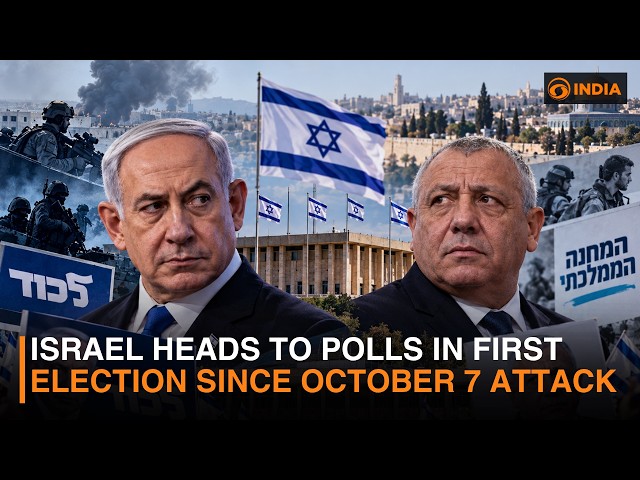
After years of political survival, Benjamin Netanyahu confronts a defining election shaped by the October 7 attacks, the devastation of Gaza, public anger and a deeply divided nation. For his supporters, he remains Israel’s indispensable strongman. For his critics, he represents a leadership that has failed the country and damaged its standing in the world.
JERUSALEM — Israel is voting in an election that could reshape the country’s political future, but one question continues to dominate the national conversation: can anyone finally dislodge Benjamin Netanyahu? The veteran prime minister has survived political crises, fractured coalitions, mass protests and a prolonged corruption trial.

AD: Capeesh Restaurant
When voters head to polling stations on Tuesday, 27 October 2026, his remarkable political resilience is facing one of its most consequential tests. The first national election since the Hamas-led attacks of 7 October 2023 has become a referendum on Netanyahu’s leadership, his security record and the direction in which he has taken Israel.
Recent polling points towards a fiercely contested race, with neither his governing bloc nor the opposition assured of the 61 seats required to command a majority in the 120-member Knesset. The result could therefore produce not a decisive political settlement, but another exhausting round of coalition negotiations. (Reuters; Associated Press)

AD: Oysterian Sea Food Restaurant And Bar
Netanyahu’s most loyal supporters consider their prime minister as possessing a quality that few of his opponents can match: an apparently inexhaustible ability to survive. They see a leader who understands Israel’s security threats, confronts hostile regional powers and refuses to surrender to international pressure. His political brand has been built around strength, deterrence and the conviction that Israel cannot afford an inexperienced hand at the wheel.
Voters who place security above almost every other consideration may deem, his longevity can look like proof of competence rather than evidence of political stagnation. His supporters are not necessarily blind to the country’s problems; many simply believe that a familiar and formidable leader is preferable to an uncertain alternative in a dangerous region. Netanyahu’s opponents argue that a prime minister who has spent years presenting himself as the guarantor of national security cannot escape responsibility for that failure.
They also criticise his handling of the wars that followed, the prolonged suffering in Gaza, the strain placed on Israeli reservists and the absence of a convincing political horizon for the conflict. For these critics, the issue is not whether Netanyahu is politically gifted. It is whether his extraordinary gift for retaining power has come at the expense of accountability. The anger extends beyond security. Netanyahu’s governing coalition has relied on far-right and ultra-Orthodox parties whose demands have deepened divisions over religion, military service, judicial reform and the future of the occupied West Bank. Exemptions from military service for many ultra-Orthodox men have become especially contentious as soldiers and reservists face the consequences of prolonged conflict. Critics also fear that judicial changes promoted by the right will weaken institutional checks on executive power.
The prime minister’s ongoing corruption trial, involving allegations of bribery, fraud and breach of trust that he denies, has added another layer of distrust. To his opponents, these controversies form a pattern: a government increasingly preoccupied with its own survival while the country struggles with the consequences of war and political division. Netanyahu’s durability should not be mistaken for an assured victory. His principal challenger, former military chief Gadi Eisenkot, has emerged as a serious contender through a campaign built around security competence, national unity and restoring public trust. Eisenkot is not an outsider to Israel’s military establishment; he is a former chief of the general staff who served in the emergency wartime government after the October 7 attacks before breaking with Netanyahu.
His own son, Gal Meir Eisenkot, was killed while serving in Gaza in December 2023, a personal loss that has shaped his public standing. Eisenkot presents himself as a disciplined alternative to a political system he believes has failed to take responsibility for its mistakes. His appeal lies in the promise of change without abandoning Israel’s traditional emphasis on security.
The opposition faces a formidable obstacle of its own: it is not a single, ideologically unified movement. Eisenkot’s centrist Yashar party competes alongside other opposition forces, including the alliance associated with Naftali Bennett and Yair Lapid, the secular right-wing Yisrael Beiteinu and the left-wing Democrats. Arab-led parties have their own constituencies and political priorities, while cooperation between Jewish-led opposition parties and Arab political representatives remains contentious.
Even voters who want Netanyahu removed may disagree sharply about what should replace him. That fragmentation offers the prime minister an opportunity to remain in office even if his bloc finishes behind its rivals. In Israel’s parliamentary system, voters elect parties, and the leader capable of assembling a governing coalition may ultimately prevail over the leader whose side wins the largest share of votes.
The international consequences are equally significant. Israel’s conduct of the Gaza war has inflicted severe damage on its standing across much of the world, while its relationship with key Western partners has become more politically fraught. Netanyahu’s supporters interpret foreign criticism as evidence that Israel is being unfairly pressured to compromise its security. Critics counter that diplomatic isolation is not inevitable and that leadership choices have contributed to it. A change of government could offer an opportunity to rebuild trust with allies, but it would not automatically resolve disputes over Palestinian rights, settlement expansion, military operations or the future governance of Gaza.
The election carries enormous consequences, for Palestinians even though their political future has not occupied the centre of the campaign to the extent that the scale of the humanitarian crisis might suggest. A Netanyahu victory would likely mean continuity in the broad direction of his right-wing coalition, although the composition of any new government would matter. An opposition victory could change the tone of Israeli politics, its relations with Washington and its approach to domestic institutions, but it should not be confused with a guaranteed breakthrough towards Palestinian statehood or an end to occupation.
The decisive question is not simply whether Netanyahu can survive another election. It is what his survival would say about the country he leads. his admirers see him as a protective figure in an unforgiving neighbourhood, a leader whose experience outweighs his mistakes. His critics see him as embodying the dangers of a political system in which personal longevity has displaced accountability and national renewal. As the ballots are cast, both interpretations compete for the future of Israel. And even if the electorate delivers a verdict, the fragmented arithmetic of the Knesset may ensure that the final decision about who governs remains unresolved for weeks. Netanyahu has repeatedly demonstrated that counting him out is dangerous. This time, however, the question is whether his greatest political strength can overcome the accumulated weight of the crises that now define his legacy.

AD: Heritage And Restaurant Lounge Bar