
By Isabelle Wilson-
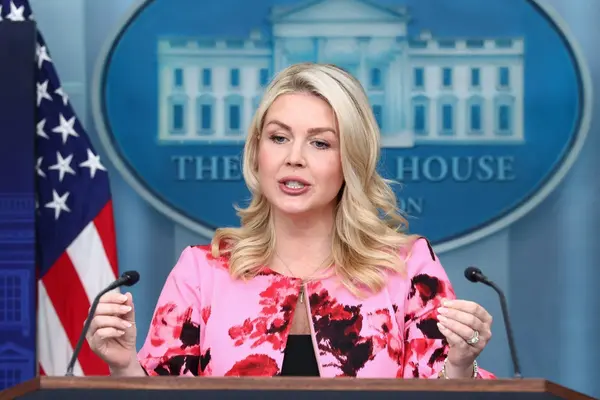
In a week dominated by escalating tensions between Washington and Tehran, White House Press Secretary Karoline Leavitt has found herself at the center of an intense public controversy not for a policy memo, but for the blending of religious language with some of the sharpest rhetoric surrounding the U.S.–Iran conflict.
Leavitt’s pronouncements, which include repeated references to her Christian faith and tough talk about Iran’s resistance to U.S. pressure, have drawn sharp reactions from both national and international audiences.

AD: Capeesh Restaurant
At a March press briefing, Leavitt opened with an invocation of prayer before pivoting to blunt declarations on the war’s progress and the administration’s stance toward Iran’s leadership and citizens resisting President Donald Trump’s demands.
The interaction, covered alongside other developments in other outlets, was striking not merely for its content but for its tone one that fused devout religious affirmation with unyielding geopolitical messaging.
Critics have accused Leavitt of leveraging religious imagery to justify lethal force. They highlight that her framing places Christian devotion alongside language about beating back perceived enemies, at times appearing to conflate spiritual love with conditional support in conflict especially against those Iranian actors the U.S. views as defying Trump’s terms for ceasefire or negotiation. But representatives of the US administration argue that invoking faith echoes historic American traditions of grounding foreign policy in moral conviction.

AD: Oysterian Sea Food Restaurant And Bar
Leavitt’s religious framing arrived against the backdrop of growing international concern over the conflict’s toll. President Trump continues to issue stark warnings to Tehran, including threats to critical infrastructure absent an agreement to halt missile strikes and re‑open strategic maritime routes escalating rhetoric that dovetails with Leavitt’s own remarks.
What has unsettled observers most, however, is the implication that Leavitt’s theological references could be used to justify or embolden harsher tactics in a war that has already exacted significant humanitarian costs.
Iran’s government has rebuffed Trump’s peace proposals and maintains its refusal to capitulate unconditionally, while the White House argues that its pressure strategy seeks to end Tehran’s influence in the region.
Leavitt’s blending of faith and foreign policy comes at a time when religion’s role in American governance is under intense debate. She has repeatedly emphasised her Christian identity in public settings, asserting that her faith underpins her commitment to American values and national defence.
Yet many Americans see a stark dissonance between the teachings of Jesus central to Christian doctrine on peace and compassion and the portrayal of military annihilation for those who resist political demands.
Within the administration’s own narrative, however, Leavitt’s statements are framed as moral clarity against what they describe as a destabilizing and violent Iranian regime. The White House has insisted that its actions are defensive and necessary to protect national and allied interests, often couching its objectives in language of righteousness and moral duty.
Her supporters point out that emphasising faith in this context aims to rally public support and offer a moral compass in the face of complex geopolitical conflict.
Yet critics worry that such rhetoric could further polarize the public and blur the line between personal belief and national policy. Religious voices around the world, including prominent leaders, have urged peaceful resolution and condemned rhetoric that could be interpreted as dehumanising entire populations.
A recent statement by a major religious figure, for instance, underscored that violence stands in contradiction to spiritual teachings of love and mercy comments that, while not directly about Leavitt, signal growing religious backlash against war‑time language.
Internationally, the framing of the conflict as a moral crusade resonates uneasily. Iran’s leadership and its supporters view American rhetoric as cultural imperialism disguised as moral righteousness, a perspective that analysts say complicates any diplomatic path forward.
With casualty rates rising and energy markets destabilised, global leaders from Europe and the Middle East are urging de‑escalation, even as Washington maintains its demands.
Amid this turmoil, Leavitt has doubled down on her message. In subsequent briefings and on social media, she has reiterated her faith while defending the administration’s hardline stance.
Public opinion remains deeply divided; within the U.S., some conservative voices praise her boldness and see no contradiction between faith and firmness, while opponents decry what they portray as an unholy alliance of religion and militarism.
Whether Leavitt’s approach will strengthen or weaken the administration’s position is uncertain. Many Americans express fatigue over protracted conflict, while global partners call for restraint and negotiations. For the Iranian people, the reverberations are immediate and personal lives lost, families displaced, and a widening humanitarian crisis.
What is clear, however, is that Leavitt’s blending of spiritual affirmation with combative geopolitical messaging has struck at a nerve in the national consciousness. It underscores the persistent challenge of articulating national purpose in a way that resonates with diverse moral frameworks at home and abroad.
In a conflict that shows no immediate signs of abating, the role of rhetoric as much as military strategy will shape public understanding and international reactions for months to come.
Leavitt’s statements illustrate the increasing power of words in modern warfare, where the battle for hearts and minds can be as consequential as the physical frontlines. Her invocation of religious principles alongside aggressive foreign policy positions signals to supporters a moral justification for U.S. actions, framing the conflict not simply as political or strategic, but as ethically necessary.
Yet, this same rhetoric risks alienating those who perceive a gap between professed spiritual values and the realities of military engagement, including civilian casualties and humanitarian crises. The tension between moral posturing and practical consequences becomes particularly visible when religious symbolism is deployed to sanction actions that could otherwise provoke condemnation.
International observers have also noted the symbolic weight of Leavitt’s approach. Countries in Europe, the Middle East, and Asia are sensitive to the idea that U.S. policy may be framed in quasi-religious terms, which could be interpreted as ideological zeal rather than pragmatic diplomacy.
While the Iranian people and their allies, this combination of faith and force can exacerbate mistrust and harden resistance, making negotiation and de-escalation even more difficult. Analysts argue that the global reception of such messaging can influence alliances, energy markets, and broader regional stability.
Leavitt’s rhetoric highlights a central challenge of contemporary statecraft, that is, how to communicate conviction and moral clarity without crossing into language that intensifies conflict or undermines legitimacy.

AD: Heritage And Restaurant Lounge Bar