
By James Simons-
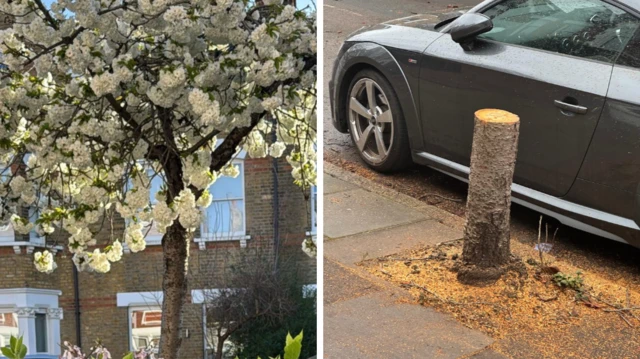
In a shocking case of human error, a healthy cherry tree was cut down on the wrong street by contractors hired to remove a dangerous tree elsewhere prompting outrage among residents and renewed scrutiny of tree-felling protocols.
The mistake, admitted by the contractor, has revealed alarming gaps in the checks and balances meant to protect urban trees, and sparked a broader conversation about how such blunders can be prevented.

AD: Capeesh Restaurant
The error took place in the early hours when a team from Premier Tree Care & Conservation arrived in Kew, Richmond, under orders to remove a diseased tree identified for removal by the local council. Instead, the team felled a thriving, mature cherry tree on Priory Road a street with the same name as the intended target but located in a different borough, roughly ten miles away.
Locals described how the healthy tree was gone in “minutes,” leaving behind a bare stump and a sense of disbelief.
Neighbours attempted to challenge the contractors on site, asking to see any council authorisation or evidence the tree was diseased, but were met with reassurances that the job was valid. Only later did the company admit the devastating mistake.

AD: Oysterian Sea Food Restaurant And Bar
In a statement issued soon after, Premier Tree Care & Conservation expressed its “deepest regret,” acknowledging the removal was due to “human error” and assuring residents that a replacement cherry tree would be planted as soon as possible.
As far as the local community is concerned, the apology and promise of a replacement brought little solace. Many described the cherry tree as a beloved landmark one that had provided shade, beauty, and a sense of place for decades.
Local resident Alison Murphy recalled standing outside her home as the contractors worked. She said she had asked to view documentation relating to the tree’s status. Instead, a worker showed a letter on his phone, apparently issued by a council in Ealing not Richmond a clear sign the crew were in the wrong location.
“I wish I’d realised they were in the wrong borough,” she said. “Then I might have stopped them.”
Beyond the emotional toll, the incident has sparked anger over the apparent lack of safeguards in place to prevent such a dramatic error. Villagers in similar cases have expressed frustration at what some call “devastating negligence.”
In another example from March 2025, a tree in the village of Dunchurch was partially felled by mistake when contractors misread a worksheet and pollarded the wrong tree a Swedish Whitebeam instead of the targeted diseased Red Oak. Locals described the error as a “travesty.”
Such recurring incidents raise serious questions about training, oversight, and accountability. When contractors misidentify properties, rely on ambiguous instructions, or fail to verify addresses the result can be irreversible damage to public green spaces and community heritage.
Advocates for urban forestry argue that there must be stricter protocols when issuing felling orders. Mapping, GPS verification, and independent checks should all be standard rather than optional. “Once a tree is down, there is no going back,” said one concerned resident.
Councils and tree-management companies often argue that confusion over street names, outdated record-keeping, and heavy workloads contribute to such mistakes. But for communities that lose a mature tree, those explanations do little to soften the blow.
Calls for Oversight and a Chance for Reform
In the wake of the error, local council members have called for an immediate review of tree-felling procedures. Questions have been raised about what checks were carried out before the contractors began work, and why no independent surveyor was sent to confirm the correct tree.
Given the gravity of the mistake removing a healthy tree and altering the character of a residential street many believe stronger oversight mechanisms should be mandatory.
Environmental groups and tree-preservation advocates argue that this incident underscores broader systemic failings not just occasional mishaps, but structural weaknesses. They stress that mature, healthy trees provide essential benefits: shade, air quality, wildlife habitat, and social value. Mistakenly felling them not only damages these benefits but undermines public trust.
Legally, the contractors have offered a replacement, but the ecological and sentimental value of a mature cherry tree cannot easily be replaced by a sapling. Some residents said they feared the replacement would be treated as a “box-ticking exercise,” rather than a restoration of lost community heritage.
The episode has prompted some to call for expanded transparency in the process: clear public documentation, notice to local residents before tree works begin, easy access to maps of targeted trees, and public-interest auditing after controversial fellings.
A review in another recent case of mistaken tree-felling concluded that miscommunication between contractor and council, ambiguous paperwork, and lack of local input helped cause the error.
In response to pressure, some councils elsewhere have begun to consider establishing independent tree-protection committees — panels composed of residents, environmental experts, and local officials to review proposed feelings and ensure accuracy before any tree is touched.
Given the sharp reaction to the Kew error, campaigners say this may be the moment for serious, long-term reform not just a quick apology and a replacement sapling, but stronger protections to ensure it doesn’t happen again.

AD: Heritage And Restaurant Lounge Bar